My post will be short today, as I have succumbed to what is commonly known as “con crud” – the general flu-like illness that befalls many a convention attendee. But I wouldn’t be true to this practice without at least singing through this beloved hymn and making a few comments before the siren song of my bed overtakes my weakened resolve.

I do love this hymn, although I think one reason is that when I hear it in my head, I hear Geraldine Granger, the Vicar of Dibley, singing it. I’m not sure what episode it appears in (“Songs of Praise” maybe?) but what I love about her singing is the enthusiasm with which she does it, egging a tiny congregation on to sing robustly.

I also love that this is in our hymnal, a wonderful expression of the transcendent god we find in the Bible.

Immortal, invisible, God only wise.
In light inaccessible hid from our eyes,
most blessed, most glorious, the Ancient of Days,
almighty, victorious, thy great name we praise.

Unresting, unhasting, and silent as light,
nor wanting, nor wasting, thou rulest in might;
thy justice like mountains high soaring above
thy clouds which are fountains of goodness and love.

To all, life thou givest, to great and to small;
in all life thou livest, the true life of all;
all laud we would render; oh, help us to see,
‘tis only the splendor of light hideth thee.

Perhaps the only quibble (and I’m not sure I disagree with this one) is that our Hymnal Commission compressed verses 3 and 4 into one verse that better reflects the process threads in our theology. Here are the original verses 3 and 4, by 19th century Scottish minister Walter Chambers Smith, who led the Free Church of Edinburgh and later was moderator of the Assembly of the Free Church of Scotland:

To all, life thou givest, to both great and small;
in all life thou livest, the true life of all;
we blossom and flourish like leaves on the tree,
then wither and perish, but naught changeth thee.

Thou reignest in glory, thou dwellest in light,
thine angels adore thee, all veiling their sight;
all praise we would render; O help us to see
’tis only the splendor of light hideth thee!

I don’t mind losing tree leaves and angels – in fact, I think the combined verse is stronger and better.

Anyway… enjoy this delightful, free Scottish hymn while I crawl back to bed.

I couldn’t find a Free Church in Edinburgh that looked old enough to be Smith’s congregation – so our image is of a Free Church in the village of Lochinver, which looks old enough and pretty enough that we’d want it to be his Edinburgh congregation.
Fred’s back!

Good ol’ Frederick Hosmer (with an M)  – 19th/early 20th c Unitarian minister and hymn lyricist – gives us the lyrics to the second of our two official Pentecost hymns.

I say official because according to STLT, this and Come Down O Love Divine are the two marked “Pentecost” – but what has become clear is that we have a lot of Pentecost hymns and songs all over our hymnals… from the joyful Every Time I Feel the Spirit, the jazzy Do When the Spirit Says Do (from Singing the Journey), and even the prayerful Spirit of Life.

It seems to me that Unitarian Universalists should be the people of the Pentecost, that time of spirit calling us to answer yes to loving the hell out of this world. Whether you believe this is the time of Jesus’ ascension into heaven or just that moment when the disciples truly became apostles (meaning they went from learning to preaching), it is a significant recognition of that which some call Spirit (or which we might call the fire of commitment – another good Pentecost hymn, as I think about it) dwelling within us, being that flame that burns within.

So I don’t know about our having only two official Pentecost hymns – but I do know this: as I said yesterday, Pentecost is about joy and excitement; I don’t think it’s a mistake that our General Assembly happens each year just after Pentecost, as we often get ourselves revved up for the work ahead, and our church is reborn a little into something a little different each time.

Anyway, I really like the lyrics Hosmer gives us for a Unitarian Pentecost:

O prophet souls of all the years, speak yet to us in love;
your faroff vision, toil and tears to their fulfillment move.

From tropic clime and zones of frost they come of every name;
this, this our day of Pentecost, on us the tongues of flame.

One Life together we confess, one all-in-dwelling Word,
one holy Call to righteousness within the silence heard:

One Law that guides the shining spheres as on through space they roll,
and speaks in flaming characters on Sinais of the soul:

One Love, unfathomed, measureless, an ever-flowing sea,
that holds within its vast embrace time and eternity.

What I don’t love is the tune. This one is Bangor – a serviceable tune to be sure, but not at all a rouser. In fact, it’s somewhat dour and all too serious. As it’s in common meter (CM), we have a plethora of other tunes to choose from – I personally like the McKee tune for these lyrics but would love even a new tune if that ever happened.

And yes, I still maintain that “love” and “move” don’t rhyme. GRR.

But all in all, a good hymn. Just don’t let this be the only Pentecost song you sing.

Um…yeah. Wow. Okay. Um… hooboy.

I don’t even know where to begin with this one. Not because I’m in awe or enraged, but because, well, wow… someone actually turned this into a song? Like, for us to sing?

You see, I sing these words and what I hear is a minister trying to explain to their very humanist congregation that we’re gonna celebrate at least one Christian holy day, dammit, so get off my back already and enjoy it, and it’s just one damn day of the year so chill out, because I’m about to give you a way to enter into the holy day that doesn’t offend your religious allergies.

Seriously:

O we believe in Christmas, and we keep Christmas day;
and we will honor Christmas the ancient worldwide way:
the Christmas of all peoples, the sun’s returning cheer
rung out from towers and steeples at midnight of the year.

And we will join at Christmas the song of hope and joy
that finds its theme at Christmas in every girl and boy.
The flame of life will dwindle as fades the sunset sky
until a child shall kindle new light and raise that high.

Then sing we all at Christmas the song of that new birth
which holds the hope of Christmas and brings its joy to earth;
which knits the generations, each daughter and each son,
beyond all tribes and nations, and makes the many one.

Shine out ye lights of Christmas from hearth and tree and star!
And let the warmth of Christmas shed kindness near and far!
And clang, ye bells of Christmas, upon the frosty air!
And may the joy of Christmas spread gladness everywhere!

It’s entirely possible this song has turned me into a curmudgeon.

And I’d love to hear from others if they ever use this song from ethical culturist Percival Chubb, an Englishman (with a name like that, who’d have doubted it?) who moved to America to teach in the Ethical Culture School in New York City (and founded the Drama League in America – yay!). I can’t imagine ever using this, even as a reading.

The image is the first thing that came up when I searched for Percival Chubb, and it delighted me so I decided to use it.

It’s been all about the tune for me this morning.

I know this lyric as a choral piece by composer and music director Michael Harrison – a beautiful setting of these lyrics that evoke the hope of the lyrics (the cascading voice thing that happens on “peace, good will” is gorgeous and the intricacies of parts on “bright as paradise” is simply glorious. I wish there was a recording of it; I own a copy of the sheet music and if you’re interested, I can see if Michael will let me share with you on an individual basis.

But I digress. My point is that I opened the hymnal, saw the title, started singing Michael’s version, and realized there was a very different tune in front of me – a plainsong chant called Adoro Te Devote. Now it does work from a mood perspective, but the pattern in each phrase is harder to pick up and felt somewhat plodding to me.

As I looked for other tunes in similar meter, my first stop was our hymnal. And guess what tune this fits?

Cranham – the one we know as In the Bleak Midwinter. Go ahead, sing a bit of it now.

In the lonely midnight, on the wintry hill,
shepherds heard the angels singing, “Peace, good will.”
Listen, O ye weary, to the angels’ song,
unto you the tidings of great joy belong.

Though in David’s city angels sing no more,
love makes angel music on earth’s farthest shore.
Though no heavenly glory meet your wondering eyes,
love can make your dwelling bright as paradise.

Though the child of Mary, heralded on high,
in his manger cradle may no longer lie,
love will reign forever, though the proud world scorn;
if you truly seek peace, Christ for you is born.

Works, doesn’t it? Beautifully, I might add. I suspect our lyricist, Unitarian minister Thomas Chickering WIlliams (who served All Souls NYC from 1883-1896), had that tune in mind as well.

Now you can do what you like, but I know that if I want a choir to sing these words, I’ll use Michael Harrison’s arrangement. And if I want a congregation to sing these words, I’ll have them sing it to Cranham.

And you can be I want these lyrics to be sung on Christmas. They honor the story, honor the awe and wonder, honor the expansiveness of our theologies. It’s gorgeous and glorious.

Kinda like the moment they describe.


I’ve been staring at the screen, sipping coffee, for longer than is entirely comfortable, feeling empty and lacking in anything of substance – humorous, snarky, historic, theological, musical, or otherwise – to say.

Perhaps in a different time and place, when there is a sense of pride in who we are as a nation, this might feel a little more inspiring. And even then, I might find this somewhat frustrating – inasmuch as I find any kind of nationalism and belief in chosenness frustrating.

This hymn, with its very German folksongy tune, celebrates the military victory of a nation and a temple at the hands of a strong-armed god. I know it is popular in many synagogues around the world, and there is biblical precedent for singing a song of victory – see Exodus 15, a song of victory led by Moses and the guys after the Egyptians die in the Reed Sea.

But, well… I don’t know. It feels strange to follow up Light One Candle and Mi Y’Malel, with their broader vision of justice for all, with this song of Maccabean military triumph.

Rock of Ages, let our song praise your saving power;
you amidst the raging foes were our sheltering tower.
Raging they assailed us, but your arm availed us,
and your word broke their sword when our own strength failed us.

Kindling new the holy lamps, priests, unbowed by suffering,
purified the nation’s shrine, brought to God their offering.
And in lands surrounding hear the joy abounding,
happy throngs singing songs with a mighty sounding.

Children of the prophet’s word whether free or fettered,
wake the echoes of the songs where you may be scattered.
Yours the message cheering that the time is nearing
which shall see nations free, tyrants disappearing.

I suspect some of my gentle readers will have a different perspective on the hymn, which I wholeheartedly welcome. I suspect they’ll put this in context, they’ll talk about right over might, they’ll see this as celebration of truth and freedom.

And perhaps if we weren’t bingewatching this bizarre thing that’s part House of Cards, part Tinker Tailor Soldier Spy, and isn’t fiction at all but actual international crisis and possible treason, I might feel willing to celebrate a bit more.

To say “I have nothing interesting to say” – which has happened – is a misnomer. I have something interesting to say…it’s just not very happy or perhaps even helpful.

The first time I remember knowing who Peter, Paul, and Mary were, I was about 8 and was watching my brother and his first wife singing the song “Lemon Tree.” Karen had long chestnut brown hair and a rich alto voice, and while I often associated her with another alto brunette named Karen – Karen Carpenter – my sister-in-law had the Mary Travers sound down too, and the song sounded great to my young ears.

Peter, Paul, and Mary – along with so many other folksingers – became part of the rich tapestry of music that filled my childhood, and they are in part why I pick up on harmonies so easily and tend to blend my voice well with whoever I am singing with. But it wasn’t until adulthood, really, that I learned about the political meaning behind their (and so many other folksingers’) lyrics.

I wonder in part if that’s because I liked so much music I didn’t pay attention to it, or if my growing up the child of Rockefeller Republicans kept me from that analysis, or – as I realized in my undergraduate course on Vietnam – the issues were so current and so present there wasn’t language or resources to teach it. I remember sitting in that college class in my early 30s with the professor doing the first-session litany of “of course you know” facts; and while the students 12-15 years younger nodded at basic information, those my age sat with puzzled looks. We recalled to the class that history went up to the Korean War and we talked about current events only after Watergate – thus shining a light into a significant gap in our knowledge.

And it was only in that class that I really came to study and understand the anti-war, civil-rights, social justice meanings of so many songs from the folksingers I had loved throughout childhood.

Which brings me to today’s hymn – written by Peter Yarrow. Sure, it’s a Hanukkah song… sort of. But wow, is it really an anti-war, pro-civil-rights song.

(A quick musical note here – please, for all that is holy, please use guitars when singing this! It just clunks along on piano, and it needs the sense of urgency and freedom that guitars provide. )

Light one candle for the Maccabee children with thanks that their light didn’t die.
Light one candle for the pain they endured when their right to exist was denied.
Light one candle for the terrible sacrifice justice and freedom demand.
But light one candle for the wisdom to know when the peacemaker’s time is at hand.

(Chorus)
Don’t let the light go out, it’s lasted for so many years.
Don’t let the light go out, let it shine through our love and our tears.

Light one candle for the strength that we need to never become our own foe.
Light one candle for those who are suff’ring the pain we learned so long ago.
Light one candle for all we believe in, that anger won’t tear us apart.
And light one candle to bring us together with peace as the song in our heart.

(Chorus)

What is the mem’ry that’s valued so highly we keep it alive in that flame?
What’s the commitment to those who have died when we cry out they’ve not died in vain?
Have we come this far always believing that justice would somehow prevail?
This is the burden and this is the promise and this is why we will not fail.

(Chorus)

What’s amazing to me, reading this the day after FBI Director James Comey was summarily and indelicately fired, just how resonant these lyrics are to Literally Today. “Light one candle for the strength that we need to never become our own foe.” Holy cow. “Have we come this far always believing that justice would somehow prevail? This is the burden and this is the promise and this is why we will not fail” – not “must not”, by the way – “WILL NOT”.

Wow do we need this song today.

Don’t let the light go out.


I am such a geek.

After singing this hymn (and loving it), I looked to see who wrote the lyrics, and I wondered to myself, in the pattern of our Universalist forebear Hosea Ballou: Do I love this lyric because Mark Belletini wrote it, or did Mark Belletini happen to be the person who wrote a lyric I love?

I can say in true Universalist fashion that it is the latter, and, it’s awfully wonderful to have then seen it written by Mark, whose words I adored from afar for years and who now is a friend and frequent reader of the Hymn by Hymn series. Additionally, Mark was on the Hymnal Commission, and he often offers a perspective about the hymns they included. I hope that once the flurry of spring is past and General Assembly is under our belts, I can find some time to visit with him and get more stories and insight about the curation of Singing the Living Tradition.

But I digress.

This hymn, y’all. Set to a joyful (and somewhat familiar) Hebrew folk song, Mark’s lyrics make a strong and poetic connection between the Exodus story and the reasons we tell it today during Passover. And… when you look at the verses closely, it could have been written for 2017:

(Chorus)
Bring out the festal bread, and sing songs of freedom.
Shout with the slaves who fled, and sing songs of freedom.

What modern pharaohs live in arrogance crownéd?
Who shall be sent to challenge folly unbounded?

(Chorus)

Chains still there are to break; their days are not finished.
Metal or subtle-made they’re still not diminished.

(Chorus)

Still does resentment bind each brother and sister.
Still do the plagues affect us red as the river.

(Chorus)

Long be our journeying, yet justice is worth it;
dance, sister Miriam, and help us to birth it.

(Chorus)

O people, lift your heads and look to the mountains;
bushes aflame still call us, rocks still gush fountains!

(Chorus)

Now I’m sure if we asked nicely, Mark would be willing to adjust the “brother and sister” line to something like “family and neighbor” since we weren’t hip to the gender spectrum in the early 1990s, but otherwise, wow.  And thanks for naming Miriam – she who gets little notice but who was a pretty wise partner in this journey when brother Aaron was, well, the worst brother in the Bible after those awful siblings in Genesis.

And while this is meant for the Passover season, I think it’s okay to sing outside of then, because we always need to sing songs of freedom and remember the systems Moses & Co. were escaping – especially since we see them played out in living color every day.

We must lift our heads out of the horror and look to the mountains, seeing the bushes aflame still calling us.

And then bring out the festal bread and sing songs of freedom.

Lord knows we need them.

I am writing this from the dining room of a sweet, retired director of religious education who has provided home hospitality for me and colleague Amy Zucker Morgenstern in Peterborough, New Hampshire, where yesterday we celebrated the installation of Diana McLean.

It’s entirely possible the sweetness of this woman, and of Amy, and of Diana, and of yesterday’s celebration, has infected me… and as I finished singing this hymn, I thought, “wow, what a sweet hymn.”

Now I admit that some of the sweetness is in the tune – it is a delightful dance by Polish violinist Leon Lewandowski, so seemingly familiar that I was sure we had other hymns set to it.

But are the lyrics really so sweet?

O hear, my people, hear me well: “I have no need for sacrifice;
but mercy, loving kindness shall alone for life and good suffice.”

Then source of peace, lead us to peace, a place profound, and wholly true.
And lead us to a mastery o’er drives in us that war pursue.

May deeds we do inscribe our names as blessings in the Book of Life.
O source of peace, lead us to heal. O source of peace, lead us from strife.

These words, from Rabbit Nachman of Bratzlav, reflect his ministry during the late 1700s, which was informed by both in-depth study of the Torah and the esoteric Kabbalah. It is a prayer of self-knowledge, searching, spiritual deepening, and deep care of each other.

So, yeah. Despite the declarative “o hear, my people”… this is a sweet hymn.

Sweet.

Day two of laryngitis – day two of not actually singing, and letting a series of YouTube videos sing for me (by and large, videos of high school choirs around the world singing this with a simplicity this middle aged voice long ago relinquished).

It is again a simple piece with deep complexity, a prayer from the Book of Lamentations 5:21: “Restore us to yourself, O Lord, that we may be restored; renew our days as of old.” (NRSV)

Hashiveinu, hashiveinu,
Adonai eilecha venashuva.
Venashuva.
Chadeish, chadeish yameinu kekedem.

“Restored” can mean a lot of things – from simple sleep and rest, to remembering who we actually are, to being brought back to repent and renew. And while I know the prayer seems like it starts with the Divine – ‘restore us to yourself” – the very act of saying this prayer is the first step. We must be willing to ask, to use that pesky free will we have, to spiritually ask God to “open the door, please, I want to repent.”

Lately in Unitarian Universalist circles, there’s been some discussion about our lack of prayers of confession, and how, without our formally being able to say “we’ve messed up, we repent, and we seek forgiveness” means a lot gets bottled up, overlooked, swept under the rug. This happens amongst each other, in our congregations, and in our denomination. I know we aren’t a ‘confessing church’ – rather, we are much more likely to feel that if humanity is innately good, what have we to confess? We forget that good people sin too, and confessing isn’t necessarily about saying “I’m terrible and was born terrible” as much as the Calvinists would like us to believe. Rather, it’s about saying “I want to be restored to the goodness I know lives in and among us.” Our Universalist theology doesn’t say we don’t sin – rather, it says sin and evil are here on earth, and we must work hard so that love, freedom, justice, and compassion win. And part of that has to be confession. How can we be good, honest partners for each other if we can’t acknowledge the elephants in the room that keep us from one another?

Lord help me, I am about to quote a poem I want beyond want to forget – mostly because I had to memorize it for a class in seminary and it annoyed me – but for real, this is at the heart of WIlliam Stafford’s poem, “A Ritual to Read to each Other”:

If you don’t know the kind of person I am
and I don’t know the kind of person you are
a pattern that others made may prevail in the world
and following the wrong god home we may miss our star.

For there is many a small betrayal in the mind,
a shrug that lets the fragile sequence break
sending with shouts the horrible errors of childhood
storming out to play through the broken dyke.

And as elephants parade holding each elephant’s tail,
but if one wanders the circus won’t find the park,
I call it cruel and maybe the root of all cruelty
to know what occurs but not recognize the fact.

And so I appeal to a voice, to something shadowy,
a remote important region in all who talk:
though we could fool each other, we should consider–
lest the parade of our mutual life get lost in the dark.

For it is important that awake people be awake,
or a breaking line may discourage them back to sleep;
the signals we give–yes or no, or maybe–
should be clear: the darkness around us is deep.

Hashiveinu calls us to reawaken, to see beyond the darkness, to talk to each other and seek restoration.

I want to tell you a story about why this song means so much to me, but I want to get two bits of “hmm” out of the way first:

First: There is a long tradition in folk music – and hymnody – of writing new words to familiar tunes, or adapting old words and tunes for new use. One of my favorites is Dan Berggren’s rewrite of “Wayfaring Stranger” with the chorus “I’m going home to help my neighbor / I’m going home to do my part / love depends on peace and justice / peace begins in my own heart.” And… I know that it gets trickier when the tune in question is borne of the spirituals sung by enslaved Africans. I’m not sure exactly what to say about that in this case, except to say I think, perhaps, in this case the lyrics continue to call of We Are Climbing Jacob’s Ladder to find freedom here and now, with new ways of expressing it. I also understand I could be wrong about my assumptions and beg forgiveness if I blew it here.

Second: I know that “sisters, brothers, all” rankles against what we now understand as a gender spectrum, and that many who don’t find themselves in the binary of male and female don’t find space for themselves in this song – particularly poignant as the lyrics are about exactly that: making space and growing. I don’t fault the lyricist, Carole Eagleheart, nor the Hymnal Commission, because we just didn’t have the understanding and the language 25 years ago. (I recently saw someone compare this new understanding of gender to how the ancients didn’t see the color blue and thus didn’t have a word for it – as our understanding grows, we get new words and see the world differently.) I have heard a few substitutions for “sisters, brothers” but the one I like best is “family, neighbors” – it widens the circle and harkens back to Jesus’s admonition to love our neighbors as ourselves.

We are dancing Sarah’s circle,
we are dancing Sarah’s circle
we are dancing Sarah’s circle,
sisters, brothers, all.

Here we seek and find our history…

We will all do our own naming…

Every round a generation…

On and on the circle’s moving…

But now the story:

In 2004, I fell into a major clinical depression with suicidal ideation. I was living in Winston-Salem, North Carolina, and had no friends, hated my job, worked too hard, and at that moment, just couldn’t figure out how to get out of the hole. Fortunately, I said the right things to the right people, and I found myself in treatment. Many long months of psychiatrists, psychologists, and a litany of medications led to me seeing the path out of the hole, which led me to move back to where my family lives in New York State. As it happens, my mother’s failing health meant she needed more care, so moving in with my mother and sister was a lifeline to me but also a help to the family. It was there that I healed and found my self again.

In order to ensure I built community outside my family, I actively sought out a Unitarian Universalist church, long my tradition but not much my practice in those years in Winston-Salem. I was embraced by Rev. Linda Hoddy and the members of the UU Congregation of Saratoga Springs, which quickly became my home, and which provided space for me to hear my call to ministry.

But in those first few months, feeling very unsure of myself and my footing, figuring out how to be in my family system again without losing myself, figuring out what to do with my life, I encountered a religious community who held and loved me, even as they were in their own pain and sorrow, as a beloved member, Sarah, surrendered her fight against stage-four breast cancer. I watched a community have enough love and care for all of us, and it helped me focus outside of myself and truly begin to heal.

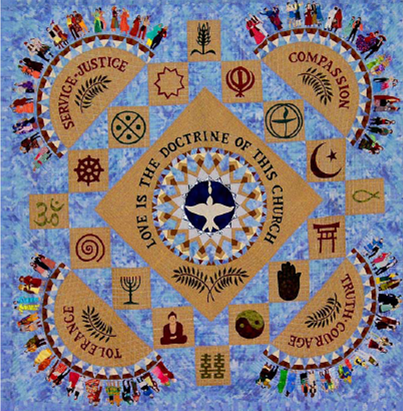
In those last months of 2004, Sarah worked as she was able on what was to be the centerpiece of a large quilt that now hangs at the back of the chancel at UU Saratoga – it features a dove which can also be a chalice, with the only piece of metallic fabric, a beacon of peace and love.

Sarah died on Christmas Eve. When the quilt, called “Journey Well,” was completed a few months later, we saw the center and instantly called it Sarah’s Circle. And we sang this song in her memory. And we all cried.

I barely knew Sarah – I met her only once. But I carry that memory, and every time I am at UU Saratoga, I pause for a moment when I approach the quilt to remember her.

Journey well, Sarah.

Journey well, all.