As with any art form, the more you engage it, the more familiar you become with those who practice it – sometimes it’s easy, like discerning Picassos in the Modern Museum of Art. Sometimes it’s less so, requiring some familiarity – signature dance moves mark the difference between Jerome Robbins and Bob Fosse, signature word patterns mark the difference between David Mamet and Aaron Sorkin, and signature guitar licks mark the difference between Eric Clapton and Stevie Ray Vaughn.

(Good lord, they’re all white men up there… well, sorry, y’all. Sometimes white men happen.)

But back to my point… such is the case too with choral music. There are some choral composers and arrangers that have signatures – I would bet many Unitarian Universalists could pick out a Jason Shelton piece in a heartbeat. Ralph Vaughn Williams has a signature sound (as we’ve talked about many many times already and probably will again because we’re not done with him), as do other modern and more classical arrangers/composers. If we’re singing as a soloist or chorister, we cheer (or groan) at the name on the score. But sometimes, we hear a piece and a few measures in can tell “this is a Moses Hogan arrangement” or “dear god, more Benjamin Britten.”

And when it comes to 20th century sacred music from the Jewish tradition, every single time I hear a piece and fall in love instantly, it’s Max Janowski.

An opulent “Akeinu Malkeinu” sung by Barbra Streisand? Max Janowski.

A lush “Sim Shalom” sung by the Zamir Chorale of Boston? Max Janowski.

This  gorgeous prayer? You guessed it. Max Janowski.

Every single time I find a beautiful piece of Jewish sacred music, it’s Janowski. Now I’m sure thre are other great composers of Jewish sacred music, and I’m fairly certain I have sung and loved singing them. but just the opening measures of this simple song, based on an English translation of the Hebrew prayer Yih’yu’l’ratzon,” screams Janowski to those who know his work.

The prayer, said at the end of the silent prayer portion of a service, is an incredible prayer of repentance and renewal.

Who can say, “I am free, I have purified my great heart?”
There are none on earth. There are none on earth.
A new heart I will give, not stone, but one that frees.
A new heart I will give, and one that frees.

May this day make us strong like a tree of life with good fruit.
Bless us now, amen. Bless us now, amen.
May we now forgive, atone, that we may live,
may we now forgive that we may live.
Amen.

“A new heart I will give.” Wow. As my colleagues are wont to say, “that’ll preach.” And I could, but I already waxed far too poetically about white men whose artistic endeavors I know and love (except for Britten – blech. I’ve only liked one of his pieces, a song from A Wealden Trio, but that may be more because of who I sang it with).

But the truth is, this piece moves me deeply, from the tips of my toes to beyond the top of my head. I feel this piece – the music and the prayer – deeply in my body. I have only ever sung it or heard it sung as a solo, and I think there is something about the solo voice on this that highlights the purity of this prayerful plea. And it’s possible I’ve gone on and on about Britten and Janowski because this almost doesn’t need any more words.

Amen.

Postscript: Listen to that Aveinu Malkeinu – you will weep from its beauty. I do, every. single, time.

Image is of the Flame Nebula.

I’m glad my voice is back, so I could sing this hymn. I love it, and just as there are those who long for Christmas carols throughout the year, I sometimes wish this hymn could be used outside of the Days of Awe.

I also wish it was less… draggy. It’s meant to be sung slowly (♩ = 48, which is a snail’s pace) but that bugs me a bit. I mean, it’s not for me to say, as I didn’t write the tune (Abraham Binder did); but a hymn mostly based on Psalm 150, the most cheerful and joyful psalm of them all shouldn’t seem like a dirge. I want this to be a dance, because even though the prayers in the verses are serious, they are cause for joyful hallelujahs.

O sing hallelujah: O sing hallelujah.

All praise be to you
through the high arch of the heavens,
and praise be by sun, moon, and stars.

(Chorus)
By trumpet, harp, and lute,
with cymbals and strings and flute,
with dancing, singing,
and music we praise you.
Sing hallelujah.

O sing hallelujah:
O sing hallelujah.
Our father and mother
and sov’reign of all mercies,
we wish to be quit of all war.

(Chorus)

O sing hallelujah:
O sing hallelujah.
Our father and mother and
sov’reign of all mercies,
inscribe us on pages of life.

(Chorus)

Anyway. I love this hymn and am always glad when we can mark the Jewish New Year with this song.

Even better when I can actually sing it.

As a harbinger of things to come, our image is appropriate to the hymn’s holy day but not to when this is published (early May). In other words, expect a lot of Christmas images soon.

I’ve been to church this mornin’.

Not literally, of course, and yet…

When I was in seminary, I joined the gospel choir – I was tentative at first, not only because I am white but because I am not a Christian. But I was assured that this gospel choir was indeed open to all, and yes, I found it exactly that way: a mix of people, a mix of beliefs, even a mix of talents. Yet our conductor, M. Roger Holland (who now teaches and conducts at the University of Denver), made everyone feel welcome as we both sang and learned a great deal about the wide expanse of the gospel milieu – from the old spirituals (and Moses Hogan’s influence) to the old timey gospel songs, to modern grooves and swings, and everything in between. We learned the history, the compositional complexities, and the vocal techniques.

And, we talked about the theologies. Some of us struggled, especially when the song was grounded in a ‘washed in the blood’ theology. We talked a lot about inclusive language and expansive meanings, and we wrestled a lot with the word “Lord” with its connotations of empire.

Which brings me to today. “Precious Lord, take my hand.” How very unlike us to sing a song of surrender to a “Lord” … and yet, here we are. Maybe we need a little surrender. Maybe we need a prayer to get through the night, to get through the hard times.

(Chorus)
Precious Lord, take my hand, lead me on, let me stand,
I am tired, I am weak, I am worn;
through the storm, through the night, lead me on to the light,
take my hand, precious Lord, lead me home.

When my way grows drear, precious Lord, linger near,
when my life is almost gone,
hear my cry, hear my call, hold my hand lest I fall;
take my hand, precious Lord, lead me home.

(Chorus)

When the darkness appears and the night draws near,
and the day is past and gone,
at the river I stand, guide my feet, hold my hand;
take my hand, precious Lord, lead me home.

Is this really any different than Spirit of Life? If we say we’re good with a range of metaphors for the Divine, then Precious Lord should fit in next to Spirit of Life. And if we’re good with asking for that Spirit of Life to come, to change us, to offer comfort and insight, then maybe we can be okay with asking Precious Lord to come, to change us, to offer comfort and insight.

And thus, it’s in that spirit that I sing this song. Lord knows we could use it right now.

Of course, that is only half of why I went to church this morning. The other half was because of my YouTube search for a good rendition to share.

I began with this fairly simple, albeit country-fied version that helps folks new to the song learn it.

And then I clicked on this one:

And then this one:

And this one by Mahalia Jackson, which doesn’t allow embedding but is worth the click.

And amen, halleluiah, I have been to church.

Photo is of the one and only Mahalia Jackson.

Of the many metaphors we use for the Divine, I think Singer of Life is my favorite.

This metaphor taps into something we know about the earth, that it has its own vibrational hum…and when you add all of the living things that have their own hums (and voices and chirps and growls and sighs), not to mention all of the machines humans have built that have their own hums (and chugs and whistles and crunches and rumbles), well, the earth is a noisy place that responds to sound.

And – if quantum mechanics are right and it’s the waves and motion, not the matter, that is the stuff of the universe, then of course we need a Singer to bring us into resonance with ourselves, each other, and the divine.

This lyric, from a poem written in Nahuatl, from the Texcoco region of Mexico, elegantly captures this idea, reminding us to look to the earth to see ourselves.

Singer of Life, all flowers are songs, with petals do you write.
Singer of Life, you color the earth, dazzling the eye with birds red and bright.
Joy is for us! The flowers are spread! Singing is our delight!

Mortal are we, with all living things, with eagles in the sky.
Even all gold and jade will not last; singing alone, I know, cannot die.
Here in this house of springtime bestow songs that like birds can fly.

It is set to a tune from the Dakota tribe, which is haunting and intriguing and offers a level of mystery the text only hints at. It’s got a few intervals Western singers might find unusual, and again, it’s one I would introduce slowly to a congregation.

However, I find the metaphor and the connection to the interdependent web rather appealing, inspiring, and yea, even comforting today.

Singer of life – joy is for us!

Amen.

I’m of several minds with this hymn today.

My first thought: I wish I knew the tune, commissioned for STLT and written by Libby Larsen. It might make a more meaningful connection to the lyrics possible. As it was, I was plunking out notes on my phone’s keyboard for all three verses.

My second thought: This is reminiscent of the line in the Sermon n the Mount (Matthew 6:24): “So do not worry about tomorrow, for tomorrow will bring worries of its own. Today’s trouble is enough for today.” And more, it’s reminiscent of the Timothy Wright song “Trouble Don’t Last Always.”

Nay, do not grieve though life be full of sadness,
dawn will not veil its splendor for your grief,
nor spring deny their bright appointed beauty
to lotus blossom and ashoka leaf.

Nay, do not pine though life be marred with trouble,
time will not pause or tarry on its way;
today that seems so long, so strange, so bitter,
will soon be some forgotten yesterday.

Nay, do not weep; new hopes, new dreams, new faces,
joy yet unspent of all the unborn years,
will prove your heart a traitor to its sorrow
and make your eyes unfaithful to their tears.

My third thought is more complex: it’s really hard, in these trouble times, to not grieve, to not be full of sadness and tears, along with the anger and determination. And I don’t think we should dishonor the need for some to continue their mourning, if it’s going to help them through. And. It’s not just that there’s beauty in life that we must look to – not just ‘new hopes, new dreams, new faces, joy yet unspent’ – but it’s getting up off the mat, turning the grief into determination, turning the sadness into action, that will bring a new dawn.

And it’s hard. Lord it’s hard. I don’t want to stop being angry and sad – and I don’t think I have to. As Nairu says, “life is full of sadness”… but here’s another hymn asking us to notice the joys despite the sorrows.

May we see through the tears and notice the richness of the life that it is we’re fighting for.

Photo (with credit on the image) is of ashoka leaves.

Gentle readers, I’m in an odd place with this one.

I am certain (and am glad) there are people who draw strength and inspiration from this text, a beloved  (anonymously translated) passage from “Buddha’s Farewell Address” – a passage from the Mahaparinibbana Suttana.

I don’t. I mean, I get what it’s about – it’s all over the place, this idea that it starts within and goes outward. It’s a lot of how we understand our rather individualistic faith.

But this idea doesn’t give me strength or comfort. As an extrovert and a theist, I process externally, with others and the Divine, in order to understand myself. My comfort comes from without, not within. And knowing myself, knowing truth, knowing the divine spark – for me, anyway – is informed and revealed only through my experience with others. I know myself in relation. And when my spark goes out, when I am not confident, when I am unsure what the truth is, well, I can’t be my own lamp if my pilot light is out.

Perhaps its my mood, or the season, or the events of the past few weeks, or the weltschmerz and general malaise of the world, but I feel sadder having sung this one.

Be ye lamps unto yourselves;
be your own confidence;
hold to the truth within yourselves
as to the only lamp.

If it brings you comfort, I am glad. Not every song has to work for every person, just as not every theology has to work for every person. I am certain for those who are internal processors, or non-theists, or just of a different temperament, this one inspires deeply – hurrah for you!

It’s just not my jam.

I have little to say this morning. In fact, most of what I have to say in this hurried morning will be below the lyrics.

But I will say WOW, these this song is timely. I appreciate it when this spiritual practice meets the times, even I grumble going through it – because it always has something to say to me.

Today’s lyrics, based on a text by Bishop Dr. Adedeji Ishola, who founded the Unitarian Brotherhood of Lagos, Nigeria in 1919 – and set to a traditional Yoruba tune – speak volumes to us today. “What will undo us is not our friend.” and “when we are raging, needing to mend, show us, O spirit, how to befriend.” Wow.

This is a beautiful, prayerful, important song for us today.

Words that we hold tight won’t let us go.
Paths we don’t follow will haunt us so.
What will undo us is not our friend.
Show us, O spirit, how to befriend.

(Chorus)
Show us how to forgive.
To all who live, show us forgiveness
that we may live.

To speak of loving is not to love.
Lies move among us, below, above.
When we are raging, needing to mend,
show us, O spirit, how to befriend.

(Chorus)

When love is doubtful, choice is not clear,
we turn to worship to cast out fear.
Teach us forgiveness, make love our end.
Show us, O spirit, how to befriend.

(Chorus)

I have a lot of opinions about the events of the past week, but I’m unfortunately running late due to a very sleepless night; thus, I will just share my edited version of something my colleague Cynthia Landrum wrote to offer some explanation for what the heck has been going on and why there’s a sea change happening in our movement:

On Thursday, two very different — and separate — pieces of painful news happened in the UU sphere:

The first issue is that a UU minister was arrested on charges of child pornography. He was a respected and well-connected colleague, and this is sending a shock wave through our association. I know him a little bit personally, and always found him to be a true pastor, living our our call to love our neighbor – his congregation is part church, part food bank. There seems to be little doubt to his guilt, as he has made admissions to the police. My heart goes out to his congregation and family, and to close colleagues of his, all of whom I’m sure are dealing with pain, grief, and shock.

The second issue is that in recent days our Unitarian Universalist Association has been in a crisis as we come to grips with the painful reality of our own racism, classism, and sexism and how that has affected hiring practices in our association, among other issues.

Not surprisingly, there have been many public statements on this from various groups and individuals in our association over the last week, seeking a systemic review of our policies and practices and calling our leadership back into covenant with the members of the denomination and our reflow religionists around the country.

Our UUA President, Peter Morales, had responded to the situation in an open letter that unfortunately escalated the situation. Today, despite his not being the decision maker in the hire that cause the controversy, Morales resigned, effective April 1, from his term that was to end in June, after the election of our next president at General Assembly. You can read more about this story here, here, and here.

It has been a hard few days leading up to Thursday, and definitely a hard day Thursday. It is a day fraught with anger, hurt, sadness, and frustration.

Our faith will remain strong. We will do the tough work to keep our leadership accountable and to examine how systemic racism, classism, and sexism have harmed us from the top of the denomination to our smallest congregations. And we will hold those in pain as they navigate the distrust and distress.

But it has been a terrible, horrible, no good, very bad day for Unitarian Universalists.

No real meaning for the image today. It reflects peace and insight, something I pray for today.

I had the opportunity to sing this once, as a solo, to commemorate Hiroshima Day. While set on a pentatonic scale, it is in what musicologists call Phrygian Dominant Minor Mode – which is another term for “very unfamiliar but striking intervals that are at once difficult and haunting.” It was not easy for me to learn, but I have never forgotten it.

The song is, at its heart, a simple and very popular Japanese folk song from the Edo period (17th century). It’s so popular that it’s used by the Japanese at international events, and it’s well known in Japan that it’s used in some electronic crosswalks as ‘guidance music.’

And the original translation is simply a celebration of spring. YAY SPRING!

 Sakura, sakura,
yayoi no sorawa.
Miwatasu kagiri.
Kasumika kumo ka.
Nioi zo izuru.
Izaya, izaya,
mini yukan.

You see that sentiment in the English text by Edwin Markham:

Cherry blooms, cherry blooms,
cherry blooms are ev’rywhere,
like a cloud from out the sky!
Mists of blossoms fill the air,
cherries, cherries blossoming!
Come and see, come and see;
let all now see and sing.

Cherry blooms, cherry blooms,
all the world their beauty sees!
Yoshino is cherry land;
tatsuta for maple trees;
karasaki for the pine.
Let us go, let us go —
where pine trees greenly shine.

Yay spring!

And then sometime after World War II, to mark the anniversary of the dropping of the bomb on Hiroshima, William Wolff wrote these alternative lyrics:

Cherry blooms, cherry blooms,
pink profusion everywhere,
like a mist of gossamer rain
cherry blossoms fill the air,
covering Hiroshima’s plain.
Come and see, spring is here,
it will not long remain.

Cherry blooms, cherry blooms,
when we die as we surely must,
why not under yonder tree?
And when we return to dust,
falling flowers our wreaths will be.
Come and see, come and see,
the fine Hiroshima tree.

Wow.

So… at Easter, I am preaching a sermon called Earth Teach Us Resurrection – with a nod to Linda Hoddy, whose sermon of the same name a decade ago has remained with me. The central metaphor of both sermons is the surprising and almost defiant return of life on Mt. St. Helens, which leads to a consideration of the Easter story with its surprising and almost defiant return of Jesus, and what such surprising and almost defiant returns to life can mean for us today.

And when I read these Hiroshima lyrics, I am struck by the same spirit. The unthinkable set out to destroy life, yet we witness the surprising and almost defiant return to life of the Japanese people – much like their cherry blooms… and it is that life that honors the dead in wreaths and falling flowers.

Yes, I might have written part of my sermon just now – at least some bones of it. In this time of rebirth and regrowth, we need every example we can find of surprising and almost defiant returns to life, so we can learn and accomplish our own.

1:52pm: Cool update at the end of this post.

One of my regular readers, Kaye, regularly points out in comments the titles that don’t make sense because they aren’t titles at all but rather first lines. I know from experience that if the first line doesn’t grab me, I don’t look further, and sometimes I wonder why we’d have a song about that.

And thus, sometimes this practice surprises me with a hymn I have regularly flipped past. Like today’s – a setting of a poem by Rachel Bates (more on that in a minute).  It’s set to one of my favorite contemplative tunes, Danby, by the master Ralph Vaughn Williams – perhaps most familiarly known to us as the Advent hymn Let Christmas Come (which we’ll get to in May. Yes, May.).

The poetry is beautiful; its imagery is reminiscent of those too-infrequent moments of real quiet without the ambient noise of 21st century motors and currents. Its pattern brings to mind the Howard Thurman piece “When the song of the angels is stilled…” And the denouement is a beautiful meditative idea – after all of the noise and bright banging flashes and shouts and screams of war…  “how sweet the darkness there.”

When windows that are black and cold are lit anew with fires of gold;
when dusk in quiet shall descend and darkness come once more a friend;

When wings pursue their proper flight and bring not terror but delight;
when clouds are innocent again and hide no storms of deadly rain;

And when the sky is swept of wars and keeps but gentle moon and stars,
that peaceful sky, harmless air, how sweet, how sweet, the darkness there.

Before we go… I promised a bit on Rachel Bates. Here’s what I know: Rachel Bates was an English woman from the Wirral (a peninsula between Liverpool and Wales) who wrote at least one poem during the First World War.

Yep, that’s all I know. I found her in a list of female war poets here. My google searches have come up with nothing useful – there are plenty of modern Rachel Bateses to fill up my search results, and no matter what details I put in, I can’t get anything other than this site.

And that to me is a real shame. Perhaps this was the only good poem Bates ever wrote. Perhaps it was the only poem period. Or perhaps she had a longer life as a poet but was obscured or cut short or… who knows. It makes me sad, and I hope her life wasn’t. I hope she found love, fulfillment, space to express her heart’s desire and her creative passion.

For all the Rachel Bateses of the world, and for those who bring them to our attention, if only for a moment, thank you.


UPDATE! After I posted, I decided to poke around the female war poets website and discovered that for £2 ($2.56) I could buy a PDF of the first compendium of poetry. It arrived about a half hour ago, and author Lucy London has this to say:

Rachel Bates was born in 1897 to parents Joseph Ambrose Bates and Edith Annie Grimshaw. The family lived in lived in Great Crosby, Waterloo, Merseyside, where she worked as a secretary at The Liverpool Daily Post and Echo in their editorial department.

In 1922 she produced her first volume of poetry entitled  “Danae And Other Poems” which was published by Erskine MacDonald Ltd, London WC1.

During the Second World War, Rachel moved to Sawrey in the Lake District where she continued to write poetry.

In 1947 she produced a collection of poems about her lakeland surroundings called “Songs From A Lake” which was published by Hutchinson.

She died in 1966 and is buried at St Michael & All Angels cemetery in Hawkshead.

Hurrah! She was a published poet! She got some recognition! And it sound as if she lived a full life in Northwest England. Now to find her published collections…

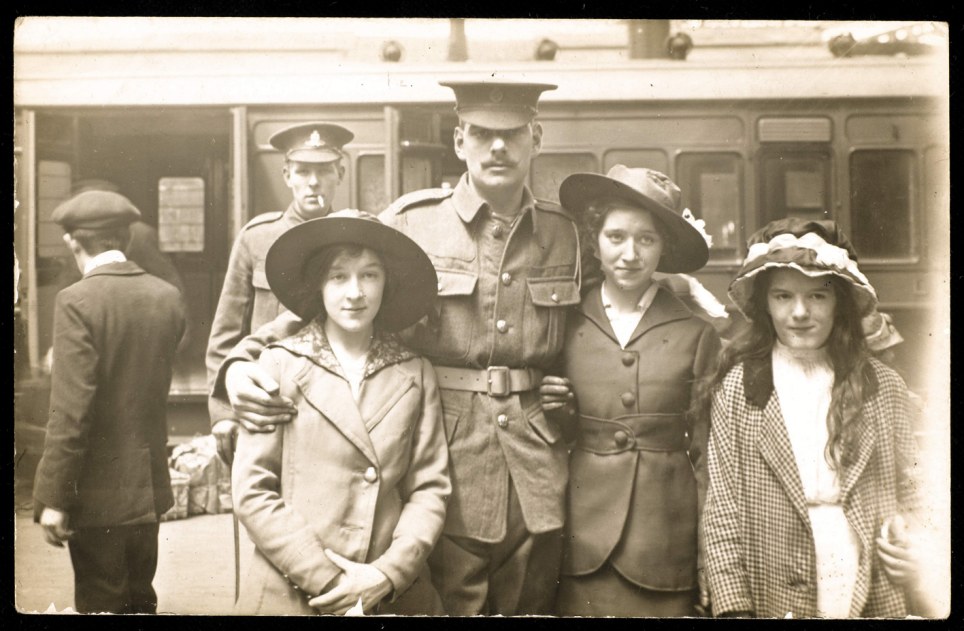
The photograph is of a British soldier and his family, circa 1917. Is the woman Rachel Bates? Probably not, but who knows…

This tune is apparently a magnet for messed up rhymes.

Now to John Holmes’ credit, his lyrics generally rhyme in a comfortable ABAB structure, but goodness, we got off to a rocky start, as ‘tablecloth’ does not rhyme with ‘truth’ … and while we’re at it, the tune does not support the correct pronunciation of the word ‘harvest’ instead making us sing ‘har-VEST’ which is just silly.

But let’s get into the hymn itself – these lyrics from John Holmes, whose words I adore in O God of Stars and Sunlight.

As a song, I don’t like them. This is one of those cases where the metaphors and narrative imagery require time and connection; singing them in this Gregorian-like chant disguises the poem’s ebb and flow. While I like this tune in other settings, I think it’s a bad pairing here.

I mean, who doesn’t want to sit with that second verse – ‘careless noon, the houses lighted late’… ‘the doorways worn at sill’… wow. The images are lush as Holmes describes the peace we can know right now… the peace and restorative, emotional and spiritual coziness the Danes call ‘hygge.’

The peace not past our understanding falls
like light upon the soft white tablecloth
at winter supper warm between four walls,
a thing too simple to be tried as truth.

Not scholar’s calm, nor gift of church or state,
nor everlasting date of death’s release;
but careless noon, the houses lighted late,
harvest and holiday: the people’s peace.

Days into years, the doorways worn at sill,
years into lives, the plans for long increase
come true at last for those of God’s good will:
these are the things we mean by saying, Peace.

This is a terrific lyric, awkward rhyme notwithstanding. It captures something ineffable about our everyday lives that matters in how we live with and for each other. But I say read it – or find a more lush, graceful, expansive tune.