I think I know why white people don’t sing this song well.

I may be late to the party on this, but it dawned on me as I was singing: we don’t know what it’s like to NOT be free.

Sure, we get close if we’re female, or queer, or live with a disability, or trans. We know the hard, scary restrictions and compromises to our rights. But if we’re one or more of those things and we’re white, we get a pass. Because we don’t have, in our living memory, a deep, soul-rooted knowledge of what it means to be in chains. We just don’t.

We white people can sing this all day long, and groove to versions of this song by John Legend and the Roots, and Nina Simone, and Natalie Cole (who sang it at the White House in 2010), or even the original, by NYC jazzman Billy Taylor – but the truth is, we can only listen to the deep, soul-rooted longing of the African Americans for whom this is reality.

I wish I knew how it would feel to be free.
I wish I could break all these chains holding me.
I wish I could say all the things I could say,
Say ‘em loud, say ‘em clear for the whole world to hear.

I wish I could share all the love in my heart,
remove all the bars that still keep us apart.
I wish you could know what it means to be me,
then you’d see and agree everyone should be free.
Then you’d see, and agree everyone should be free.

I wish I could give all I’m longing to give.
I wish I could live like I’m longing to live.
I wish I could do all the things I can do,
though I’m way overdue I’d be starting anew.
Though I’m way overdue I’d be starting anew.

I wish I could be like a bird in the sky.
How sweet it would be if I found I could fly.
I’d soar to the sun and look down at the sea,
then I’d sing ‘cause I’d know how it feels to be free.
Then I’d sing ‘cause I’d know how it feels to be free.

For what it’s worth, I love the song, and I have sung it with gusto, because in my heart of hearts, I wish everyone could be free. But I can’t sing it the way it’s meant to be sung, because I can’t pretend for a second that I understand the longing in my deep, soul-root.

Picture of Billy Taylor, composer of this song.
Oof.

This is a complex lyric – three verses of a complex poem, “Stanzas on Freedom,” written by James Russell Lowell (one of the 19th century American Fireside Poets). It’s not even a terribly good poem – technically, his writing was good, but as Margaret Fuller wrote, “”his verse is stereotyped; his thought sounds no depth, and posterity will not remember him.”

And it’s a complex topic – slavery. What’s worse is that Lowell’s anti-slavery position came largely because his wife wore him down; many of his thoughts about race make my skin crawl; I can’t even bear to repeat it here – if you’re curious, check out his Wikipedia page, under “Beliefs.”

The truth is, I don’t want to dig any deeper into this history and make a justification about why this should or shouldn’t be in our hymnal, or why it should or shouldn’t matter what a person’s belief is and we should honor the art, and what are the lines we draw between sacred and profane. Largely, because, I don’t know if I have the knowledge or the life experience or even the right to say if this is an appropriate and helpful hymn. And I do not want to mess it up.

What I do know is that it’s not a terribly familiar tune, nor is it as intuitive as I’d hoped, so I really struggled to sing it and pay attention to the lyrics all at once. And if I couldn’t manage it, how can our congregations? These are not casual lyrics – there’s something really complex, possibly meaningful and possibly terrible, about them.

All whose boast it is that we come of forebears brave and free,
if there breathe on earth a slave, are we truly free and brave?
If we do not feel the chain when it works another’s pain,
are we not base slaves indeed, slaves unwilling to be freed?

Is true freedom but to break fetters for our own dear sake,
and with leathern hearts forget we owe humankind a debt?
No, true freedom is to share all the chains that others wear,
and, with heart and hand, to be earnest to make others free.

They are slaves who fear to speak for the fallen and the weak;
they are slaves who will not choose hatred, scoffing, and abuse,
rather than in silence shrink from the truth they needs must think.
They are slaves who dare not be in the right with two or three.

Oof. Opinions, comments, history, and perspectives welcome.

Photo courtesy of  Internet Archive Book Images – https://www.flickr.com/photos/internetarchivebookimages/14595373847/
Source book page: https://archive.org/stream/historyprogresso09sand/historyprogresso09sand#page/n489/mode/1up,
No restrictions, https://commons.wikimedia.org/w/index.php?curid=42034844

I once almost made a mistake with this hymn.

It was spring 2011, and a small committee of Unitarian Universalists from four NY Capital Region congregations were planning our third joint service. We had moved to a new venue, which features an historic tracker organ, and we decided to do a hymn sing before the service, featuring the organ. Thus, we were selecting familiar, rousing hymns we thought would sound especially good on the organ, and I suggested this one.

One of the committee members, colleague Viola (Vee) Abbitt, recoiled, feeling some shock that I had cavalierly suggested this hymn be used without context. Vee explained her concerns, namely that this piece is considered the African American National Anthem and is not to be thought of as just another hymn, especially when it would be so casually sung by a predominantly white crowd greeting each other and finding their seats.

Of course, I quickly eliminated it from the list, and later went home to learn more.

I learned that this song, originally written as a poem by James Weldon Johnson and set to music by his brother John Rosamond Johnson, was sung by a group of young black children at a segreated school in Jacksonville, Florida, to honor Booker T. Washington. It became popular almost immediately, and by 1919, the NAACP dubbed it the African American National Anthem. It is said that this was one of Martin Luther King, Jr.’s favorite hymns.

And thus, we must be careful about using it.

Yes, these powerful lyrics could be sung about, by, and for many today – and yet it is specific enough that we should not consider for a moment adopting it or colonizing it for other needs. I think back to the lesson I learned in seminary, that we cannot make a presumption of sameness or else we run the risk of normalizing events, attitudes, and experiences that are not shared, not universal, not normal.

Resist the urge to use this song for purposes other than talking about racism, Jim Crow, the NAACP, and the incredible, bittersweet, angry yet hopeful expression of resistance that I see reflected by my African American friends and colleagues.

Lift every voice and sing, till earth and heaven ring,
ring with the harmonies of liberty;
let our rejoicing rise high as the listening skies,
let it resound loud as the rolling sea.
Sing a song full of the faith that the dark past has taught us;
sing a song full of the hope that the present has brought us;
facing the rising sun of our new day begun,
let us march on till victory is won.

Stony the road we trod, bitter the chastening rod,
felt in the days when hope unborn had died;
yet with a steady beat, have not our weary feet
come to the place for which our fathers sighed?
We have come over a way that with tears has been watered;
we have come, treading our path thru the blood of the slaughtered,
out from the gloomy past, till now we stand at last
where the white gleam of our bright star is cast.

God of our weary years, God of our silent tears,
thou who hast brought us thus far on the way;
thou who hast by thy might led us into the light,
keep us forever in the path, we pray.
Lest our feet stray from the places, our God, where we met thee;
lest our hearts drunk with the wine of the world, we forget thee;
shadowed beneath thy hand, may we forever stand,
true to our God, true to our native land.

Do not colonize this song. Let it shine in the context in which it is intended.

The photo is of John and James Weldon.

Welcome to the Freedom section of our hymnal, perhaps one of the most fraught sections – not because the songs aren’t good, or important to preserve, but because there’s no guiding language in the hymnal that helps us use the music with due diligence, and thus we wind up with misappropriation and colonization and a thousand other problems, just because “we have it, so we can sing it” is the unspoken rule.

It’s not necessarily going to be a fun section for us to go through. I admit, I’m already bracing for it, because I have opinions, and I know others do too. But I am committed to the practice, and so I will sing, and write, and probably contradict myself a time or two.

So strap in, folks. We’re about to get real with freedom songs.

The section starts with this hymn, which instantly makes me think of the US Civil War. Here are Jacob Trapp’s lyrics:

Let freedom span both east and west, and love both south and north,
in universal fellowship throughout the whole wide earth.

In beauty, wonder, everywhere, let us communion find;
compassion be the golden cord close-binding humankind.

Beyond all barriers of race, of color, caste, or creed,
let us make friendship, human worth, our common faith and deed.

Then east and west will meet and share, and south shall build with north,
one human commonwealth of good throughout the whole wide earth.

I’m not entirely certain I’m NOT supposed to think of the Civil War, even though there is a bounty of references to people from the other side of the planet. I say that, because the tune is an African American spiritual tune (adapted and harmonized by Harry T. Burleigh, an African American composer from Erie, PA). And while the tune is African American in origin, it has a distinctly Gaelic influence, again evidence of the convergence of the West Africans with the Irish and Scottish in Appalachia.

And lyrics like “south shall build with north” – combined with this tune, which for all the world could have been popular in the 1860s – bring images of the war and its aftermath to mind. Even if we also talk about east and west and castes.

It’s definitely a hymn that has made me go ‘hmmm”….not because there’s anything distinctly objectionable in it. In fact, it’s pretty inclusive for a lyric written in the mid-20th century. But something feels a tad… off. It’s just a feeling I have.

Like maybe, because I can’t stop thinking about the US Civil War when I sing this hymn, I recognize how much we are still fighting it, and how hard and sad it is.

I am so confused.

This is a Kwanzaa hymn. The only one we have, apparently.

It is placed in this second source section, between In Time to Come and Freedom. I understand, from a sources point of view, why this isn’t slipped in between the Christmas and Epiphany hymns, but still.

Its lyrics (which are shockingly generic UU, except for “the lights of Kwanzaa”) are from an anonymous source, without even a clue from Between the Lines where they were found.

Its tune a very lovely little piece written by UU Musicians Network stalwart Betty Jo Angelbranndt (may she rest in peace), but definitely, if I may be so bold, a white people’s tune. For Christmas.

I am so confused. Kwanzaa is a celebration of African heritage in African American culture. And all we can manage is an anonymous lyric set to a white composer’s Christmas hymn?

I’m very confused. And awfully ashamed of us.

When all the peoples on this earth know deep inside their precious worth
when every single soul is free, we’ll earn the name Humanity.

The choice to be the best we can begins the day we say, “I am.”
The unity for which we sigh will never come through hate or lie.

The lights of Kwanzaa now proclaim that when we share our inner flame
and nurture root and branch with pride, we’ll harvest peace both far and wide.

Dear Anyone who might be on the next Hymnal Commission:

Do better.

Thanks,
the rest of us.

There are those who know right from the start what their path in life is meant to be. And there are those, like me, who have tried a number of different paths, some successful until they weren’t, some interrupted by crisis or tragedy or failure. I personally got to the point where I stopped thinking about the future, because I couldn’t bear the crushing disappointment.

So when I answered the call to ministry, I was very clear that I couldn’t think all the way to ordination, because I couldn’t bear it if I didn’t make it. Instead, I would just do what was in front of me – apply to seminary, get funding, get through the semester, fill out the forms, write the essays, check off the boxes, etcetera, etcetera, etcetera.

When I arrived in Southold in August 2015 following seminary and my internship, there were still steps ahead, and I still kept my head down, focusing on just the next step – prepare for the ministerial fellowship committee, complete my clinical pastoral education, fill out the forms, have the conversations, etcetera, etcetera, etcetera.

And now, having been welcomed into preliminary fellowship (with more forms and essays, because I think paperwork will actually be the death of me), there is just one final step.

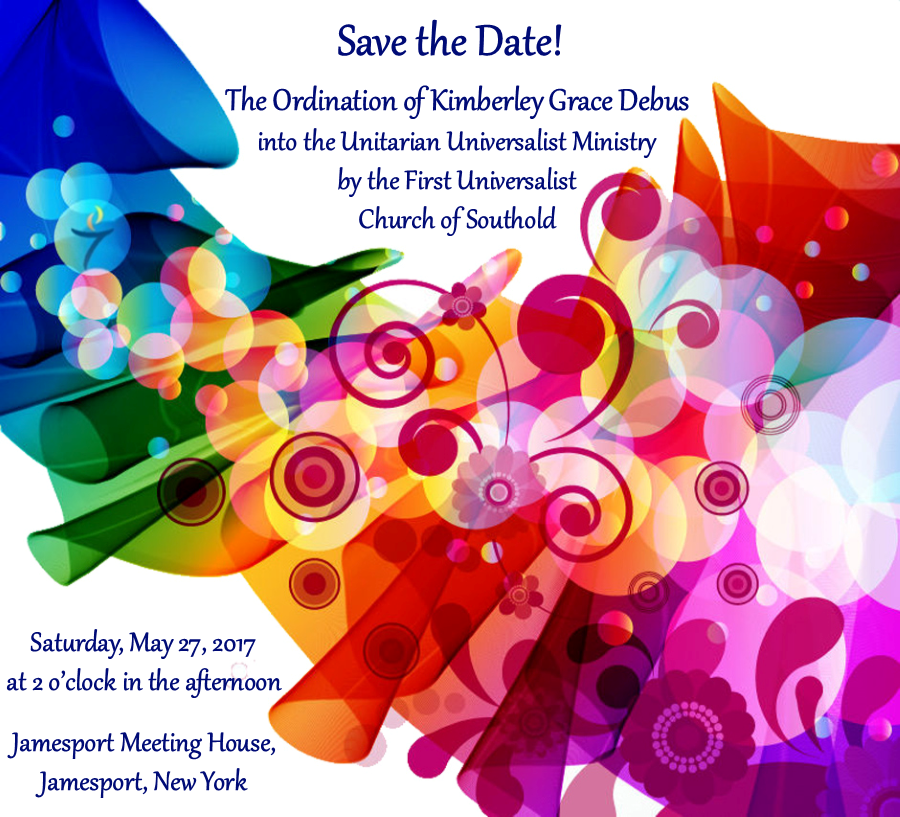
I am blessed that the Board of Trustees, on behalf of the First Universalist Church of Southold, has agreed to ordain me into Unitarian Universalist ministry.

I realize of course that the ordination is not the start of my ministry. Rather, an ordination is in some ways like a wedding – just as a wedding is in many ways a spiritual and legal affirmation of the existing relationship, so too an ordination is a spiritual and legal affirmation of the existing ministry.

And still, the act of ordination is a big moment – it will be a big service with some great music, great preaching and readings, and some pomp and circumstance. It will also be a party to celebrate the long road I have traveled, which you have traveled with me.

As details emerge, and as more thoughts emerge, I will undoubtedly write more. But for now…

SQUEE!


I was hoping Jacqui James would bail me out today.

I was really hoping there would be some long explanation of the origins of this song – that the lyricist, Ehud Manor, had written this in response to a particular moment/tragedy/event that I could expand upon, or that the composer, Nurit Hirsch, had discovered an ancient melody that he modernized in a unique way.  Something. ANYTHING to capture my interest as we come to the close of this seemingly endless section In Time To Come.

But no, in Between the Lines, James has written simply this:

Well hell.

Okay, so there’s no there there. It’s just another song expressing belief in a better tomorrow. In case we didn’t have enough of those already in the hymnal.

Now be clear: I like this one. I am fond of whatever quality it is that makes Jewish music distinctive, despite being not at all Jewish. It’s easy to sing, it’s got better than decent lyrics, and it’s going to be with me all day because of its prime ear worm qualities. I have used it and will used it. I just don’t have anything else to say about it. It’s a song. A good, decent, hopeful song.

Soon the day will arrive when we will be together,
and no longer will we live in fear.
And the children will smile without wondering whether
on that day thunderclouds will appear.

(Chorus)
Wait and see, wait and see what a world there can be
if we share, if we care, you and me.
Wait and see, wait and see what a world there can be
if we share, if we care, you and me.

Some have dreamed, some have died to make a bright tomorrow,
and our vision remains in our hearts.
Now the torch must be passed with new hope, not in sorrow,
and a promise to make a new start.

(Chorus)

I guess Freud was right. Sometimes a song is just a song.

(And sometimes a sunrise behind a tree is just a picture to use because no other images come to mind.)

The Matriarch hates this hymn.

Every time I sing this hymn, I think of the Matriarch of the congregation I serve, a woman who is a seventh generation Universalist, whose family has served the congregation I now serve in lay and ministerial positions for nearly the entire life of the church. In fact, the Matriarch made sure that the second thing I learned from her (after her name) was her lineage here.

I have to be careful when I talk about the denomination, to lean into the “Universalist” a bit more than the “Unitarian” – because every time she thinks I forget I am serving a Universalist congregation, she reminds me that “Unitarian is the adjective that describes what kind of Universalists we are”…. and then she proceeds to get angry at those people who gathered in Syracuse in 1961 and agreed to the consolidation of the American Unitarian Association and the Universalist Church in America. Her arguments aren’t without merit – there were some concerning issues around the finances and leadership, and a fear that the Universalists would be subsumed. But yes, she is still bitter about merger.

And every time I use this hymn in a service, the Matriarch catches my eye and shoots a look my way that says “I am still angry, you know.”

Now those who know the history of this hymn will know why – for those who don’t, here’s the very short version: Marion Franklin Hamm wrote this lyric in 1933, in advance of the first hymnal shared by the AUA and the UCA, Hymns of the Spirit. It was intentionally written to celebrate the growing relationship between the two denominations, who were finding it useful to work together. As the final votes were cast and a new Unitarian Universalist Association was formed, the assembled sang this very singable hymn together:

As tranquil streams that meet and merge and flow as one to seek the sea,
our kindred hearts and minds unite to build a church that shall be free —

Free from the bonds that bind the mind to narrow thought and lifeless creed;
free from a social code that fails to serve the cause of human need:

A freedom that reveres the past, but trusts the dawning future more;
and bids the soul, in search of truth, adventure boldly and explore.

Prophetic church, the future waits your liberating ministry;
go forward in the power of love, proclaim the truth that makes us free.

Today, we sing it about the individuals who make up the church – but it is much bigger than that. It is about your congregation and mine, your cluster and mine, your region and mine, all of us together, agreeing that we are stronger together and that the future awaits OUR liberating ministry. And goodness knows the present needs us too.


The image is of the AUA and UCA symbols at the UU Congregation in Albuquerque.

I can’t decide if I’m just annoyed by this practice right now, or if the songs in this section are annoying me personally right now, or if really, I have stumbled into a difficult section and hymns like this annoy just about everyone.

Suffice it to say, I’m annoyed.

First off, I’m not so sure I am fond of the recasting of Christian hymns; I’m fine with finding ways that the original lyrics might hold new, expansive meaning for us, and I love using music in unexpected places. But this isn’t the first, nor do I expect it to be the last, example of a decidedly Christian lyric – in this case, by Jane Laurie Borthwick – being changed to remove its original intent.

Second off, I’m rather annoyed that this once Christian hymn has been set to a tune that is so strongly associated with a different set of lyrics, “Stand Up, Stand Up for Jesus” – I mean, it’s like they wanted us to think about Christian ideas REALLY BADLY but didn’t want to say it.

Seriously – I spent enough time in a Methodist church in my youth that I just can’t hear this tune without singing “Stand up, stand up for Jesus, ye soldiers of the cross…” and then cringe at the militarism. Forget how lovely the lyrics try to be about world community. The tune is as encoded with militarism as is the tune for Onward Christian Soldiers, which we sing as Forward Through the Ages.

Here are our lyrics:

Now is the time approaching, by prophets long foretold,
when all shall dwell together, secure and manifold.
Let war be learned no longer, let strife and tumult cease,
all earth a blessed garden and God the god of peace.

Let all that now divides us remove and pass away,
like mists of early morning before the blaze of day.
Let all that now unites us more sweet and lasting prove,
a closer bond of union, in blessed lands of love.

O long-expected dawning, come with your cheering ray!
Yet shall the promise beckon and lead us not astray.
O sweet anticipation! It cheers the watchers on
to pray, and hope, and labor, till all our work is done.

On their own, with no context and no melody, they’re not bad. Not great, certainly (and I am also annoyed with that old way of rhyming “prove” and “love”), but not horrific. But knowing they were originally about the second coming of Christ, and set to that tune?

Yep, I’m annoyed.

It is possible I am about to ruin this hymn for some people.

If you can’t bear to read about the context of this lyric that might change how you see it,  close this window and go do something else. I say, write a letter to your Congress critter. I say, dive into some good work of resistance. Maybe that act for you today is to do art or play with children or run the errands you’ve been putting off. Whatever it is, if you don’t want this hymn ruined, go do it.

For those of you who have stayed, well, you still should do those things, but read first, because I can’t stop giggling. First, the lyrics – read them carefully, and relish in the beautiful language of Alfred, Lord Tennyson, as well as the beautiful vision of a world to be.

Not in vain the distance beacons. Forward, forward let us range.
Let the great world spin forever down the ringing grooves of change;
through the shadow of the globe we sweep ahead to heights sublime,
we, the heirs of all the ages, in the foremost files of time.

Oh, we see the crescent promise of that spirit has not set;
ancient founts of inspiration well through all our fancies yet;
and we doubt not through the ages one increasing purpose runs,
and the thoughts of all are widened with the process of the suns.

Yea, we dip into the future, far as human eye can see,
see the vision of the world, and all the wonder that shall be,
hear the war-drum throb no longer, see the battle flags all furled,
in the parliament of freedom, federation of the world.

Lovely, right? Stirring, right? And set to the triumphant melody “Ode to Joy” by Beethoven, it’s strong and inspiring.

Dear Reader, Alfred was writing about love gone wrong.

I’m not kidding.

In the poem “Locksley Hall”, the narrator of the poem is clearly a young man wondering what his future would be, and one evening, he catches a vision:

When I dipt into the future far as human eye could see;
Saw the Vision of the world and all the wonder that would be.—

Except it wasn’t a vision of the world as we might expect. It was a woman.

Our intrepid poet goes on for dozens of couplets about their meeting, their falling in love, and eventually the relationship ending. And in his despair, our narrator decided he’s so broken hearted that he’s done with women. The distant that beacons in “Not in vain the distant beacons” is a life on the sea and away from women.

THIS IS THE POEM OUR LYRICS ARE FROM.

Now, credit where credit is due – someone, somewhere, with identity lost to the annals of time, remembered the inspiring couplets buried in this poem, and managed to put them together into three sung verses that hold together fairly well.

And yes, it’s true that wisdom and inspiration can come out of otherwise secular pieces about other things. I am certainly not one to poo poo the idea that we find the sacred in the profane – hell, I co-led a service based on the Golden Girls, for goodness’ sake. And recently I played a game with myself to see how many turns of phrase from The West Wing I could sneak into the first 200 words of a sermon. (Seven, as it turns out.)

But I also know that I will never see this song the same way again, because at its root, it’s the grandiose thinking of a heartbroken young man.

Make of it what you will.

The image is of our brooding poet as a young man.
