Well, that was boring.

Maybe I’m asking too much of a hymn. Maybe I am too invested in meaning and movement. Maybe it’s okay to have songs that just sit there and get folks to sing together even if all they are doing is noticing the season. Maybe the singing is enough.

These lyrics, though. “Let’s here it for the harvest. Yay, harvest!” Sigh.

Heap high the farmer’s wintry hoard! Heap high the golden corn!
No richer gift has autumn poured from out the lavish horn!

Through vales of grass and meads of flowers our plows their furrows made,
while on the hills the sun and showers of changeful April played.

We dropped the long, bright days of June beneath the sun of May,
and frightened from our sprouting grain the robber crows away.

All through the long, bright days of June its leaves grew green and fair,
and waved in hot mid-summer’s noon its soft and yellow hair.

And now, with autumn’s moonlit eyes, its harvest time has come,
we pluck away the frosted leaves and bear the treasure home.

Maybe I am missing something. Maybe it’s my sad mood, matched by a dark, rainy day that called me to linger in bed in order not to face it. Maybe it’s like those damn morning songs that came the days after the election – too much joy for the day. Or maybe I am still too cynical to be happy just noticing a thing that happens every year and celebrating it. We’re coming up on Christmas, and I am really clear that it has meaning and resonance for our time, so the celebration is in fact a call to resistance. This is just… there.

It’s not a hard tune to sing – Land of Rest appears serveral times in the hymnal and has a familiarish melody. And if you sing it with a lilt, it could be almost Irish.

But I’m not a fan of the lyrics and am not sure why I would ever use a hymn like this when there are others that connect more deeply.

For those who were hoping for more analysis, wit, or poetry, I’m sorry. This one is just a dud to me, and so you get a dud of a post. Maybe tomorrow will be better.
I looked at the title and started singing the hymn before I’d even gotten to the page.

I knew this was another one of those wonderful Southern Harmony tunes, and I relished in it as I flipped open the hymnal. “What more can I say about Southern Harmony?” I said to myself. “I don’t want to bore my readers.”

Flip…flip…flip….ah, number 69. Oh wait. Union Harmony.

UNION Harmony?

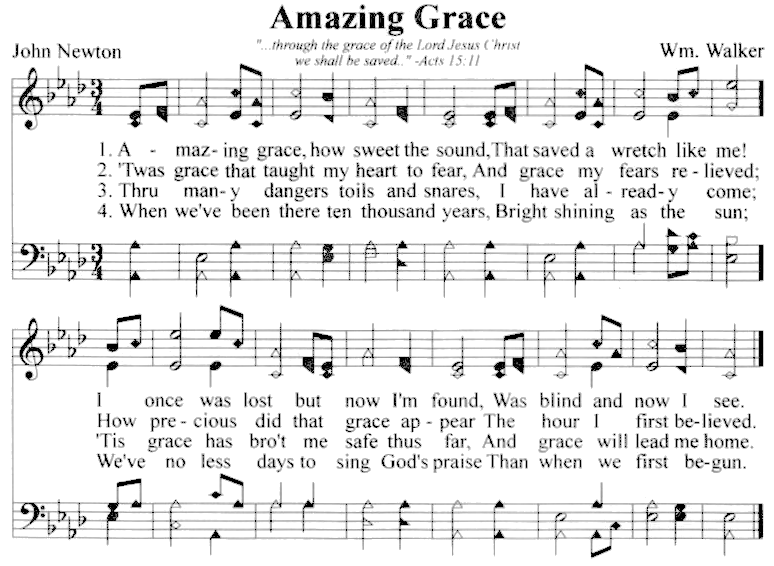
Apparently, while William Walker was in South Carolina compiling Southern Harmony, WIlliam Caldwell was in Tennessee compiling Union Harmony. Both are collections of tunes noted in shape note (the note heads have different shapes to, as the theory goes, facilitate easier learning – here’s an example of Amazing Grace in shape note:

Both men collected tunes that had cropped up in the first two hundred years of European settlement in the eastern US – tunes that, as I reflected a few days ago, are borne of tragedy and sorrow but tinged with hope.

Such is the case in this one (the tune is called Foundation). And because of the vague melancholy of the tune, the words seem less plainly cheerful and more earnest.

Give thanks for the corn and the wheat that are reaped,
for labor well done and for barns that are heaped,
for the sun and the dew and the sweet honeycomb,
for the rose and the song and the harvest brought home.

Give thanks for the mills and the farms of our land,
for craft and the strength in the work of our hands,
for the beauty our artists and poets have wrought,
for the hope and affection our friendships have brought.

Give thanks for the homes that with kindness are blessed,
for seasons of plenty and well-deserved rest,
for our country extending from sea unto sea,
for ways that have made it a land for the free.

And it becomes even more melancholy at that last couplet. Is this the land of the free? Free for whom? Or is this aspiration again, knocking on our doors, reminding us of the vision and intention of America even as we regularly watch ourselves fall short?

We have much to be thankful for – even if not everyone has all of those things. We have much to be thankful for – even as we work to ensure everyone eventually does.  We have much to be thankful for – even if it’s simply a hymn that reminds us not just what we have, but what we know is true in the world, and what calls us to help.

I’ve been watching the series The Crown on Netflix – it’s the story of the first few years of the reign of Queen Elizabeth II, told in that predictably sweeping BBC style that endears to us such shows as Downton Abbey and Call the Midwife. It’s full of beautiful scenery, palace intrigue (literally in this case), and lots of traditional music intertwined with the glorious score written for the show. As expected, several scenes happen in religious settings (state funerals, royal weddings, coronations – just regular stuff), and thus the familiar English hymns make prominent appearance.

And so it is with this mental backdrop that I approach this hymn today. It is set to a tune called “St George’s Windsor” – which made me think immediately of the Royal Family, knowing that in the House of Windsor there have been a couple of Georges (although I doubt many would consider them saints). And sure enough, the composer George Elvey was the organist at the Windsor Chapel, hence the name. (Elvey also wrote “Crown Him with Many Crowns” – which is another staple in mainline Protestant churches).

This is, as the Psalter Hymnal Handbook describes, “a serviceable Victorian tune.”

Talk about damning with faint praise.

Come, ye thankful people, come, raise a song of harvest home:
fruit and crops are gathered in, safe before the storms begin;
God, our Maker, will provide for our needs to be supplied;
come to God’s own temple, come, raise a song of harvest home.

All the world is but a field, given for a fruitful yield;
wheat and tares together sown, here for joy or sorrow grown:
first the blade, and then the ear, then the full corn shall appear;
God of harvest, grant that we wholesome grain and pure may be.

Now here’s the truth for me: it’s not a hymn that gets my blood moving or my spirit soaring. It’s not a hymn that comforts me or inspires me. And yet, I really like it. It appeals to that part of me that cries every time I hear Holst’s Planets, or the English hymn Jerusalem (click on that link – it’s a stunning rendition). It is a lovely English melody tinged with pomp and circumstance, and for some reason, that works for me. As unstuffy as I am, I very much appreciate this tune.

I realize I haven’t talked lyrics today. It’s not that they’re not interesting – they are. The metaphor of harvest for human goodness is an intriguing one worth unpacking some day. I don’t know that I’ve actually read the lyrics before (because it’s possible to sing the words but not actually read the lyrics), but I’m intrigued. I have no conclusions yet… but there’s something aspirational about “grant that we wholesome grain and pure may be”…and maybe a little unattainable. But just as we will never get close to the crown by watching The Crown, we will never get to pure by singing about it. But it sure is nice to think that we’re working on it.

Update, November 15, 2017:

A few days ago, my colleague Kendyl Gibbons offered this new set of lyrics. She wrote, “It occurs to me that a re-do of the traditional Thanksgiving hymn Come Ye Thankful People that I have been using for a while may be of use to others as we plan for the next few weeks.  The adaptation is mine; please use freely.”

Come, ye thankful people, come;
Raise the song of harvest home.
All is safely gathered in
Ere the winter storms begin.
Earth is bounteous to provide
For our wants to be supplied;
Come, in glad thanksgiving, come;
Raise the song of harvest home.

These our days are as a field
Sweet abundant fruit to yield;
Wheat and tares together sown,
Unto joy or sorrow grown.
First the bud and then the ear,
Then the full corn shall appear.
Live so that at harvest we
Wholesome grain and pure may be.

Field and furrow, heavy grown;
Yours to tend but not your own.
Bread of life shall ye restore
To your neighbors evermore.
Gather all the nations in,
Free from sorrow, free from sin.
Let the world in gladness come;
Share the joy of harvest home.

Hey, look! We’ve entered the “Harvest and Thanksgiving” section of the hymnal. And we start right off with the usual Thanksgiving song.

C.J.: There’s a usual song?
DONNA: “We Gather Together.”
C.J.: The song.
DONNA: That’s the usual song.
C.J.: So you know it?
DONNA: Everybody knows it.
C.J.: I don’t know it.
DONNA: [sighs] Didn’t you go to elementary school?
C.J.: Yes, right before being a National Merit Scholar.

(Sorry, West Wing fans, I couldn’t find a clip. But it’s season 2, episode 8, “Shibboleth”, written (of course) by Aaron Sorkin).

So yes, there’s a song. And somewhere later in the hymnal, we sing the usual words to the usual song. But here, in the “Harvest and Thanksgiving” section, we sing this paean to humanity.

We sing now together our song of thanksgiving,
rejoicing in goods which the ages have wrought,
for life that enfolds us, and helps and heals and holds us,
and leads beyond the goals which our forebears once sought.

We sing of the freedoms which martyrs and heroes
have won by their labor, their sorrow, their pain;
the oppressed befriending, our ampler hopes defending,
their death becomes a triumph, they died not in vain.

We sing of the prophets, the teachers, the dreamers,
designers, creators, and workers, and seers;
our own lives expanding, our gratitude commanding,
their deeds have made immortal their days and their years.

We sing of community now in the making
in every far continent, region, and land;
with those of all races, all times and names and places,
we pledge ourselves in covenant firmly to stand.

It’s not bad. Overall, it’s a decent “yay, humans” piece, sweet in an approaching-but-not-quite-completely-mired-in-treacle sort of way.

However – and here comes the serious quibble:  What is hard is the ending of the second verse – I am not a fan of the idea that tragic deaths and assassinations are in any way a triumph. “They died not in vain” is a humanist’s way of saying “It is God’s will” and it constantly feels empty and angering. They died and they shouldn’t have is the only right answer. Maybe we get woke and stay woke because they died, but they still should not have died. Death is never a triumph and anyone who says that has a pretty twisted way of understanding life.

But I digress.

The question is this: on balance, would I use this hymn? Probably in the right setting, gritting my teeth through the end of verse two, made easier with a memory of the sweetest flentl in the entire series:


What is it about the Southern Harmony tunes? There’s something that just gets me about them – they get inside me and speak deeply to my soul.

In a recent episode of Krista Tippett’s On Being with Béla Fleck and Abigail Washburn, two amazing banjo players and musicians, Washburn talks about hearing Doc Watson for the first time. She remarks that although she was studying law in China at the time, that ancient melody played on banjo and sung by Watson revealed the heart and truth of America. Washburn talks about the African roots of the banjo and this music:

“As people were being boarded onto the slave ships, the people said “throw your heart down here; you’re not going to want to carry it to where you’re going.’ A lot of the slave masters figured out that if they had a banjo player on board, playing the music of home, more of the ‘cargo’ would live to the other side. So the origins of the banjo in America are the bitterest of roots … and it formed an amazing origin to what became a blend of traditions from Africa, Scotland, and Ireland, when those banjo players from Africa and the fiddlers from Scotland and Ireland started playing plantation dances together. That’s what started what we know as that early Appalachian and that early American sound. That sound is based in this bitter root but with this hope ‘that I can live – I can survive.’

It is that truth – the bitter root tinged with hope – that appears in the Southern Harmony tunes, I think. And so whatever words we apply to them both benefit from and should contribute to this deep soul truth.

In this case, the lyric gets close, but for me, doesn’t go deep enough.

When the summer sun is shining over golden land and sea,
and the flowers in the hedgerow welcome butterfly and bee;
then my open heart is glowing, full of warmth for everyone,
and I feel an inner beauty which reflects the summer sun.

When the summer clouds of thought bring the long-awaited rain,
and the thirsty soil is moistened and the grass is green again;
then I long for summer sunshine, but I know that clouds and tears
are a part of life’s refreshment, like the rainbow’s hopes and fears.

In the cool of summer evening, when the dancing insects play,
and in garden, street, and meadow linger echoes of the day;
then my heart is full of yearning; hopes and mem’ries flood the whole
of my being, reaching inwards to the corners of my soul.

It’s close – so close – dancing around the edges of meaning, offering a glimpse of some deeper words to come.

And they don’t here. But maybe that’s a good thing in this case. Maybe this hymn is an opening, an invitation to offer the ‘next ten words, and the ten after that’ because our bitter roots tinged with hope need more words and more ideas and more play.

Meanwhile, set to the tune Holy Manna, these words open the door to something deeper, something maybe unnamable.

Like, maybe, truth.

Another season, another praise for the season song.

Color me surprised.

Now don’t get me wrong – this isn’t a bad thing. Hymns like this are wonderful openings for seasonal services, especially those that celebrate our seventh principle. And the tune is delightful and lively – this is a perfect opening hymn for the first week of June.

It’s the sacred version of “The Lusty Month of May” from Camelot. Tra la.

The sweet June days are come again; once more the glad earth yields
its golden wealth of rip’ning grain, and breath of clover fields,
and deep’ning shade of summer woods, and glow of summer air,
and winging thoughts and happy moods of love and joy and prayer.

The sweet June days are come again; the birds are on the wing;
bright anthems, in their merry strain, unconsciously they sing.
Oh, how our cup o’er brims with good these happy summer days;
for all the joys of field and wood we lift our song of praise.

The truth is, I wish I had more to say (It is possible that this is exhaustion talking – I landed at LaGuardia after a short trip to Phoenix at midnight and had to drive 90 minutes home, so I haven’t exactly had a full eight).

This isn’t a hymn that moves me or awakens anything in me. It’s lovely, it’s something you’ll hum in the lobby…er…coffee hour later, it’s a nice piece. But it’s not an earth-shaker for me. It’s just a nice, sweet little hymn that I am glad exists.

Although to be fair, it’s cold here on the North Fork of Long Island, and I don’t see myself tra-la-ing any time soon. Fa-la-la-ing around a Christmas tree, on the other hand…

Man oh man. Robert Frost can really bring it, can’t he?

There’s a reason he is one of the 20th century’s most celebrated poets – while this is not as famous as “The Wall” or “The Road Less Traveled” or “Stopping by Woods on a Snowy Evening,” this poem too had impact and depth and meaning.

It’s almost a shame that it’s set to a hymn tune.

Oh, give us pleasure in the flowers today,
and give us not to think so far away
as the uncertain harvest; keep us here
all simply in the springing of the year.

Oh, give us pleasure in the orchard white
like nothing else by day, like ghosts by night;
and make us happy in the happy bees,
the swarm dilating round the perfect trees.

And make us happy in the darting bird
that suddenly above the bees is heard,
the meteor that thrusts in with needle bill,
and off a blossom in mid air stands still.

For this is love and nothing else is love,
the which it is reserved for God above
to sanctify to what far ends he will,
but which it only needs that we fulfill.

Now why on earth would I say that? Especially when it’s a lovely tune, one I love, that has its own tinge of melancholy (which is apparently something I am drawn to). For the record: I adore the Coolidge tune.

However: what I know about hymn singing is that the song moves right along. Hymns don’t meander, so we don’t get a chance to ponder the lyrics we’re singing, that is even if we notice them at all (I am convinced that while the lyrics are important, if a singer is learning the tune, the lyrics are just syllables, and the meaning goes right by). And these lyrics especially beg to be noticed.

And herein lies the problem – this poem is written in four equal verses, making it easy to set to a hymn tune. But I wish it wasn’t, because there is a masterful build in the poem that takes us into nature, deeper and deeper, and then POW! “For this is love, and nothing else is love.” We don’t need quite yet to move on to the next powerful phrase of the verse, we need to sit with that for a bit. Ponder. Consider the path Frost has created for us. Lean into the meaning and depth. Only then can we entertain the rest of the verse, which is as powerful as the turn phrase at the top of this verse.

This isn’t to say I wouldn’t use it – I probably would. But I am grateful today for the chance to ponder the poem.


And with one turn of a page, we enter the sublimely ridiculous.

Yes, it’s time, in these last days of autumn, as the nights grow dark and cold, to begin singing our Spring and Summer songs. Because if spiritual practice teaches us anything, it’s to expect bizarre coincidences and juxtapositions. Plus, this is what I get for starting this project on my early October birthday. If I’d started on January 1st, like a normal person might have done, we’d be in the start of March right now and all this singing about spring might make sense. But no, I started on October 4th, which means we’re stuck with spring tunes here in Advent.

I’d say I’m sorry, but if you’re like me, you’re enjoying the juxtaposition too, delighting in my fake misery, and maybe a little relieved that I am giving you a break from the constant cacophony of carols this season brings. (Just remember this feeling when it’s May and we’re working through the aforementioned cacophony of carols.)

I will say this: I am glad we start with this hymn, a beloved and familiar tune, and more lyrics from our man Sam (Samuel Longfellow, that is).

Lo, the earth awakes again — Alleluia!
From the winter’s bond and pain.
Alleluia! Bring we leaf and flower and spray — Alleluia!
to adorn this happy day. Alleluia!

Once again the word comes true,
Alleluia! All the earth shall be made new. Alleluia!
Now the dark, cold days are o’er, Alleluia!
Spring and gladness are before. Alleluia!

Change, then, mourning into praise, Alleluia!
And, for dirges, anthems raise. Alleluia!
How our spirits soar and sing, Alleluia!
How our hearts leap with the spring! Alleluia!

As I sang this – especially the second verse, I thought about how it’s maybe not so bad to sing a spring hymn in autumn, as it reminds us that the dark, cold days we’re facing now will not last – even though at some point it feels like we will never see light and feel warmth again.

I like this one. And because it’s a catchy tune, I will probably be singing it all day. Thank god the only one I will annoy with that is my cat.

I love being surprised by a hymn.

I opened the page and groaned a little at yet another hymn I don’t know – wild bells? Clouds? Frosty light? Oy vei. Here we go again, I thought. Another fairly fluffy lyric that doesn’t go anywhere. And oh, look, another tune I have never sung.

I decided to tackle the tune first, which I discovered is a remarkable little melody with graceful lines and a touch of melancholy. That in hand, I turned to sing.

And I discovered the fluffy lyrics don’t last long at all.

Ring out, wild bells, to the wild, wild sky,
the flying cloud, the frosty light:
the year is dying in the night;
ring out, wild bells, and let it die.

Ring out the old, ring in the new,
ring, happy bells, across the snow:
the year is going, let it go;
ring out the false, ring in the true.

Ring out the grief that saps the mind
for those that here we see no more;
ring out the feud of rich and poor;
ring in redress to humankind.

Ring out false pride in place and blood,
the civic slander and the spite;
ring in the love of truth and right;
ring in the common love of good.

In fact, holy cow, this hymn was written for today.

I did finally realize this is a setting of an Alfred Lord Tennyson poem, which I immediately looked up. There are a few more verses, all equally powerful statements against greed, abuse, hatred, and callousness – and ends with a plea for peace, kindness, compassion, and “the Christ that is to be.’

Wow. Why are we not singing this hymn every week? Are others using this hymn right now in this strange time in our history and I’m just late to the party? Are they waiting to use it in December? I’m thinking now about how this would fit in, because we need to ring out a lot of things right now to make room for “truth and right” and “the common love of good.”

It’s time to ring the bells.

There’s a funny opening in an episode of Family Guy, where the guys are sitting at the Drunken Clam, and a Barry Manilow concert is announced. At first they make fun of it, but slowly, they are comfortable enough to confess how much they love Manilow and are soon like excited teenagers as they plan to see him in concert.

I feel a little like this, especially in the company of my friends who are lovers of much less schmaltzy English composers like Benjamin Britten. But the truth is, I love Ralph Vaughn Williams, who set this English folk tune in a lovely arrangement. He did hymnody a great service with his settings and compositions. He parted from his contemporaries and leaned into the beautiful folk tunes of England and France, and wrote lush, harmonious pieces that are a joy to listen to and a joy to sing. And I am definitely a fan of this tune.

I also rather like the lyrics, with some rich metaphors and turns of phrase, although their place is complex: is it a winter hymn? An Advent hymn? A praise hymn? Some part of all three, I suspect.

All beautiful the march of days, as seasons come and go;
the hand that shaped the rose hath wrought the crystal of the snow;
hath sent the hoary frost of heaven, the flowing waters sealed,
and laid a silent loveliness on hill and wood and field.

O’er white expanses sparkling clear the radiant morns unfold;
the solemn splendors of the night burn brighter through the cold;
life mounts in every throbbing vein, love deepens round the hearth,
and clearer sounds the angel-hymn, “Good will to all on earth.”

O Thou from whose unfathomed law the year in beauty flows,
thy self the vision passing by in crystal and in rose.
Day unto day doth utter speech, and night to night proclaim,
in ever changing words of light, the wonder of thy name.

My problem is this: the tune’s a bit cheery and springy and seems a tad odd in this setting. It will seem odd in future posts too – I go back to my comment a few weeks ago about how meter doesn’t always mean the lyrics fit. For me, it’s a hair too happy a tune, especially for lyrics like “laid a silent loveliness” and “life mounts in every throbbing vein, love deepens round the hearth”… I don’t want spritely trills while singing those lyrics, I want a lush, lengthened melody line there.

And for all this grousing, I sang this with some measure of gusto. The tune almost requires a full-bodied sing with its lilt and intricate movement. So I don’t know. Maybe this series has me looking at these hymns with a more critical eye than is necessary. Maybe it’s the mood, and it will pass, and soon I will be transported again into the mystery, inspiration, and comfort of singing hymns. Who knows?

What I know is that despite my thinking this marriage of tune and lyric doesn’t quite work, I am glad for the singing.