My first instinct this morning was to talk around the history of this song to get to a discussion of grammar – namely the meaning that shifts when we go from singing ‘we will overcome’ to ‘we shall overcome’… there’s something there, but god help me I just can’t be bothered to dig in. And really, if you are interested in the history, Google is your friend.

As soon as I started writing, I thought about what actually awakened me with a start this morning, and that’s this thought: with the testimony of the Director of the FBI, clearly stating there’s an investigation about 45’s ties to Russia, and Rep. Adam Schiff’s eloquent litany of the circumstantial evidence, I worry this morning: are we being played?

Will this result in nothing, like a tantalizing distraction, while morality, ethics, justice, and compassion are thrown away like yesterday’s candy wrappers? Are we really placating ourselves with these snippets only to find ourselves being crushed and destroyed as a country, as a democracy, as human beings?

And if that’s the case, shall we ever overcome? I know it’s our duty as humans to overcome, but will we? And how will singing a song together at marches and rallies and services make a whisper of a difference?

 We shall overcome,
we shall overcome,
we shall overcome someday!
Oh, deep in my heart I do believe
we shall overcome someday!

We’ll walk hand in hand,
we’ll walk hand in hand,
we’ll walk hand in hand someday!
Oh, deep in my heart I do believe
we’ll walk hand in hand someday!

We shall all be free,
we shall all be free,
we shall all be free someday!
Oh, deep in my heart I do believe
we shall all be free someday!

We shall live in peace,
we shall live in peace,
we shall live in peace someday!
Oh, deep in my heart I do believe
we shall live in peace someday!

This is so aspirational, so confident. I feel so little of that this morning. I am scared to death, and on a day like today I feel paralyzed. Singing this song, alone with my thoughts, did nothing to assuage my fears.

Perhaps it would be better if I was singing with others, or in a place of action. Sitting in my sister’s living room is most assuredly not that place.

But as am scared today. Maybe I’ll be better tomorrow, and maybe tomorrow I will see a way out of the paralyzing fear, but today, I’m not so sure we shall overcome.

image is from a 1966 rally organized by SNCC in Virginia.
A few short thoughts today.

First, composer Joyce Poley is one of the sweetest people I have ever met and very much wrote this before we had an awareness of ableist language.

But despite how sweet she is, she wrote one of the most annoying earworms we have. Sadly, it mostly gets played as an oom-pa-pa and not the more gentle waltz I am sure Poley anticipated. And so it’s often avoided on those grounds, even before considering the language of the first verse.

Yet the sentiment is good and righteous and motivating. It’s Frederick Buechner’s “There can be no peace and joy for me until there is peace and joy for you also” in song. So it still works – but requires a lot of care in the introduction and performance.

One more step,
we will take one more step,
‘til there is peace for us and everyone,
we’ll take one more step.

One more word,
we will say one more word,
‘til every word is heard by everyone,
we’ll say one more word.

One more prayer,
we will say one more prayer,
‘til every prayer is shared by everyone,
we’ll say one more prayer.

One more song,
we will sing one more song,
‘til every song is sung by everyone,
we’ll sing one more song.

I think my feelings about this can be summed up as ‘this song hasn’t aged well – but bless its heart.’

I rarely use stock images, but this one seemed to fit…

Yesterday (and elsewhere) I talked about how the first line of a song wasn’t always or necessarily the title of a song, and the use of such can be frustrating or misleading.

I’m thinking it may be a good thing that the original title of this piece, by Universalist minister Adin Ballou, “Reign of Christian Peace,” is not being used in our hymnal. I wish it was noted somewhere besides Between the Lines, however, because it is an interesting note in our theological history, a reminder that Universalism was not always as expansive and inclusive as we think of it today – it was a long while before Universalists pushed the doctrine of universal salvation to its inevitable conclusion.

But I digress from the hymn. Despite some unfamiliar-to-me language (a falchion is a machete-like sword), it’s your basic call for peace in a time of war. (It’s interesting that this was first published in 1842, during the Seminole Wars, and then republished in 1861, at the start of the US Civil War. Not surprising, just interesting. What may be more interesting (as I scan a history timeline) is that the Mormon War, which took place as Mormons were moving west through Missouri, also took place in the late 1830s, a much more theologically-based war, which the Universalists would have been on the non-Mormon side of. I don’t know if there’s any writing from Universalists of the day about the Mormons and other movements that cropped up… might be an interesting side trip some day.

But again, I digress. (Sorry – it’s one of those days.)

The lyrics ultimately are fine – but I am a tad disoriented by the tune it’s set to. Yes, this is set to Hyfrodol, which is such a joyful tune, made even more joyful by Peter Mayer in his recasting for Blue Boat Home. And it seems really odd to be singing about swords and trumpets and war banners in this delightful Welsh melody. But maybe that’s the point. I don’t know if this lyric has ever been set to anything else – it could be that Ballou himself wanted a spirit of joy and loveliness to emphasize the call of his words, setting the ridiculousness of war in contrast to the joy that the reign of Peace portends.

Years are coming, speed them onward
when the sword shall gather rust,
and the helmet, lance, and falchion
sleep at last in silent dust.
Earth has heard too long of battle,
heard the trumpet’s voice too long.
But another age advances,
seers foretold in ancient song.

Years are coming when forever
war’s dread banner shall be furled,
and the angel Peace be welcomed,
regent of a happy world.
Hail with song that glorious era,
when the sword shall gather rust,
and the helmet, lance, and falchion
sleep at last in silent dust.

But it’s still weird to sing those words to this tune.

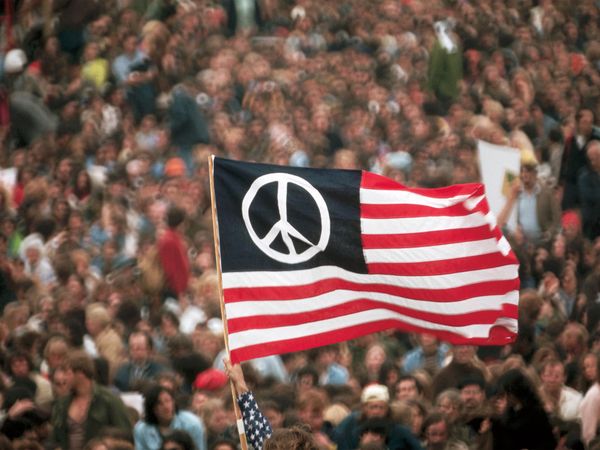
I know, the image of the peace sign on the American flag may draw controversy… but it seems the right image for this hymn today.


1:52pm: Cool update at the end of this post.

One of my regular readers, Kaye, regularly points out in comments the titles that don’t make sense because they aren’t titles at all but rather first lines. I know from experience that if the first line doesn’t grab me, I don’t look further, and sometimes I wonder why we’d have a song about that.

And thus, sometimes this practice surprises me with a hymn I have regularly flipped past. Like today’s – a setting of a poem by Rachel Bates (more on that in a minute).  It’s set to one of my favorite contemplative tunes, Danby, by the master Ralph Vaughn Williams – perhaps most familiarly known to us as the Advent hymn Let Christmas Come (which we’ll get to in May. Yes, May.).

The poetry is beautiful; its imagery is reminiscent of those too-infrequent moments of real quiet without the ambient noise of 21st century motors and currents. Its pattern brings to mind the Howard Thurman piece “When the song of the angels is stilled…” And the denouement is a beautiful meditative idea – after all of the noise and bright banging flashes and shouts and screams of war…  “how sweet the darkness there.”

When windows that are black and cold are lit anew with fires of gold;
when dusk in quiet shall descend and darkness come once more a friend;

When wings pursue their proper flight and bring not terror but delight;
when clouds are innocent again and hide no storms of deadly rain;

And when the sky is swept of wars and keeps but gentle moon and stars,
that peaceful sky, harmless air, how sweet, how sweet, the darkness there.

Before we go… I promised a bit on Rachel Bates. Here’s what I know: Rachel Bates was an English woman from the Wirral (a peninsula between Liverpool and Wales) who wrote at least one poem during the First World War.

Yep, that’s all I know. I found her in a list of female war poets here. My google searches have come up with nothing useful – there are plenty of modern Rachel Bateses to fill up my search results, and no matter what details I put in, I can’t get anything other than this site.

And that to me is a real shame. Perhaps this was the only good poem Bates ever wrote. Perhaps it was the only poem period. Or perhaps she had a longer life as a poet but was obscured or cut short or… who knows. It makes me sad, and I hope her life wasn’t. I hope she found love, fulfillment, space to express her heart’s desire and her creative passion.

For all the Rachel Bateses of the world, and for those who bring them to our attention, if only for a moment, thank you.


UPDATE! After I posted, I decided to poke around the female war poets website and discovered that for £2 ($2.56) I could buy a PDF of the first compendium of poetry. It arrived about a half hour ago, and author Lucy London has this to say:

Rachel Bates was born in 1897 to parents Joseph Ambrose Bates and Edith Annie Grimshaw. The family lived in lived in Great Crosby, Waterloo, Merseyside, where she worked as a secretary at The Liverpool Daily Post and Echo in their editorial department.

In 1922 she produced her first volume of poetry entitled  “Danae And Other Poems” which was published by Erskine MacDonald Ltd, London WC1.

During the Second World War, Rachel moved to Sawrey in the Lake District where she continued to write poetry.

In 1947 she produced a collection of poems about her lakeland surroundings called “Songs From A Lake” which was published by Hutchinson.

She died in 1966 and is buried at St Michael & All Angels cemetery in Hawkshead.

Hurrah! She was a published poet! She got some recognition! And it sound as if she lived a full life in Northwest England. Now to find her published collections…

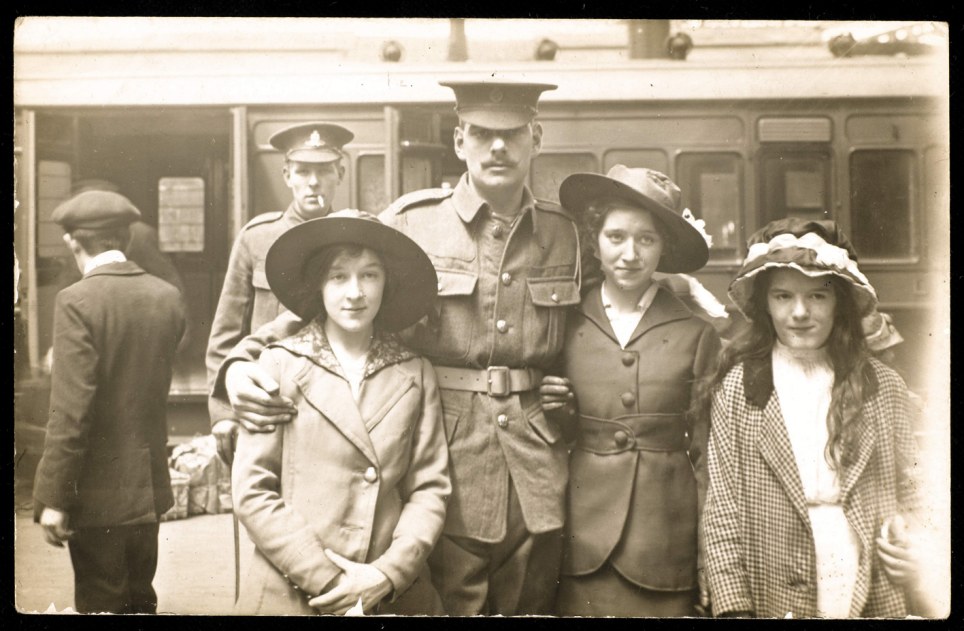
The photograph is of a British soldier and his family, circa 1917. Is the woman Rachel Bates? Probably not, but who knows…

This tune is apparently a magnet for messed up rhymes.

Now to John Holmes’ credit, his lyrics generally rhyme in a comfortable ABAB structure, but goodness, we got off to a rocky start, as ‘tablecloth’ does not rhyme with ‘truth’ … and while we’re at it, the tune does not support the correct pronunciation of the word ‘harvest’ instead making us sing ‘har-VEST’ which is just silly.

But let’s get into the hymn itself – these lyrics from John Holmes, whose words I adore in O God of Stars and Sunlight.

As a song, I don’t like them. This is one of those cases where the metaphors and narrative imagery require time and connection; singing them in this Gregorian-like chant disguises the poem’s ebb and flow. While I like this tune in other settings, I think it’s a bad pairing here.

I mean, who doesn’t want to sit with that second verse – ‘careless noon, the houses lighted late’… ‘the doorways worn at sill’… wow. The images are lush as Holmes describes the peace we can know right now… the peace and restorative, emotional and spiritual coziness the Danes call ‘hygge.’

The peace not past our understanding falls
like light upon the soft white tablecloth
at winter supper warm between four walls,
a thing too simple to be tried as truth.

Not scholar’s calm, nor gift of church or state,
nor everlasting date of death’s release;
but careless noon, the houses lighted late,
harvest and holiday: the people’s peace.

Days into years, the doorways worn at sill,
years into lives, the plans for long increase
come true at last for those of God’s good will:
these are the things we mean by saying, Peace.

This is a terrific lyric, awkward rhyme notwithstanding. It captures something ineffable about our everyday lives that matters in how we live with and for each other. But I say read it – or find a more lush, graceful, expansive tune.


I am a little bit excited to get to this hymn today.

First, because it’s just so beautiful. It’s sweeping and lush in its composition, and similarly sweeping and lush in its lyric. Written for Paul Winter’s Missa Gaia, Kim Oler captured something here that is a bit ineffable even as it is grounded and real.

Second, I love this hymn because of a memory I have of a fellow congregant at my home congregation in Saratoga Springs, NY. I don’t remember the service or my role in it, but I do remember Jane Root coming up to me afterwards, tears in her eyes, thanking us for doing this hymn because it was her favorite and made her cry every time. Which made me cry. To which we laughed and shared a deep connection for a moment.

Third, I can’t help but wonder if Peter Mayer was a little inspired to write “Blue Boat Home” (1064) because of this song – and I spent the five or so minutes between singing this and getting settled at my computer imagining a mashup of the two … and surprisingly, it works.

For the earth forever turning; for the skies, for ev’ry sea;
for our lives, for all we cherish, sing we our joyful song of peace.

For the mountains, hills, and pastures in their silent majesty;
for the stars, for all the heavens, sing we our joyful song of peace.

For the sun, for rain and thunder, for the seasons’ harmony,
for our lives, for all creation, sing we our joyful praise to Thee.

For the world we raise our voices, for the home that gives us birth;
in our joy we sing returning home to our bluegreen hills of earth.

This song is truly beautiful. Unlike some of the other hymns we sing that seem to be very ‘in your face’ about beauty, hope, and aspiration, this one gently entices you into a consideration of beauty, hope, and aspiration. More, it makes you feel part of it, not looking in at it. It’s so elegantly crafted that it in four short verses it entices and embraces and maybe changes us a bit.


Ear worm in three.. two… one….

As an American growing up in the 1970s, I learned this in elementary school, and I associated it with Vietnam War protests. This might even have been the first African American spiritual I learned, and I didn’t even know at the time it was one. In fact, I don’t know if I knew until well into adulthood, because to me it was a protest folk song, and in my mind, I hear Pete Seeger and Peter, Paul, & Mary.

What I know is that is history is long, and it wasn’t always just an anti-war song, but rather a song about baptism and freedom – going to glory and from slavery, and to a place where fighting (literally and metaphorically) ceases – “gonna study war no more” is likely a reference to this passage in Isaiah (2:4):

“He shall judge between the nations,
and shall arbitrate for many peoples;
they shall beat their swords into ploughshares,
and their spears into pruning-hooks;
nation shall not lift up sword against nation,
neither shall they learn war any more.

How the whole song came to be, and how it was used, and its journey to our current view of it…. well, like many songs handed down in oral tradition, the path and the ‘real story’ is murky and may never really be known. What we do know is its powerful imagery was inspired by the plight of those who had gone before, and continues to inspire those who go on.

Gonna lay down my sword and shield,
down by the riverside,
down by the riverside.
Gonna lay down my sword and shield,
down by the riverside,
gonna study war no more.

(Chorus)
I ain’t gonna study war no more,
ain’t gonna study war no more. (2x)

Gonna lay down my burden
down by the riverside …

(Chorus)

Gonna shake hands around the world,
ev’rywhere I roam …

(Chorus)

May it be so for all of us.

—-

Yep, that picture is of the River Jordan.

Remember when I was eyeballs deep in those aspirational hymns in the In Time To Come section? And how wearing, given our current political crisis, I found them?

Yeah. Here we are again. I am worn out by these hymns, barreling down, calling us over and over and over again to remain hopeful and energized. I am feeling quite unhopeful and exhausted right now. And may I say, Dear Spiritual Practice, I don’t need you reminding me of what I know already.

Sigh.

I also know that what I am doing is not normal, and we don’t just sing through the hymnal like this. My experience is not a typical experience.

For people approaching this hymn in a typical manner, flipping through hymns known and unknown seeking a couple of songs of inspiration and vision, this one will certainly fit the bill. Odell Shepard’s lyrics remind us of our aspirations and calls us to remember what it’s all about. (Plus, the tune’s a familiar one from the Southern Harmony collection.)

Peace! The perfect word is sounding, like a universal hymn
under oceans, over mountains, to the world’s remotest rim.

Toiling centuries have struggled upward on a stony way
just to set the torch of freedom where it flames aloft today.

All the old forlorn lost causes, every fair forbidden dream,
and the prophet’s hopeless vision, and the poet’s fitting gleam,

All the hopes of subject peoples, all the dreams of the oppressed,
must be ours, our hopes, our visions. We can never stay or rest.

Good, solid lyrics, hopeful, aspirational. The right hymn, I am sure, for many occasions, which could be well paired with any of the other Peace or In Time to Come or even Freedom songs.

Just don’t try to sing them all, all at once.

The picture? Oh, that’s a peace plant. 🙂

This hymn, y’all.

First – we’re already into the Peace section; Labor and Learning was short, sweet, and to the point.

Second – I am not Finnish. Nowhere in my family’s known genealogy is there any Scandinavian blood; we’re all German and English, with a dollop of Dutch and a dash of Irish. Yet this tune, from a longer symphonic piece by Finnish composer Jean Sebelius and considered if not the national anthem then at least Finland’s most important song, makes me weep from its beauty and connection to the ineffable.

In our hymnal, this tune appears twice – with these lyrics, by Lloyd Stone, written as a prayer of peace – and later in our journey as We Would Be One. And every time we use it, whichever lyrics we use, I am literally moved to tears. Because not only does the tune reach something deep in our souls, the lyrics reach something deep in our hearts: the call of peace, the call of humanity.

I sometimes think of this lyric as the First Principle on the national/global level. If we affirm and promote the inherent worth and dignity of every person, we must also affirm and promote the inherent worth and dignity of every nationality – with the important caveat, of course, that governments regularly deny and oppress and stir up nationalistic jingoism in egotistical shows of empty bravado. (I’m lookin’ at you, 45.)

But this… this is the vision, the prayer, the call for peace.

This is my song, O God of all the nations,
a song of peace for lands afar and mine.
This is my home, the country where my heart is;
here are my hopes, my dreams, my holy shrine;
but other hearts in other lands are beating
with hopes and dreams as true and high as mine.

My country’s skies are bluer than the ocean,
and sunlight beams on cloverleaf and pine;
but other lands have sunlight too, and clover,
and skies are everywhere as blue as mine.
O hear my song, thou God of all the nations,
a song of peace for their land and for mine.

Amen.

If it seemed like I phoned it in a bit the last few days, well, you’re not wrong. The truth is, I could blame it on being sick, but mostly I blame it on my personal fears that I wouldn’t treat the freedom songs from the African American spirituals tradition well – and in fact I may have been unclear or hurtful more than once in my efforts to seek balance and information. For all this, I apologize.

What I won’t apologize for, however, is a sense of pride in myself that despite the horrible sinus headaches and annoying coughs, I have kept this up. Much like those hard weeks after the election, I felt a sense of commitment to myself and the process. And that matters. (Now if I could only feel the same sense of commitment to exercise…)

Anyway… we’re on to the Labor and Learning hymns, beginning with this iconic song of the labor movement. In learning more about the song, I ran across an interview with singer-songwriter John McCutcheon, who spoke of his admiration of this song, which is

able to say everything you need to say in four lines. I tried to write verses for it and they were just pointless. … They can’t be improved. It was like a perfect distillation of the sentiment of the song. … the way it talks about the basic, the most basic things about communities and unions, and … it’s just a perfect song as a piece of craft work.

The song, like most folk music, has its own stories, with various sources claiming various origins. In his songbook Where Have All the Flowers Gone, Pete Seeger says this:

Waldemar Hille, editing the People’s Songs bulletin in 1948, once showed me two short verses he found when researching U.S. labor history:

Step by step the longest march can be won, can be won.
Many stones can form an arch, singly none, singly none.
And by union, what we will can be accomplished still;
drops of water turn a mill, singly none, singly none.

It was printed in the preamble to the constitution of an early coal miner’s union. Says Wally, “good verse.” Says I, “What’s the tune?”

“I don’t know,” says Wally, “I suppose some old Irish tune might fit it. Like the song from the Irish famine of the 1840’s, ‘The Praties they Grow Small.’”

“Let’s try it,” says I. It fit. And has been sung to that melody ever since.

And so this is the melody we sing. Two simple, compact, complete couplets – a perfect introduction to this section, and a good section to be starting on this day after the International Women’s Day general strike, A Day Without a Woman. There will be more space to talk about women and the labor movement in upcoming songs… so I’ll save my energy for those.

For now, I leave you with this wonderful, short, meaningful song. I’m glad we sing it.