It’s time for everybody’s favorite new game, “Who Will Love This Hymn I Hate” – this week, starring lyricist Joseph Cotter and composer Frederich Filitz!

I wish I could make sense of this one.  No, seriously. I mean, I get that the lyrics are a rain song, and thus appropriate for a section called The World of Nature. I also get that we want to include voices beyond white men, and thus the hymn led me to learn about Joseph Cotter, Jr, who was an African American playwright and poet who died of tuberculosis at age 24.

But seriously – this too, too simple German tune? I found only one recording of it here, tied to a long washed-in-the-blood hymn. It’s really a boring tune, though, and it’s bad enough we sing it in 4 verses – imagine singing the eight in the one I linked too!

MAYBE this tune sounds okay in a round, but certainly not in a song about dry earth and ancient (I assume native American) drums.

Everything just seems wrong about this. And it makes me realize how much we had yet to do as a movement around cultural appropriation.

On the dusty earth drum beats the falling rain;
now a whispered murmur, now a louder strain.

Slender, silvery drumsticks on an ancient drum
beat the mellow music bidding life to come.

Chords of life awakened, notes of greening spring,
rise and fall triumphant over everything.

Slender, silvery drumsticks beat the long tattoo —
God, the Great Musician, calling life anew.

Now to make the piece even vaguely palatable for singing (because I couldn’t get to the second verse – lord help me I just couldn’t make it with this tune), I went hunting for another 6.5.6.5 tune, and I found this one that seems to make this feel less frivolous.

But really, this just doesn’t work. I am not moved. I am not changed. If anything, I’m a little annoyed, and this is not how you want to do spiritual practice. Time to go back and sing something I love, like What Wondrous Love, if only to bring some balm to my soul on this cold morning.
Singing Belletini

(a hastily written ode)

It is the volume I reach for first
looking for that particular presence
that metaphor
that cadence
that neither Sarton nor Oliver can match
nor even Whyte in his rich considerations

It is the rhythm of Belletini
who knows us deeply
who has served us and continues to
who understands the need
for Unitarian Universalists
to linger
and consider
what our voices cry out for

there is always a turn in his words
a something that gives us pause
whether it be a unique word like “starwheel”
or a repetition like “is upon us”
words that turn our heads
and make us wish
we weren’t singing at all
because we need the precious time
to revel in the glorious and sweet
to lean into the glow and the greening

would Rumi make us barrel on?
would Julian or Hildegard?
would Hafiz?

why then should our own poetic prophet
demand that we chant away
barreling onward
losing the moment?

we wish we weren’t singing at all

but rather
reading aloud
to one
another
and letting our NPR voices
fade
into silence.

(Autumn)
Summertime has turned the starwheel, autumn is upon us.
Sweet the angling sun, sweet upon the air the smell of blue mist rising.
Summertime has turned the starwheel, autumn is upon us.
Glorious the trees, glorious the sight of rust leaves falling, falling.
Summertime has turned the starwheel, autumn is upon us.

(Winter)
Autumn cold has turned the starwheel, winter is upon us.
Grey the windy storms, cold upon our cheeks the wet rain glistens, glistens.
Autumn cold has turned the starwheel, winter is upon us.
Leaping is the fire, golden in the glass the cider glows like amber.
Autumn cold has turned the starwheel, winter is upon upon us.

(Spring)
Winter rains have turned the starwheel, springtime is upon us.
Sharp the smell of loam, bursting in our eyes the turrets of the tulip.
Winter rains have turned the starwheel, springtime is upon us.
Greening is the grass; soft upon our brows the sunlight warm caresses.
Winter rains have turned the starwheel, springtime is upon us.

(Summer)
Vernal clouds have turned the starwheel, summer is upon us.
Gliding are the hawks, hovering above the hot and yellow hillside.
Vernal clouds have turned the starwheel, summer is upon us.
Crickets in the night, chirping in our ears the sound of moonlit music.
Vernal clouds have turned the starwheel, summer is upon us.

I’ve not much more to say. I love Belletini’s words – although I’m not a huge fan of the tune sung alone. Perhaps with others, with accompaniment, I would find the connection that would move me.

But for now, clearly what has moved me is Mark Belletini. The truth is, his meditation book, Sonata for Voice and Silence, is indeed my go-to when I need a reading, or even when I just need to read some poetry. Don’t get me wrong – I love other poets and mystics. But Mark is something special.

I had the pleasure of working with Mark for one of the Soulful Sunday services co-led by the Church of the Larger Fellowship and First Unitarian-Portland last winter, and after I fangirled a little (yes, it’s true, I did fangirl on the Zoom video conference), I discovered in Mark a minister as loving and gentle and surprising as his poetry. It was a delight and an honor to help him bring a visual element to his words, to be, just for a moment, a part of that creation.

On a day of blustery cold, it’s nice to have a warm memory to hold me.

I’m not sure if this should be a new rule, but it should be something: This title is highly misleading, and we need to do something about that beyond the couple dozen of you who read this blog.

“Has Summer Come Now, Dawning” sounds for all the world like a SUMMER song, doesn’t it? And it doesn’t help when you look to the bottom of the page and see that it is in the “Solstice and Equinox” section. Of course it’s about midsummer – it’s right there in the title!

Well, not so much, as I discovered.

It’s a Yule tune. And more, it’s the Yule tune I have long needed and didn’t know existed.

Has summer come now, dawning amidst the winter’s snows?
And shall we nest the tiny birds within the pine tree’s boughs?

Already now the candles have blossom’d on the tree
to light the longest winter night for all of us to see,
to light the longest winter night for all of us to see.

The old one now made youthful, just like a child at play,
the bending back now straighten’d so in our hearts we pray,
the bending back now straighten’d so in our hearts we pray.

In all our hearts is kindled a hearthfire so sublime.
Would that this yuletide spirit be with us for all time.

Set to a delightful German folk tune, lyrics translated from the Finnish, this is just perfect. It actually deserves to be on a music box, and I can imagine a pianist lightly playing it up a couple of octaves on the piano as an instrumental before going back to what’s written so we can sing it.

It’s about a week early for the winter solstice tunes, but only that much. And I’m a bit delighted by this hymn. Now some of you might be saying “gee, Kimberley, you rail against hymns that don’t go anywhere, yet you like this simple little ditty? Just how fickle are you?”

Well, dear reader, it actually does do something. First, using it at the end of a solstice service would be a cheerful send off after entering the dark – a corrective, a harbinger of the light to come. Second, it embodies hygge, which Louisa Thomsen Brits (author of The Book of Hygge) describes as “art of building sanctuary and community, of inviting closeness and paying attention to what makes us feel open hearted and alive. To create well-being, connection and warmth. A feeling of belonging to the moment and to each other. Celebrating the everyday.”

This hymn is a little bit of hygge, and I’m grateful that this project gets me past the titles. What a delightful little gem on a cold near-winter morning.

Surely we can come up with some sort of rule, can’t we?

It’s almost like someone heard me complain about hymns going nowhere, and slid this one right in for me so I wouldn’t lose faith in our hymnal.

This isn’t bad, as hymns go. The title hides the message, for sure – you wouldn’t think something called “In the Spring with Plow and Harrow” would be an anti-war tune, but sure enough: anti-war, anti-greed. And really, we don’t sing the word “avarice” enough in hymns.

In the spring, with plow and harrow,
farmers worked in field and furrow;
now we harvest for tomorrow.

Beauty adds to bounty’s measure
giving freely for our pleasure
sights and sounds and scents to treasure.

But earth’s garden will not flourish
if in greed we spoil and ravish
that which we should prize and cherish.

We must show a deeper caring,
show compassion to the dying,
cease from avarice and warring.

So may we at our thanksgiving
give this pledge to all things living:
that we will obey love’s bidding.

My real problem in writing about this hymn is not the hymn itself – it’s good, it moves, it’s easy to sing, it’s a mid-20th century hymn that doesn’t try to be too clever. My real problem is that I’m becoming frustrated by this lingering in the first source.

You see, while hymnals from Christian denominations are arranged by liturgical season, ours are arranged by source – from the start, we’ve been working through Transcending Mystery and Wonder (don’t believe me? Look at the Contents page of your hymnal). We are about three-quarters of the way through, with more nature, then meditations, mystical songs, and hymns of transience still to go. We will be stuck in the first source until mid-January.

I get it. Oh lordy, do I get it. Through dark days – politically, spiritually, and naturally – it’s been all about transcending mystery and wonder. And sure, on ordinary days in ordinary times, I’m a big fan of the first source. But it just keeps on coming right now, day after day, when I am tired of taking the long view, tired of seeing the long arc of the universe grow longer, tired of looking beyond the here and now for some greater inspiration and meaning, tired of looking at nature to inform us, tired of awe.

Really, it just boils down to being tired, beaten down, still fearful, still angry, feeling uncertain and frustrated, and watching these cold dark days get colder and darker. I’m tired.

But tomorrow, I’ll pick up the hymnal again and sing a hymn of mystery and wonder again, and maybe feel just as tired, or maybe less so, but most certainly will keep on moving forward. Maybe I’ll feel a little more transcendence in another day or so.

Well, that was boring.

Maybe I’m asking too much of a hymn. Maybe I am too invested in meaning and movement. Maybe it’s okay to have songs that just sit there and get folks to sing together even if all they are doing is noticing the season. Maybe the singing is enough.

These lyrics, though. “Let’s here it for the harvest. Yay, harvest!” Sigh.

Heap high the farmer’s wintry hoard! Heap high the golden corn!
No richer gift has autumn poured from out the lavish horn!

Through vales of grass and meads of flowers our plows their furrows made,
while on the hills the sun and showers of changeful April played.

We dropped the long, bright days of June beneath the sun of May,
and frightened from our sprouting grain the robber crows away.

All through the long, bright days of June its leaves grew green and fair,
and waved in hot mid-summer’s noon its soft and yellow hair.

And now, with autumn’s moonlit eyes, its harvest time has come,
we pluck away the frosted leaves and bear the treasure home.

Maybe I am missing something. Maybe it’s my sad mood, matched by a dark, rainy day that called me to linger in bed in order not to face it. Maybe it’s like those damn morning songs that came the days after the election – too much joy for the day. Or maybe I am still too cynical to be happy just noticing a thing that happens every year and celebrating it. We’re coming up on Christmas, and I am really clear that it has meaning and resonance for our time, so the celebration is in fact a call to resistance. This is just… there.

It’s not a hard tune to sing – Land of Rest appears serveral times in the hymnal and has a familiarish melody. And if you sing it with a lilt, it could be almost Irish.

But I’m not a fan of the lyrics and am not sure why I would ever use a hymn like this when there are others that connect more deeply.

For those who were hoping for more analysis, wit, or poetry, I’m sorry. This one is just a dud to me, and so you get a dud of a post. Maybe tomorrow will be better.

I looked at the title and started singing the hymn before I’d even gotten to the page.

I knew this was another one of those wonderful Southern Harmony tunes, and I relished in it as I flipped open the hymnal. “What more can I say about Southern Harmony?” I said to myself. “I don’t want to bore my readers.”

Flip…flip…flip….ah, number 69. Oh wait. Union Harmony.

UNION Harmony?

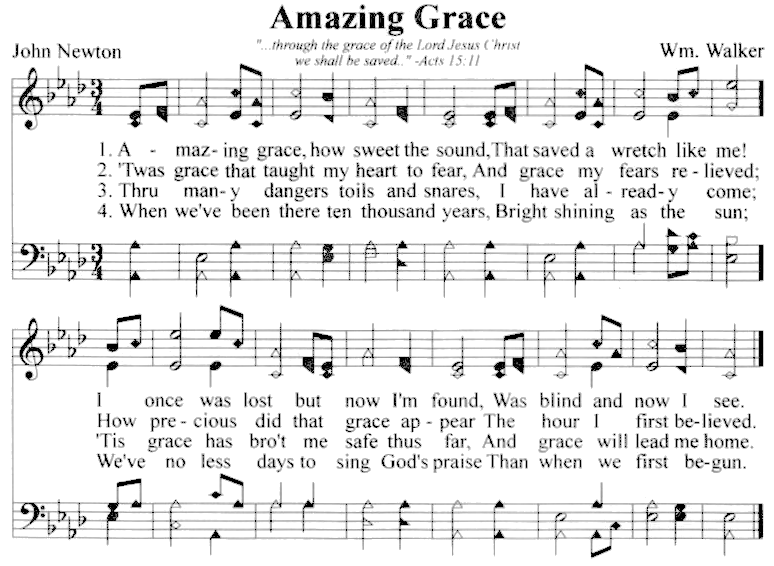
Apparently, while William Walker was in South Carolina compiling Southern Harmony, WIlliam Caldwell was in Tennessee compiling Union Harmony. Both are collections of tunes noted in shape note (the note heads have different shapes to, as the theory goes, facilitate easier learning – here’s an example of Amazing Grace in shape note:

Both men collected tunes that had cropped up in the first two hundred years of European settlement in the eastern US – tunes that, as I reflected a few days ago, are borne of tragedy and sorrow but tinged with hope.

Such is the case in this one (the tune is called Foundation). And because of the vague melancholy of the tune, the words seem less plainly cheerful and more earnest.

Give thanks for the corn and the wheat that are reaped,
for labor well done and for barns that are heaped,
for the sun and the dew and the sweet honeycomb,
for the rose and the song and the harvest brought home.

Give thanks for the mills and the farms of our land,
for craft and the strength in the work of our hands,
for the beauty our artists and poets have wrought,
for the hope and affection our friendships have brought.

Give thanks for the homes that with kindness are blessed,
for seasons of plenty and well-deserved rest,
for our country extending from sea unto sea,
for ways that have made it a land for the free.

And it becomes even more melancholy at that last couplet. Is this the land of the free? Free for whom? Or is this aspiration again, knocking on our doors, reminding us of the vision and intention of America even as we regularly watch ourselves fall short?

We have much to be thankful for – even if not everyone has all of those things. We have much to be thankful for – even as we work to ensure everyone eventually does.  We have much to be thankful for – even if it’s simply a hymn that reminds us not just what we have, but what we know is true in the world, and what calls us to help.

I’ve been watching the series The Crown on Netflix – it’s the story of the first few years of the reign of Queen Elizabeth II, told in that predictably sweeping BBC style that endears to us such shows as Downton Abbey and Call the Midwife. It’s full of beautiful scenery, palace intrigue (literally in this case), and lots of traditional music intertwined with the glorious score written for the show. As expected, several scenes happen in religious settings (state funerals, royal weddings, coronations – just regular stuff), and thus the familiar English hymns make prominent appearance.

And so it is with this mental backdrop that I approach this hymn today. It is set to a tune called “St George’s Windsor” – which made me think immediately of the Royal Family, knowing that in the House of Windsor there have been a couple of Georges (although I doubt many would consider them saints). And sure enough, the composer George Elvey was the organist at the Windsor Chapel, hence the name. (Elvey also wrote “Crown Him with Many Crowns” – which is another staple in mainline Protestant churches).

This is, as the Psalter Hymnal Handbook describes, “a serviceable Victorian tune.”

Talk about damning with faint praise.

Come, ye thankful people, come, raise a song of harvest home:
fruit and crops are gathered in, safe before the storms begin;
God, our Maker, will provide for our needs to be supplied;
come to God’s own temple, come, raise a song of harvest home.

All the world is but a field, given for a fruitful yield;
wheat and tares together sown, here for joy or sorrow grown:
first the blade, and then the ear, then the full corn shall appear;
God of harvest, grant that we wholesome grain and pure may be.

Now here’s the truth for me: it’s not a hymn that gets my blood moving or my spirit soaring. It’s not a hymn that comforts me or inspires me. And yet, I really like it. It appeals to that part of me that cries every time I hear Holst’s Planets, or the English hymn Jerusalem (click on that link – it’s a stunning rendition). It is a lovely English melody tinged with pomp and circumstance, and for some reason, that works for me. As unstuffy as I am, I very much appreciate this tune.

I realize I haven’t talked lyrics today. It’s not that they’re not interesting – they are. The metaphor of harvest for human goodness is an intriguing one worth unpacking some day. I don’t know that I’ve actually read the lyrics before (because it’s possible to sing the words but not actually read the lyrics), but I’m intrigued. I have no conclusions yet… but there’s something aspirational about “grant that we wholesome grain and pure may be”…and maybe a little unattainable. But just as we will never get close to the crown by watching The Crown, we will never get to pure by singing about it. But it sure is nice to think that we’re working on it.

Update, November 15, 2017:

A few days ago, my colleague Kendyl Gibbons offered this new set of lyrics. She wrote, “It occurs to me that a re-do of the traditional Thanksgiving hymn Come Ye Thankful People that I have been using for a while may be of use to others as we plan for the next few weeks.  The adaptation is mine; please use freely.”

Come, ye thankful people, come;
Raise the song of harvest home.
All is safely gathered in
Ere the winter storms begin.
Earth is bounteous to provide
For our wants to be supplied;
Come, in glad thanksgiving, come;
Raise the song of harvest home.

These our days are as a field
Sweet abundant fruit to yield;
Wheat and tares together sown,
Unto joy or sorrow grown.
First the bud and then the ear,
Then the full corn shall appear.
Live so that at harvest we
Wholesome grain and pure may be.

Field and furrow, heavy grown;
Yours to tend but not your own.
Bread of life shall ye restore
To your neighbors evermore.
Gather all the nations in,
Free from sorrow, free from sin.
Let the world in gladness come;
Share the joy of harvest home.

Hey, look! We’ve entered the “Harvest and Thanksgiving” section of the hymnal. And we start right off with the usual Thanksgiving song.

C.J.: There’s a usual song?
DONNA: “We Gather Together.”
C.J.: The song.
DONNA: That’s the usual song.
C.J.: So you know it?
DONNA: Everybody knows it.
C.J.: I don’t know it.
DONNA: [sighs] Didn’t you go to elementary school?
C.J.: Yes, right before being a National Merit Scholar.

(Sorry, West Wing fans, I couldn’t find a clip. But it’s season 2, episode 8, “Shibboleth”, written (of course) by Aaron Sorkin).

So yes, there’s a song. And somewhere later in the hymnal, we sing the usual words to the usual song. But here, in the “Harvest and Thanksgiving” section, we sing this paean to humanity.

We sing now together our song of thanksgiving,
rejoicing in goods which the ages have wrought,
for life that enfolds us, and helps and heals and holds us,
and leads beyond the goals which our forebears once sought.

We sing of the freedoms which martyrs and heroes
have won by their labor, their sorrow, their pain;
the oppressed befriending, our ampler hopes defending,
their death becomes a triumph, they died not in vain.

We sing of the prophets, the teachers, the dreamers,
designers, creators, and workers, and seers;
our own lives expanding, our gratitude commanding,
their deeds have made immortal their days and their years.

We sing of community now in the making
in every far continent, region, and land;
with those of all races, all times and names and places,
we pledge ourselves in covenant firmly to stand.

It’s not bad. Overall, it’s a decent “yay, humans” piece, sweet in an approaching-but-not-quite-completely-mired-in-treacle sort of way.

However – and here comes the serious quibble:  What is hard is the ending of the second verse – I am not a fan of the idea that tragic deaths and assassinations are in any way a triumph. “They died not in vain” is a humanist’s way of saying “It is God’s will” and it constantly feels empty and angering. They died and they shouldn’t have is the only right answer. Maybe we get woke and stay woke because they died, but they still should not have died. Death is never a triumph and anyone who says that has a pretty twisted way of understanding life.

But I digress.

The question is this: on balance, would I use this hymn? Probably in the right setting, gritting my teeth through the end of verse two, made easier with a memory of the sweetest flentl in the entire series:


What is it about the Southern Harmony tunes? There’s something that just gets me about them – they get inside me and speak deeply to my soul.

In a recent episode of Krista Tippett’s On Being with Béla Fleck and Abigail Washburn, two amazing banjo players and musicians, Washburn talks about hearing Doc Watson for the first time. She remarks that although she was studying law in China at the time, that ancient melody played on banjo and sung by Watson revealed the heart and truth of America. Washburn talks about the African roots of the banjo and this music:

“As people were being boarded onto the slave ships, the people said “throw your heart down here; you’re not going to want to carry it to where you’re going.’ A lot of the slave masters figured out that if they had a banjo player on board, playing the music of home, more of the ‘cargo’ would live to the other side. So the origins of the banjo in America are the bitterest of roots … and it formed an amazing origin to what became a blend of traditions from Africa, Scotland, and Ireland, when those banjo players from Africa and the fiddlers from Scotland and Ireland started playing plantation dances together. That’s what started what we know as that early Appalachian and that early American sound. That sound is based in this bitter root but with this hope ‘that I can live – I can survive.’

It is that truth – the bitter root tinged with hope – that appears in the Southern Harmony tunes, I think. And so whatever words we apply to them both benefit from and should contribute to this deep soul truth.

In this case, the lyric gets close, but for me, doesn’t go deep enough.

When the summer sun is shining over golden land and sea,
and the flowers in the hedgerow welcome butterfly and bee;
then my open heart is glowing, full of warmth for everyone,
and I feel an inner beauty which reflects the summer sun.

When the summer clouds of thought bring the long-awaited rain,
and the thirsty soil is moistened and the grass is green again;
then I long for summer sunshine, but I know that clouds and tears
are a part of life’s refreshment, like the rainbow’s hopes and fears.

In the cool of summer evening, when the dancing insects play,
and in garden, street, and meadow linger echoes of the day;
then my heart is full of yearning; hopes and mem’ries flood the whole
of my being, reaching inwards to the corners of my soul.

It’s close – so close – dancing around the edges of meaning, offering a glimpse of some deeper words to come.

And they don’t here. But maybe that’s a good thing in this case. Maybe this hymn is an opening, an invitation to offer the ‘next ten words, and the ten after that’ because our bitter roots tinged with hope need more words and more ideas and more play.

Meanwhile, set to the tune Holy Manna, these words open the door to something deeper, something maybe unnamable.

Like, maybe, truth.

Another season, another praise for the season song.

Color me surprised.

Now don’t get me wrong – this isn’t a bad thing. Hymns like this are wonderful openings for seasonal services, especially those that celebrate our seventh principle. And the tune is delightful and lively – this is a perfect opening hymn for the first week of June.

It’s the sacred version of “The Lusty Month of May” from Camelot. Tra la.

The sweet June days are come again; once more the glad earth yields
its golden wealth of rip’ning grain, and breath of clover fields,
and deep’ning shade of summer woods, and glow of summer air,
and winging thoughts and happy moods of love and joy and prayer.

The sweet June days are come again; the birds are on the wing;
bright anthems, in their merry strain, unconsciously they sing.
Oh, how our cup o’er brims with good these happy summer days;
for all the joys of field and wood we lift our song of praise.

The truth is, I wish I had more to say (It is possible that this is exhaustion talking – I landed at LaGuardia after a short trip to Phoenix at midnight and had to drive 90 minutes home, so I haven’t exactly had a full eight).

This isn’t a hymn that moves me or awakens anything in me. It’s lovely, it’s something you’ll hum in the lobby…er…coffee hour later, it’s a nice piece. But it’s not an earth-shaker for me. It’s just a nice, sweet little hymn that I am glad exists.

Although to be fair, it’s cold here on the North Fork of Long Island, and I don’t see myself tra-la-ing any time soon. Fa-la-la-ing around a Christmas tree, on the other hand…