Remember back when the news was bad and I was singing happy cheerful hope-filled hymns?  It was hard; I struggled to get past my own fears and anger and see the message those songs at those times held for me.

Well, what goes around comes around, I suppose.

Yesterday, I spent the day in Boston with a dear friend, Elizabeth Assenza, who was seeing the Ministerial Fellowship Committee. I got to be her chaplain; she didn’t need a quiet, contemplative experience – she needed me to “extrovert at her” so we gabbed excitedly and told stories in the lead up to her appointment. We also got to meet the legendary Denny Davidoff and spend time talking with Danielle DiBona and others in the room. And yes, Elizabeth is now in preliminary fellowship (yay!). We had a delicious meal in Chinatown, and then went to Kings Chapel, where a shared ancestor – John Winthrop – is buried.

It was a terrific day, made a breath or two easier knowing the ACA repeal vote was not brought to the floor, knowing that at least for a moment, the hard work of justice and the holy work of ministry won the day.

So here I am, having had a good, joyful day, and I wake up to sing this.

O earth, you are surpassing fair, from out your store we’re daily fed,
we breathe your life-supporting air and drink the water that you shed.
Yet greed has made us mar your face, pollute the air, make foul the sea:
the folly of the human race is bringing untold misery.

Our growing numbers make demands that e’en your bounty cannot meet;
starvation stalks through hungry lands and some die hourly in the street.
The Eden-dream of long ago is vanishing before our eyes;
unwise, unheeding, still we go, destroying hopes of paradise.

Has evolution been in vain that life should perish ere its prime?
Or will we from our greed refrain and save our planet while there’s time?
We must decide without delay if we’re to keep our race alive:
the choice is ours, and we must say if we’re to perish or survive.

Our lyricist, John Andrew Storey, is not wrong. And set to Welsh composer Joseph Parry’s tune Merthyr Tyfdil, with its somber, minor tones and lamenting rhythms, it’s well done and much needed. Unlike yesterday’s, that felt difficult as a congregational song (and really, cankerworms?), this has the right combination of melody and lyric to be well sung and thoughtfully internalized.

But wow did this harsh my mood.
This is our happy, light Hymn.

Not.

A short post today, as I am traveling and typing this on my phone.

I will say that the tune was deceptively harder than I expected – the intervals didn’t flow gracefully for me, and were at times discordant.

Maybe that’s the point.

This lyric is clearly not meant to cheer but to make the point that if we don’t do our duty as stewards of the earth, we’re failing. Yet it feels manipulative – and I am not sure that given this is an unfamiliar tune that congregants singing it would pay attention – until they got to the word “cankerworm” – I’m sure that stops everyone in their tracks.

In the branches of the forest, in the petals of the marigold,
on the shoulder of the mountain, in the vastness of the sea,
you will find a brooding sadness over all the ancient watershed.
You will see it written plainly on the wind and in the sand.

There’s a blight upon the mountain, there’s a sickness in the evening sky,
and we ask the age-old question: can we purge us of this sin?
Can we save the little nestling from the venom of the cankerworm?
Can we clear the look of anguish from the soft eyes of the doe?

In the thunder new commandments sound a warning through the wilderness,
let the forest be untainted, let the streams be undefiled,
let the waters of the river as they flow down to the ocean
be as sweet as in the old days when the mountain stood alone.

The song is not wrong.  And in the right hands, it certainly makes a good point. I also think it is just a helluva thing to turn to after the energetic strength of yesterday’s South African call for justice.

So… there it is.

This is another freedom song from South Africa, from during the time of apartheid.

It’s got energy and power and a sense of urgency that is compelling and captivating. And while it isn’t the only thing that makes liberation happen, song does remain a powerful tool in the activist toolbox. From the songs of enslaved Africans, to the protest songs of the civil rights movement, to the Singing Revolution in Estonia, to the songs of the Anti-Apartheid movement – along with many other examples I am too precaffeinated to think of – music makes a difference.

Music has power to give voice to our spirits, to soothe our nerves, to engage us, to motivate and awaken us, to bring us together, to provide not just a soundtrack but a unifying …. something… for what freedom and justice sound like. Music doesn’t just come from our heads through our mouths and to our ears, it vibrates our entire bodies. And when my body, vibrating in song, is next to your body, vibrating in song, we change the atmosphere and matter itself.

(Zulu) Siph’ amandla N’kosi. Wokungeverysabi.
Siph’ amandla N’kosi. Siyawadinga.

O God, give us power to rip down prisons.
O God, give us power to lift the people.

O God, give us courage to withstand hatred.
O God, give us courage not to be bitter.

O God, give us power and make us fearless.
O God, give us power because we need it.

I’m waxing a bit poetic today without much content about this particular song, I know. I am still not sure if the language of our first verse is Zulu or Xhosa – again, some varying sources. But it is inspiring nonetheless – such strong words of prayer, not just to make change but to keep us whole and remind us of our humanity. Good stuff.

Good good stuff.

I started this post thinking it was random thought day here at the Far Fringe, but as I write, I realize I do have some thoughts, largely because what I have learned about the song. So here goes:

First, it’s helpful to know what this song is and where it’s from. It was written in 1897 by Enoch Sontonga, a Xhosa minister at a Methodist mission school. The hymn was originally a pan-African song of liberation and was adopted at different times as a national anthem by various countries, including Zambia, Tanzania, Namibia , and Zimbabwe. It is now part of the South African national anthem and remains the national anthem of Tanzania.

It’s interesting to listen to the South African national anthem, as it is definitely a mashup of several songs in several languages (South Africa recognizes 11 official languages – English, Xhosa, and Zulu are the top three). And recognizing that getting to that moment (in 1994) was hard won, it’s (to me at least) a joy to know that this song of liberation leads off the anthem.

While the hymnal, Between the Lines, and some other sites list this as being in the Zulu language, I have also found references to this being in Xhosa, which are somewhat related but distinct South African languages. I’m not faulting the hymnal commission, because they might be right – I just wonder why there’s some conflict in the information. Is this a byproduct of western imperialism that we can’t even detect what language a song is written in?

I wasn’t sure how I felt about this being included in the hymnal, nor the idea of a bunch of white Americans singing it. I’m glad we have it, and I think because the continent of Africa is the cradle of humanity itself, it’s important that we remember and raise our awareness of the ugly imprint centuries of European colonization have left across the continent. I’m not sure as a European American I can sing this without a great deal of care and preparation. I’d be curious to hear from others on this score. But I am glad it’s here for us to see and hear and think about.

I’ll leave you with this version, with Miriam Makeba, Ladysmith Black Mambazo and Paul Simon (this has to be in the 1990s, but I’m not clear what this was).

N’ko-si, si-kel-el’ i Afrika,
mal-u-pha-ka-nyi-sw’u-phon-do lwa-yo.
Yiz-wa i-mi-than-da-zo ye-thu.
N’ko-si sikel-el-a.
Thi-na lu-sa-pho lwa-yo.

Wo-za mo-ya, (wo-za mo-ya,)
wo-za mo-ya, (wo-za mo-ya,)
wo-za mo-ya o-wo-yi-ngcwe-le.
U-si-si-kel-el-e.
Us-si-si-kel-el-e.

Bless, O God, our country, Africa,
so that she may waken from her sleep.
Fill her horn with plenty, guide her feet.
Bless our mother Africa.

Spirit descend, (spirit descend,)
spirit descend, (spirit descend,)
spirit descend, spirit descend.
Spirit divine,
Spirit divine.

Bless our mother Africa.

The downside of this spiritual practice is that it demands attention even on days when attention is hard to give. And more often than not, it is demanding the exact kind of attention I want to hide from on that particular day.

This song, written by Holly Near in the wake of the Harvey Milk assassination, is a call to action. It demands that we make sure everyone knows who we are and how many we are, we who will not be moved, we who are scared, and angry, and loving, and resisting.

We are a gentle, angry people,
and we are singing, singing for our lives.
We are a gentle, angry people,
and we are singing, singing for our lives.

We are a justice-seeking people…

We are young and old together…

We are a land of many colors…

We are gay and straight together….

We are a gentle, loving people…

The truth is, I’m nearly paralyzed by fear right now – it’s all coming on so many fronts, this insanity. And I am really worried that there are so many things happening we’ll miss the big one – and they’re all big ones. And worse, it seems like there is no one to hold them accountable, because they’ve stacked the decks. I know there are simple things I can do, and I know that just by refusing to accept this as normal, contacting elected officials, preaching justice, supporting boots on the ground – I know those things matter. But this is big, all that is rolling down the hill at us in speeds heretofore unmeasured. And that’s got me scared and not sleeping and a little afraid to take my eyes off the ball and even more afraid to look at the ball.

So…yeah. Holly Near’s song wants me to stop being paralyzed and get back in the game. I’m not ready. But I suppose none of us ever truly are when it matters like this.

Sigh.

Okay.

Still scared, but …okay. What’s next?

UPDATE November 5, 2017: In a concert at the Eighth Step @ Proctors in Schnectady, NY, last night, Holly Near performed, and toward the end of the show led us in this song. We sang the first couple of verses, and then she began to speak (her words transcribed to the best of my ability – I was typing on my phone as quickly as I could once I realized what was happening):

“I wrote this song when Harvey Milk and George Moscone were assassinated. We originally sang ‘we are gay and lesbian together’ but then we were surrounded by the support of allies and so I changed it to ‘we are gay and straight together.’ And now we are learning more and more about gender and sexuality and it now requires many more syllables than I can fit into the song, and so let us now sing ‘we are all in this together.”

In that 30 second riff, she updated her lyrics to expand the circle of love that this song holds.

Thank you, Holly.

Photo is at an unnamed rally, with Holly Near and emma’s revolution, and other singers I’m not familiar with…


My first instinct this morning was to talk around the history of this song to get to a discussion of grammar – namely the meaning that shifts when we go from singing ‘we will overcome’ to ‘we shall overcome’… there’s something there, but god help me I just can’t be bothered to dig in. And really, if you are interested in the history, Google is your friend.

As soon as I started writing, I thought about what actually awakened me with a start this morning, and that’s this thought: with the testimony of the Director of the FBI, clearly stating there’s an investigation about 45’s ties to Russia, and Rep. Adam Schiff’s eloquent litany of the circumstantial evidence, I worry this morning: are we being played?

Will this result in nothing, like a tantalizing distraction, while morality, ethics, justice, and compassion are thrown away like yesterday’s candy wrappers? Are we really placating ourselves with these snippets only to find ourselves being crushed and destroyed as a country, as a democracy, as human beings?

And if that’s the case, shall we ever overcome? I know it’s our duty as humans to overcome, but will we? And how will singing a song together at marches and rallies and services make a whisper of a difference?

 We shall overcome,
we shall overcome,
we shall overcome someday!
Oh, deep in my heart I do believe
we shall overcome someday!

We’ll walk hand in hand,
we’ll walk hand in hand,
we’ll walk hand in hand someday!
Oh, deep in my heart I do believe
we’ll walk hand in hand someday!

We shall all be free,
we shall all be free,
we shall all be free someday!
Oh, deep in my heart I do believe
we shall all be free someday!

We shall live in peace,
we shall live in peace,
we shall live in peace someday!
Oh, deep in my heart I do believe
we shall live in peace someday!

This is so aspirational, so confident. I feel so little of that this morning. I am scared to death, and on a day like today I feel paralyzed. Singing this song, alone with my thoughts, did nothing to assuage my fears.

Perhaps it would be better if I was singing with others, or in a place of action. Sitting in my sister’s living room is most assuredly not that place.

But as am scared today. Maybe I’ll be better tomorrow, and maybe tomorrow I will see a way out of the paralyzing fear, but today, I’m not so sure we shall overcome.

image is from a 1966 rally organized by SNCC in Virginia.

A few short thoughts today.

First, composer Joyce Poley is one of the sweetest people I have ever met and very much wrote this before we had an awareness of ableist language.

But despite how sweet she is, she wrote one of the most annoying earworms we have. Sadly, it mostly gets played as an oom-pa-pa and not the more gentle waltz I am sure Poley anticipated. And so it’s often avoided on those grounds, even before considering the language of the first verse.

Yet the sentiment is good and righteous and motivating. It’s Frederick Buechner’s “There can be no peace and joy for me until there is peace and joy for you also” in song. So it still works – but requires a lot of care in the introduction and performance.

One more step,
we will take one more step,
‘til there is peace for us and everyone,
we’ll take one more step.

One more word,
we will say one more word,
‘til every word is heard by everyone,
we’ll say one more word.

One more prayer,
we will say one more prayer,
‘til every prayer is shared by everyone,
we’ll say one more prayer.

One more song,
we will sing one more song,
‘til every song is sung by everyone,
we’ll sing one more song.

I think my feelings about this can be summed up as ‘this song hasn’t aged well – but bless its heart.’

I rarely use stock images, but this one seemed to fit…

Today we get to the first of several pieces by Jim Scott, a prolific UU songwriter and performer. It’s interesting to me that while some of his songs are full on hymns (Gather the Spirit, The Oneness of Everything, etc.) we also get some short pieces that are the choruses of longer songs. That’s the case here, the joyful chorus of a longer song.

Now Between the Lines will only tell you that he is a singer songwriter who was part of the Paul Winter Consort. But in this interview with Northern Spirit Radio, Jim tells a longer story about this song, inspired by the people who walked for six months on the Great Peace March for Global Nuclear Disarmament in 1986; having played concerts along the way, he felt inspired to join them in Baltimore, and then inspired to write this song, hearing the snippets of other music they were singing and knowing they needed a good 4/4 marching song for peace.

Nothing but peace is enough for me.
Nothing but peace is enough,
nothing but peace is enough!
Nothing but peace is enough for me.

Now I must admit, while I know Jim’s other songs in our hymnals, I didn’t know this one until this morning, and I really was baffled in a way by its notation in the hymnal. I’m not sure why…. but I couldn’t get the hang of it until I listened to it in that interview. Then it all made sense. So I recommend that whoever leads it should know it and have the hang of it – it’ll make it easier for the rest of the congregation.

Oh…and the sentiment. Nothing but peace is enough. I’m not sure it’s all I want it to be, and I could spend a few thousand words unpacking what that all means, but it’s a pretty good, simple sentiment for those seeking an end to wars and conflicts. So I won’t quibble, I won’t unpack, I’ll let it be.

And then I’ll go listen to the rest of the interview, because Jim has some great music and great stories to tell.

Photo from this flickr album by Dan Coogan of the Great Peace March. It is ABSOLUTELY worth looking through.

Yesterday (and elsewhere) I talked about how the first line of a song wasn’t always or necessarily the title of a song, and the use of such can be frustrating or misleading.

I’m thinking it may be a good thing that the original title of this piece, by Universalist minister Adin Ballou, “Reign of Christian Peace,” is not being used in our hymnal. I wish it was noted somewhere besides Between the Lines, however, because it is an interesting note in our theological history, a reminder that Universalism was not always as expansive and inclusive as we think of it today – it was a long while before Universalists pushed the doctrine of universal salvation to its inevitable conclusion.

But I digress from the hymn. Despite some unfamiliar-to-me language (a falchion is a machete-like sword), it’s your basic call for peace in a time of war. (It’s interesting that this was first published in 1842, during the Seminole Wars, and then republished in 1861, at the start of the US Civil War. Not surprising, just interesting. What may be more interesting (as I scan a history timeline) is that the Mormon War, which took place as Mormons were moving west through Missouri, also took place in the late 1830s, a much more theologically-based war, which the Universalists would have been on the non-Mormon side of. I don’t know if there’s any writing from Universalists of the day about the Mormons and other movements that cropped up… might be an interesting side trip some day.

But again, I digress. (Sorry – it’s one of those days.)

The lyrics ultimately are fine – but I am a tad disoriented by the tune it’s set to. Yes, this is set to Hyfrodol, which is such a joyful tune, made even more joyful by Peter Mayer in his recasting for Blue Boat Home. And it seems really odd to be singing about swords and trumpets and war banners in this delightful Welsh melody. But maybe that’s the point. I don’t know if this lyric has ever been set to anything else – it could be that Ballou himself wanted a spirit of joy and loveliness to emphasize the call of his words, setting the ridiculousness of war in contrast to the joy that the reign of Peace portends.

Years are coming, speed them onward
when the sword shall gather rust,
and the helmet, lance, and falchion
sleep at last in silent dust.
Earth has heard too long of battle,
heard the trumpet’s voice too long.
But another age advances,
seers foretold in ancient song.

Years are coming when forever
war’s dread banner shall be furled,
and the angel Peace be welcomed,
regent of a happy world.
Hail with song that glorious era,
when the sword shall gather rust,
and the helmet, lance, and falchion
sleep at last in silent dust.

But it’s still weird to sing those words to this tune.

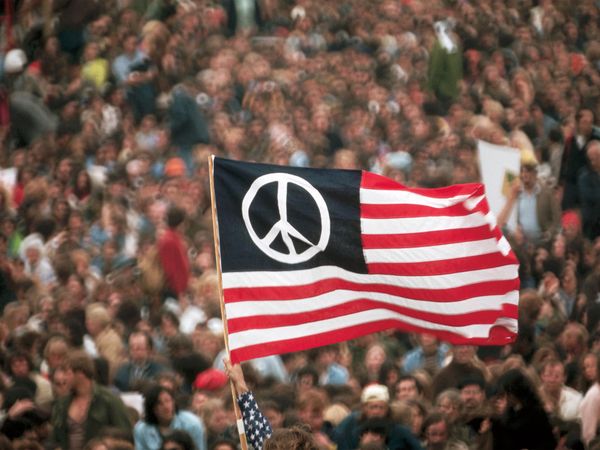
I know, the image of the peace sign on the American flag may draw controversy… but it seems the right image for this hymn today.


1:52pm: Cool update at the end of this post.

One of my regular readers, Kaye, regularly points out in comments the titles that don’t make sense because they aren’t titles at all but rather first lines. I know from experience that if the first line doesn’t grab me, I don’t look further, and sometimes I wonder why we’d have a song about that.

And thus, sometimes this practice surprises me with a hymn I have regularly flipped past. Like today’s – a setting of a poem by Rachel Bates (more on that in a minute).  It’s set to one of my favorite contemplative tunes, Danby, by the master Ralph Vaughn Williams – perhaps most familiarly known to us as the Advent hymn Let Christmas Come (which we’ll get to in May. Yes, May.).

The poetry is beautiful; its imagery is reminiscent of those too-infrequent moments of real quiet without the ambient noise of 21st century motors and currents. Its pattern brings to mind the Howard Thurman piece “When the song of the angels is stilled…” And the denouement is a beautiful meditative idea – after all of the noise and bright banging flashes and shouts and screams of war…  “how sweet the darkness there.”

When windows that are black and cold are lit anew with fires of gold;
when dusk in quiet shall descend and darkness come once more a friend;

When wings pursue their proper flight and bring not terror but delight;
when clouds are innocent again and hide no storms of deadly rain;

And when the sky is swept of wars and keeps but gentle moon and stars,
that peaceful sky, harmless air, how sweet, how sweet, the darkness there.

Before we go… I promised a bit on Rachel Bates. Here’s what I know: Rachel Bates was an English woman from the Wirral (a peninsula between Liverpool and Wales) who wrote at least one poem during the First World War.

Yep, that’s all I know. I found her in a list of female war poets here. My google searches have come up with nothing useful – there are plenty of modern Rachel Bateses to fill up my search results, and no matter what details I put in, I can’t get anything other than this site.

And that to me is a real shame. Perhaps this was the only good poem Bates ever wrote. Perhaps it was the only poem period. Or perhaps she had a longer life as a poet but was obscured or cut short or… who knows. It makes me sad, and I hope her life wasn’t. I hope she found love, fulfillment, space to express her heart’s desire and her creative passion.

For all the Rachel Bateses of the world, and for those who bring them to our attention, if only for a moment, thank you.


UPDATE! After I posted, I decided to poke around the female war poets website and discovered that for £2 ($2.56) I could buy a PDF of the first compendium of poetry. It arrived about a half hour ago, and author Lucy London has this to say:

Rachel Bates was born in 1897 to parents Joseph Ambrose Bates and Edith Annie Grimshaw. The family lived in lived in Great Crosby, Waterloo, Merseyside, where she worked as a secretary at The Liverpool Daily Post and Echo in their editorial department.

In 1922 she produced her first volume of poetry entitled  “Danae And Other Poems” which was published by Erskine MacDonald Ltd, London WC1.

During the Second World War, Rachel moved to Sawrey in the Lake District where she continued to write poetry.

In 1947 she produced a collection of poems about her lakeland surroundings called “Songs From A Lake” which was published by Hutchinson.

She died in 1966 and is buried at St Michael & All Angels cemetery in Hawkshead.

Hurrah! She was a published poet! She got some recognition! And it sound as if she lived a full life in Northwest England. Now to find her published collections…

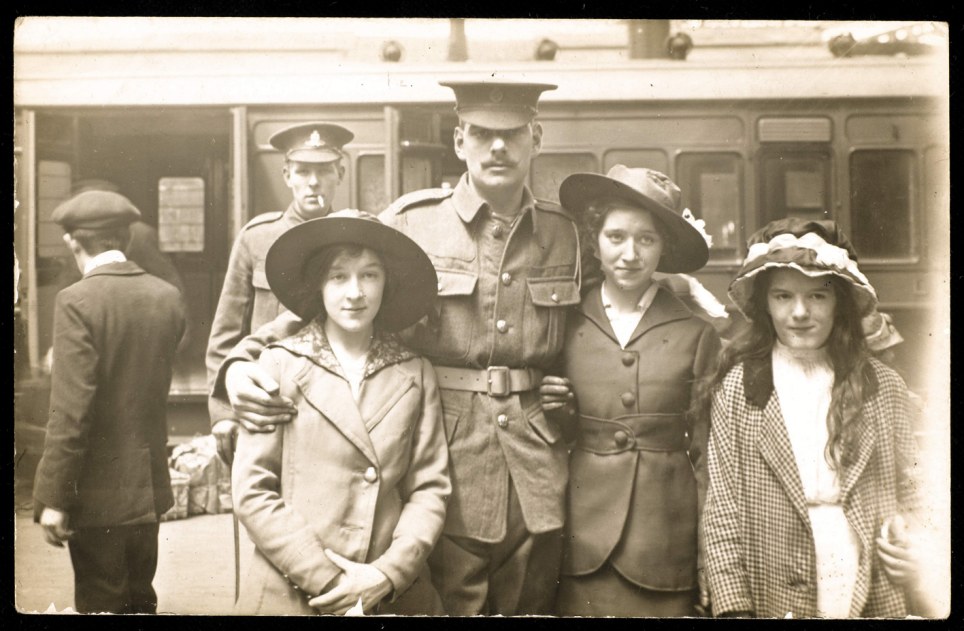
The photograph is of a British soldier and his family, circa 1917. Is the woman Rachel Bates? Probably not, but who knows…