Day two of laryngitis – day two of not actually singing, and letting a series of YouTube videos sing for me (by and large, videos of high school choirs around the world singing this with a simplicity this middle aged voice long ago relinquished).

It is again a simple piece with deep complexity, a prayer from the Book of Lamentations 5:21: “Restore us to yourself, O Lord, that we may be restored; renew our days as of old.” (NRSV)

Hashiveinu, hashiveinu,
Adonai eilecha venashuva.
Venashuva.
Chadeish, chadeish yameinu kekedem.

“Restored” can mean a lot of things – from simple sleep and rest, to remembering who we actually are, to being brought back to repent and renew. And while I know the prayer seems like it starts with the Divine – ‘restore us to yourself” – the very act of saying this prayer is the first step. We must be willing to ask, to use that pesky free will we have, to spiritually ask God to “open the door, please, I want to repent.”

Lately in Unitarian Universalist circles, there’s been some discussion about our lack of prayers of confession, and how, without our formally being able to say “we’ve messed up, we repent, and we seek forgiveness” means a lot gets bottled up, overlooked, swept under the rug. This happens amongst each other, in our congregations, and in our denomination. I know we aren’t a ‘confessing church’ – rather, we are much more likely to feel that if humanity is innately good, what have we to confess? We forget that good people sin too, and confessing isn’t necessarily about saying “I’m terrible and was born terrible” as much as the Calvinists would like us to believe. Rather, it’s about saying “I want to be restored to the goodness I know lives in and among us.” Our Universalist theology doesn’t say we don’t sin – rather, it says sin and evil are here on earth, and we must work hard so that love, freedom, justice, and compassion win. And part of that has to be confession. How can we be good, honest partners for each other if we can’t acknowledge the elephants in the room that keep us from one another?

Lord help me, I am about to quote a poem I want beyond want to forget – mostly because I had to memorize it for a class in seminary and it annoyed me – but for real, this is at the heart of WIlliam Stafford’s poem, “A Ritual to Read to each Other”:

If you don’t know the kind of person I am
and I don’t know the kind of person you are
a pattern that others made may prevail in the world
and following the wrong god home we may miss our star.

For there is many a small betrayal in the mind,
a shrug that lets the fragile sequence break
sending with shouts the horrible errors of childhood
storming out to play through the broken dyke.

And as elephants parade holding each elephant’s tail,
but if one wanders the circus won’t find the park,
I call it cruel and maybe the root of all cruelty
to know what occurs but not recognize the fact.

And so I appeal to a voice, to something shadowy,
a remote important region in all who talk:
though we could fool each other, we should consider–
lest the parade of our mutual life get lost in the dark.

For it is important that awake people be awake,
or a breaking line may discourage them back to sleep;
the signals we give–yes or no, or maybe–
should be clear: the darkness around us is deep.

Hashiveinu calls us to reawaken, to see beyond the darkness, to talk to each other and seek restoration.
Confession time: I did not actually sing this today.

It’s not that I don’t like this hymn – I do. It’s that I have laryngitis and I physically can’t. That laryngitis – and the accompanying cold – is also why this is so late: I turned off the alarm so I could sleep. The good news is I am not preaching this weekend; the bad news is I am singing and doing a blessing of hands at Diana McLean’s installation – so I have to find the voice by Sunday afternoon. Fingers crossed!

Anyway, I said I like this hymn, and I do. First, it’s got a wonderful tune to sing – as Jacqui James notes in Between the Lines, it is one of seven traditional tunes for this text and “has been the accepted Friday evening tune in England for two centuries.”

The text is pretty wonderful too – without any context, this is a fantastic view into the transcendent God upon high that we find now and then in our hymnal. This is the God Luther sings to in A Mighty Fortress Is Our God and whom we see in Immortal Invisible and Immortal Love. A loving, strong, god-outside-of-us. A solid, Psalm 23 god. Very much an Old Testament god.  And…one that seems somehow present and connected to our more theistic theologies.

Praise to the living God! All praised be The Name,
which was, and is, and is to be, for aye the same.
The one eternal God ere aught that now appears:
the first, the last, beyond all thought or timeless years.

Unformed all lovely forms declare God’s loveliness;
no holiness on earth can e’er The Name express
whose love enfolds us all; whose laud the earth displays.
Yea, everywhere, above, below, is perfect praise.

The spirit floweth free, high surging where it will;
in prophet’s word did speak of old, and speaketh still.
The Torah rests secure, and changeless it shall stand,
deep writ upon the human heart, on sea and land.

Eternal life hath God implanted in the soul;
such love shall be our strength and stay while ages roll.
Praise to the living God! All praised be The Name
which was, and is, and is to be, for aye the same.

In context, however, it’s even more wonderful. I will quote James here, as her explanation of the hymn text is pretty awesome:

This text, originally named “The Yigdal” fo its first Hebrew word, is sun antiphonally by cantor and congregation at the close of Jewish worship on the eve of the Sabbath and other festivals. probably written by Daniel ben Judah Dayyan between 1396 and 1404, it is a versification of the thirteen articles of Jewish faith drawn up by Maimonides. A Christian hymn based on “The Yigdal,” written ca. 1770 by Thomas Olivers, and English Methodist preacher, was used in England and the United States. In the 1880s, Rabbi Max Landsberg of Temple Berith Kodesh in Rochester, NY, asked Newton Mann, minister of the Unitarian church there, to make a more exact translation. later, Rabbi Landsberg asked Mann’s successor, William Channing Gannett, to recast Mann’s version in traditional meter. That version, omitting one stanza, appears here in revised form.

Now I’m not sure what was omitted – and yes, the revisions are largely about gender – but I am both surprised and not that a rabbi and a Unitarian minister worked together on this. It feels both appropriate and connected.

I’m a fan. I just wish I’d had a voice to sing it today.


The song is simple. The lyrics even more so. Yet it is hardly simple at all, is it?

Shabbat shalom is the traditional greeting on the Sabbath, meaning essentially ‘may the peace of God be with you on this Sabbath day.’ The joyful three part song is a reminder that there is joy to be found in this day of rest. And with it come the complexities of human habit, to keep doing… the complexities of what the commandment to keep the Sabbath holy is really all about… the complexities of ensuring we honor, not misappropriate, this song and practice…the complexities of wanting simply to sing a joyful greeting on a Sabbath day.

And at it’s heart, it is just a joyful song…and for me, it evokes thoughts of a member of my clinical pastoral education (CPE) cohort, a cantor who is becoming a rabbi in a new tradition. Our mutual love of music meant we shared a lot of songs with one another last fall during our CPE unit, and she was often surprised when I knew songs they sang in her congregation. She is now one of those people I send a quick “Shabbat shalom” text to on Friday evenings, because it means a lot to her to be seen by me.

Shabbat Shalom, Shabbat Shalom.
Shabbat, Shabbat, Shabbat,
Shabbat Shalom. (2x)

Shabbat, Shabbat, Shabbat, Shabbat Shalom. (2x)

Shabbat Shalom, Shabbat Shalom.
Shabbat, Shabbat, Shabbat,
Shabbat Shalom. (2x)

Otherwise remember to enter the Hymn By Hymn at GA drawing, and be joyful and gentle with one another. May the peace of God be with you always.

Shalom.

I’m afraid I couldn’t find the artist for this painting – best source I could come up with was this post at Soul Mazal.

There’s a special announcement at the end of this post – but you have read it first. No cheating! (Like I’d notice, but really, what fun would it be? Especially since there’s a good hymn to talk about!)

This hymn, y’all. It’s not the most lush or most poetic, but don’t let aesthetics get in the way of an incredibly important message: STOP LIMITING GOD.

I know that it’s an easy trap for all of us – me included – to fall into. It’s what kept me from talking to God for over a decade, figuring that God was prey to human whims and conditions. But the day I realized, sobbing in my car with my snoring then-boyfriend in the passenger seat, that God speaks without limits, through all of creation, and loves abundantly, more abundantly than seven billion humans could begin to conceive – that day was a lightning bolt. If I were a 16th century German monk, I’d have fallen off my horse, it was that strong.

And even in the lyrics (by Frederick William Faber), the metaphors trying to help us understand the expansiveness are limited – “like the wideness of the sea” is a nice start and infinitely more imaginable than is the wideness of the Divine. But I venture that like me, standing on the shore of an ocean reminds you of that expansive, infinite whatever-it-is that is so much bigger than us.

There’s a wideness in your mercy like the wideness of the sea;
there’s a kindness in your justice which is more than liberty.

But we make your love too narrow by false limits of our own,
and we magnify your strictness with a zeal you will not own.

For the love of God is broader than the measures of our minds
and the heart of the Eternal is most wonderfully kind.

I needed this hymn today. Those days when it’s rainy and dark, when the to do list is so long you have several of them cross referenced to keep track, when exhaustion and allergies and the unrelenting sadness and anger of the times beats down. Those days, a hymn like this, with its Sacred Harmony lilt, gets inside and pulls me out of the funk, at least for a moment, as I remember how wide, merciful, kind, and loving the Divine truly is.

Amen.

And now, the announcement: I love engaging with you all in comments here and Facebook, and I thought it would be fun to engage in person… click here to learn more!

And…today’s image is from the Hubble – the Tarantula Nebula. Infinite indeed.

I want to tell you a story about why this song means so much to me, but I want to get two bits of “hmm” out of the way first:

First: There is a long tradition in folk music – and hymnody – of writing new words to familiar tunes, or adapting old words and tunes for new use. One of my favorites is Dan Berggren’s rewrite of “Wayfaring Stranger” with the chorus “I’m going home to help my neighbor / I’m going home to do my part / love depends on peace and justice / peace begins in my own heart.” And… I know that it gets trickier when the tune in question is borne of the spirituals sung by enslaved Africans. I’m not sure exactly what to say about that in this case, except to say I think, perhaps, in this case the lyrics continue to call of We Are Climbing Jacob’s Ladder to find freedom here and now, with new ways of expressing it. I also understand I could be wrong about my assumptions and beg forgiveness if I blew it here.

Second: I know that “sisters, brothers, all” rankles against what we now understand as a gender spectrum, and that many who don’t find themselves in the binary of male and female don’t find space for themselves in this song – particularly poignant as the lyrics are about exactly that: making space and growing. I don’t fault the lyricist, Carole Eagleheart, nor the Hymnal Commission, because we just didn’t have the understanding and the language 25 years ago. (I recently saw someone compare this new understanding of gender to how the ancients didn’t see the color blue and thus didn’t have a word for it – as our understanding grows, we get new words and see the world differently.) I have heard a few substitutions for “sisters, brothers” but the one I like best is “family, neighbors” – it widens the circle and harkens back to Jesus’s admonition to love our neighbors as ourselves.

We are dancing Sarah’s circle,
we are dancing Sarah’s circle
we are dancing Sarah’s circle,
sisters, brothers, all.

Here we seek and find our history…

We will all do our own naming…

Every round a generation…

On and on the circle’s moving…

But now the story:

In 2004, I fell into a major clinical depression with suicidal ideation. I was living in Winston-Salem, North Carolina, and had no friends, hated my job, worked too hard, and at that moment, just couldn’t figure out how to get out of the hole. Fortunately, I said the right things to the right people, and I found myself in treatment. Many long months of psychiatrists, psychologists, and a litany of medications led to me seeing the path out of the hole, which led me to move back to where my family lives in New York State. As it happens, my mother’s failing health meant she needed more care, so moving in with my mother and sister was a lifeline to me but also a help to the family. It was there that I healed and found my self again.

In order to ensure I built community outside my family, I actively sought out a Unitarian Universalist church, long my tradition but not much my practice in those years in Winston-Salem. I was embraced by Rev. Linda Hoddy and the members of the UU Congregation of Saratoga Springs, which quickly became my home, and which provided space for me to hear my call to ministry.

But in those first few months, feeling very unsure of myself and my footing, figuring out how to be in my family system again without losing myself, figuring out what to do with my life, I encountered a religious community who held and loved me, even as they were in their own pain and sorrow, as a beloved member, Sarah, surrendered her fight against stage-four breast cancer. I watched a community have enough love and care for all of us, and it helped me focus outside of myself and truly begin to heal.

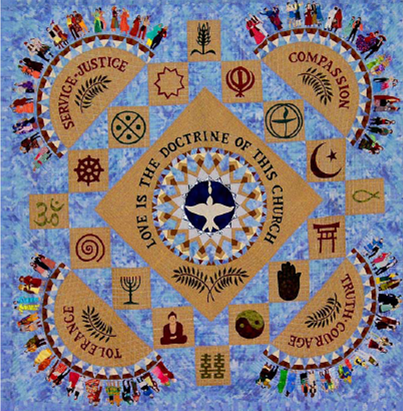
In those last months of 2004, Sarah worked as she was able on what was to be the centerpiece of a large quilt that now hangs at the back of the chancel at UU Saratoga – it features a dove which can also be a chalice, with the only piece of metallic fabric, a beacon of peace and love.

Sarah died on Christmas Eve. When the quilt, called “Journey Well,” was completed a few months later, we saw the center and instantly called it Sarah’s Circle. And we sang this song in her memory. And we all cried.

I barely knew Sarah – I met her only once. But I carry that memory, and every time I am at UU Saratoga, I pause for a moment when I approach the quilt to remember her.

Journey well, Sarah.

Journey well, all.

Later this morning, I am leading our congregation’s Teach In on White Supremacy, joining over 600 Unitarian Universalist congregations around the country in examining the larger cultural systems that even progressive organizations like ourselves don’t realize we’re perpetuating.

In this service, I am preferencing the words of people of color, letting their words inform and minister to my largely elderly, almost entirely white congregation. To pontificate myself would do a huge disservice, for how can I possibly speak for those whose pain, fear, anger, and sorrow I can never know?

Similarly, I find myself unable to talk much about this song, which holds such deep resonance for the descendants of enslaved Africans, for whom this song spoke of hope, salvation, and freedom. It may have been a coded song, although its origins in 1825 or so tell us it was being sung was before the Underground Railroad, and certainly before the US Colored Infantry and US Colored Troops, which some say the original lyric “soldiers of the cross” alludes to.

What I know is that there is a deep, soulful, melancholy to this song that I can never understand for myself but can hear from others, most powerfully, to me, from Sweet Honey in the Rock:

We are climbing Jacob’s ladder,
we are climbing Jacob’s ladder,
we are climbing on.

Ev’ry round goes higher, higher…

If I stumble, will you help me? …

Though the road is steep and rugged…

Amen.

Painting of Jacob’s Ladder is by Marc Chagall

I’m feeling at a bit of a loss this morning.

On one hand, this is an important code song from the Underground Railroad, a warning to follow the river and keep an eye out for the friendly folk.  As Walter Rhett at Black History 360 writes, “People think the song is about Moses and Exodus, but the troubled waters the spiritual refers to are in a New Testament verse. The conventional wisdom of history contends the song sent a signal to runaway slaves: Use the river so the hounds can’t trace you. Tonight is the moment for flight; move swiftly; the reaction will be fierce.”

That new testament verse is John 5:4 – “For an angel went down at a certain season into the pool, and troubled the water: whosoever then first after the troubling of the water stepped in was made whole of whatsoever disease he had.”

So there’s that.

On the other hand, I am simultaneously preparing my remarks for the Teach In on White Supremacy, and I am keenly aware of how damaging misappropriation can be, and how much I wish more notes could have been included in the printed hymnal rather than as a extra book.

And… in the middle of those hands is my experience singing, which was full and rich and deep as I thought of all the people for whom this song might have been a lifeline.

(Chorus)
Wade in the water,
wade in the water, children,
wade in the water,
God’s gonna trouble the water.

See that band all dressed in white.
God’s gonna trouble the water.
The leader looks like an Israelite.
God’s gonna trouble the water.

(Chorus)

See that band all dressed in red.
God’s gonna trouble the water.
It looks like the band that Moses led.
God’s gonna trouble the water.

(Chorus)

I’m uncomfortable right now, and I should be. I know that my English and Dutch ancestors settled in New England and New York in the 1600s, but that doesn’t mean they weren’t complicit in the spread of slavery. And still I want to honor ancestors that weren’t mine, ancestors of my friends who are descended from the enslaved Africans, because they did survive, and their descendants live today, fighting for what should always have been theirs – freedom.

In the first semester of a masters of divinity program at Union Theological Seminary, you are required to take a course in the Old Testament (with New Testament in the spring). Along with thrice weekly lectures with the professor, you also have a 90-minute “tutorial” with a teaching fellow, where you and nine of your new best friends review and deepen knowledge of the material. In my case, it included some spectacular moments of insight, incredibly emotional explorations of troubling texts, along with some hysterical moments, out and out buffoonery, and cooing over new puppies.

While many moments from that tutorial stick out to me, the one that I am remembering now, and which actually relates to the hymn is when we were doing Isaiah. Now many of you are well educated and know that the Biblical texts were written by many different hands at many different times. But it may come as a surprise to some that some entire books were written by various people; this is the case with Isaiah, from which our lyric comes.

Our teaching fellow, Amy, helped us understand the reasons why texts might be attributed to an earlier writer or teacher, and that we could tell through linguistic study, along with theme and theology, which was the original Isaiah text, and which came after. Amy was gentle, saying she learned her lesson after teaching a Sunday school class at a Southern Baptist church while she was at a southern university.

“These poor old church ladies lost their minds when I told them about Second Isaiah – they couldn’t believe they’d been misled their whole lives. One of them went screaming down the hall to the pastor’s office. Another nearly fainted. As I watched them fall apart, I changed the next part of my lesson plan. I didn’t have the heart to tell them about Third Isaiah.”

This text is actually from Second Isaiah, or Dutero-Isaiah, a gorgeous affirmation to the exiled Judeans that their God would not abandon them.

And it’s helpful in these days, even for us with our various understandings of the Divine, as it turns our gaze back to the interdependent web and the lessons the earth can teach us.

O come, you longing thirsty souls, drink freely from the spring.
And come, you weary, famished folk, and end your hungering.
Why spend yourself on empty air? Why not be satisfied?
For everywhere a feast is spread that’s always at our side.

For as the rain and snow above fall not in vanity,
but for this purpose water earth: to feed humanity.
So shall the word of spirit serve as seed within our loam,
that we may bear so rich a yield as brings the harvest home.

For we shall go in peace secure and leave in joy sublime!
The hills outside will burst with song, the trees will clap in time!
No more shall thorns and nettles grow! The bay tree and the pine
shall sign for us th’eternal Name that makes the world a shrine.

This is the third time so far we’ve used Ralph Vaughan Williams’ tune Forest Green (see All Beautiful the March of Days and The Sweet June Days. It’s not the most familiar for me, but it’s quickly growing to be my favorite use, at least today. I return again and again to its gentle lilt and cheer. This is a lyric I find particularly well suited to the tune, as it invokes hope.

And lord knows, we could use a little hope these days.


You may wonder why I chose this drawing of three owls for this hymn. Well, first, owls are cool. But more, but I love that the artist, Isaiah Stephens, said, “I added a Snowy Owl and a Barn Owl to my original Owl Sketch.” First, Second, and Third Isaiah, indeed.

This is one of those hymns that make you go “huh!” (And that isn’t a bad thing.)

First “huh” – it’s a Pentecost song, most definitely, stuck in the Worship section. And I go “huh, is that so we’ll use it, because some music directors and ministers will flip right by that liturgical season?”

Second “huh” – it’s a spiritual from the 18th century, with unknown origins. And I go “huh, check out that coded language in the second verse, pointing to the Underground Railroad!”

(Chorus)
Ev’ry time I feel the Spirit moving in my heart, I will pray.
Yes, ev’ry time I feel the Spirit moving in my heart, I will pray.

Upon the mountain, my God spoke,
o’er the mount came fire and smoke.
All around me looks so shine,
ask my God if all was mine.

(Chorus)

The River Jordan runs right cold,
chills the body, not the soul.
Ain’t but one train on this track,
runs to heaven and right back.

(Chorus)

Third “huh” – the first hit I get when putting this title into Google is Nat King Cole. “Huh, I didn’t know he did an album of hymns and spirituals…. is it sacrilege that I don’t like this version?”

Fourth “huh” I wonder if I can find a less late-50s-good-for-the-white-Ed-Sullivan-audience version on YouTube version to share with y’all, because “huh – this is a song you need to experience, not talk about.”

I did spend a long time listening to versions – and there are a plethora out there. But my eye was caught by the suggestion that the African American choral composer and arranger Moses Hogan did an arrangement of this song, and so I started listening to those. To be honest, there are a LOT of bad versions, mostly sung by high school and college ensembles. There’s the overproduced version by the Mormon Tabernacle Choir, too, and men-only or women-only versions.

But “huh” happened again, when I found a version that really moved me, by the University of Santo Tomas in Manila, Philippines. Here they are, in some traditional garb (which is reflective of the Spanish influence on the indigenous culture, something I learned about during my CPE unit with a Filipino supervisor). I love this version, because there is such life and light in the soloist’s voice, demeanor, and eyes.

Enjoy. Feel the spirit.


Postscript: Sorry these are coming out so late these days – I seem to be experiencing a shift in my sleep habits since Easter. We’ll see if this is the new pattern or if I’ll go back to rising earlier.

Hmm.

I’ve been staring at the screen for longer than is helpful, thinking about this hymn and what to say about it, wondering what it really is I feel about it that’s quantifiable. There’s something about it that bugs me, which actually makes me sad, as it’s perfectly suited for the beloved Hyfrodol hymn tune, and I’m always happy to connect the earth and our sense of the Divine.

I can see why, in 1993, it won a competition held by the Hymnal Commission, seeking new hymns. This lyric, by UU Quaker Roberta Bard, has everything you could want, for its time. And I say that, because as Jacqui James points out in Between the Lines, “her lyrics reflect her concern for gender-inclusive and spiritually-inclusive language.”

In 1993, I could see how this would be true.

And yet.

By now, you now I will point out the binaries, which 25 years ago was fine, but as we now know doesn’t accurately reflect our current understanding of a gender spectrum. (I recently saw someone brilliantly compare this new understanding to the relatively late human understanding of the color blue.)

But even that’s not quite what’s stuck in my craw.

I think it’s that I bristle against the use of the Genesis lens, the idea that earth was given to humans, as though we were so special that all of this is ours to do with as we wish:

Earth was given as a garden, cradle for humanity;
tree of life and tree of knowledge placed for our discovery.
Here was home for all your creatures born of land and sky and sea;
all created in your image, all to live in harmony.

Show to us again the garden where all life flows fresh and free.
Gently guide your sons and daughters into full maturity.
Teach us how to trust each other, how to use for good our power,
how to touch the earth with rev’rence. Then once more will Eden flower.

Bless the earth and all your children, one creation: make us whole,
interwoven, all connected, planet wide and inmost soul.
Holy mother, life bestowing, bid our waste and warfare cease.
Fill us all with grace o’erflowing. Teach us how to live in peace.

I know Bard tries to redeem it in the third verse, making sure we know we’re part of one creation, but it feels too little too late for me. I know it’s hard to say I don’t love this hymn, given that there’s a lot of good stuff within it, but it has an overall feeling of ‘ick’ to me. The parts do not make up a good whole.

One more thing – and this is something I would not have thought of except for a long conversation with my colleague Marisol Caballero, whose ancestors are from east Texas long before Europeans conquered the Americas. When we talk about discovery in connection to land, it reinforces a long and hard doctrine of discovery that dates back to the 16th century, which “sanctioned and promoted the conquest, colonization, and exploitation of non-Christian territories and peoples.” This isn’t to say that discovery in and of itself isn’t important – Mari would likely agree with me that discovering new cures, new planets, and new species is pretty awesome. But ‘discovery’ of lands that are inhabited already and taking dominion over them? Not cool. And that first verse suggests we do just that with the entire earth.

(I should note that our memories are short – this is all we talked about just five years ago when we prepared for Justice GA in Arizona.)

So yeah. I’m not a fan of this hymn – despite some good parts, and despite its award-winning status 25 years ago. It’s proof that as times goes on, our knowledge and our faith evolves.