I brought my spirit to the sea;
I stood upon the shore.
I gazed upon infinity,
I heard the waters roar.

And then there came a sense of peace,
some whisper calmed my soul.
Some ancient ministry of stars
had made my spirit whole.

I brought my spirit to the trees
that loomed against the sky.
I touched each wand’ring careless breeze
to know if god was nigh.

And then I felt an inner flame that
fiercely burned my tears.
Upright, I rose from bended knee
to meet the asking years.

I am sad to say I have never sung this before – sad because it is beautiful, and touches both lyrically and melodically on that mystery contained in all of existence. It is reverent and mystical and makes me want to take a walk along the Sound.

That it is the fourth hymn tells me of nature’s import to our hymn curators but also to our theology (at least the theology of the early 90s); it places our Transcendentalist forebears in a position of import. And I don’t know who ever sings it – I hope other congregations do, because I’ve never encountered it anywhere, other than in flips through the hymnal on the way to other hymns.

And that’s a shame. I for one want to really learn it and use it, because it speaks deeply, even to my very theist self.

The melody alone has a graceful flow, gentle scales supporting surprising intervals that emphasize the lyric mysticism. And the lyrics, calling us to give in and give over and draw strength from that which is so much bigger than us alone, tangible yet infinite. These lyrics evoke a primordial Yes… “I felt an inner flame that fiercely burned my tears” … “An ancient ministry of stars had made my spirit whole”…. I am surrendered. I am ready. Yes… deep within my soul, every cell and molecule cries ‘yes’ to the ancient mystery.


Words by Max Capp
Music by Alex Wyton

The world stands out on either side no wider than the heart is wide;
above the world is stretched the sky no higher than the soul is high.

The heart can push the sea and land so far away on either hand;
the soul can split the sky in two and let the face of God shine through.

Hmm.

This is a hymn I have never sung, nor never heard.  The lyrics are amazing – let’s not kid ourselves: Edna St. Vincent Millay can write. The lyrics talk about the expansiveness of our souls, of God, and what I perceive as a challenge against the limits we try to put on our ideas of the divine. It’s a lush pair of couplets. That last line… so delicious: the SOUL can split the sky in two. It comes from us. We’re the only thing trying to hold it all in, but as Leonard Cohen taught us, ‘there’s a crack in everything – that’s how the light gets in.’ I wonder if Cohen had read Millay before writing that song. And I am led to wonder about the ways I try to hold it in, hold it all together, try to seal the cracks that my soul is yearning to open up.

Yes. The lyric is inspiring, beautiful, hopeful, lush.

The music is not so lush – at least not the melody, which is the only thing I can manage to play on the piano app on my iPad. I long for a Ralph Vaughn Williams kind of tune here – something with a bit of sentimentality, but maybe with a bit of simplicity.

I agree with Jason Shelton that no song is unsingable – and I did indeed sing it. But I didn’t feel it – there seemed to me no marriage of word and melody, and thus it was a chore, not a delight.

Alas.


Words by Edna St. Vincent Millay
Music by W. Fredrick Wooden

Down the ages we have trod
many paths in search of God,
seeking ever to define
the Eternal and Divine.

Some have seen eternal good
pictured best in Parenthood,
and a Being throned above
ruling over us in love.

There are others who proclaim
God and Nature are the same,
and the present Godhead own
where Creation’s laws are known.

There are eyes which best can see
God within humanity,
and God’s countenance there trace
written in the human face.

Where compassion is most found
is for some the hallowed ground,
and these paths they upward plod
teaching us that love is God.

Though the truth we can’t perceive
this at least we must believe,
what we take most earnestly
is our living Deity.

Our true God we there shall find
in what claims our heart and mind,
and our hidden thoughts enshrine
that which for us is Divine.

For me, this is less an inspirational hymn and more a utilitarian hymn – it is a lesson in theology: what do we believe about God? I have used this hymn in services – most notably in my series “Singing About God” – using a handful of verses each week helps introduce the perspective I explore.

But it’s not very inspirational, not like May Nothing Evil Cross This Door. It doesn’t have soaring lyrics or a soaring melody – in fact, the melody (written by a much admired friend) is rather light for such a heady subject. This is not a song I would turn to for meditation or spiritual deepening – it’s a song I turn to when I want to talk about Unitarian Universalist theology.

Not that that’s bad – not everything can have the heart-tugging power of Finlandia (which I’ll explore when we get to #159, This Is My Song). One of the reasons we have hymns, curated and collected, is to hold our theology as it is experienced in our congregations. It’s why the hymnals get revised every so often, or supplements get released – because the theology as we experience it in our congregations changes to meet our souls’ and our world’s needs. Even Singing the Journey, released only 11 years ago, feels a little outdated now, because so much has shifted. And yet, this is what we have for now – this, plus the new songs and lyrics written and shared, that soon become the ‘extra-canonical’ works of our sung theology. (Jason Shelton’s “Life Calls Us On” is one among many examples of this – I fully expect it will be included in a future hymnal.)

So… this is a fine hymn – it does what it is meant to, and it’s easy to sing. I’m glad it’s here.


Words by John Andrew Storey
Music by Thomas Benjamin

May nothing evil cross this door,
and may ill fortune never pry about
these windows; may the roar
and rain go by.

By faith made strong, the rafters will
withstand the battering of the storm.
This hearth, though all the world grow chill,
will keep you warm.

Peace shall walk softly through these rooms,
touching our lips with holy wine,
till every casual corner blooms
into a shrine.

With laughter drown the raucous shout,
and, though these sheltering walls are thin,
may they be strong to keep hate out
and hold love in.

And so it begins – with a lilting 3/4 tune, which I have heard too many times played like a dirge. It’s full of strong sentiment, but it is a blessing, not a demand. It is a prayer, not a protest….although they are often the same thing.

My point, however, is that this opening hymn is a dance – a waltz, a welcoming, loving blessing to all of the spirits who enter: the book, the congregation, the faith, life itself.

Imagine if we greeted people at the door with a hand jive, then twirling them into our foyers, one-two-three, one-two-three to the ushers who lead them gently to seats and then dance off to meet the next willing, dance-filled congregants?

Imagine if the pianist choir cha-cha’d to the bench, hips gently propelling them to feel the rhythm of the beating hearts filling the room?

Imagine the choir doing the electric slide into the loft, rocking their souls soulfully into place?

Imagine the worship leaders entering with an energetic Charleston, weaving an energetic magic that catches fire?

Imagine the whole congregation moving and breathing in sync, ready to be together because their spirits already are engaged in the dance of welcome and blessing?


Words by Louis Untermeyer, music by Robert N. Quaile
Tune: Oldbridge

Why this, why now?

I realized that I feel most connected to myself when I take up a special project as a spiritual practice – something with a particular scope and time limit. I’ve previously spent a year studying a particular pantheon, or spiritual path, or in the case of my 50th year, the project that was My Year of Jubilee.

Why Hymns?

I put out a call for ideas on Facebook, and my colleague Heather Petit suggested singing a hymn a day. It seemed perfect – hymns are almost second nature, but to walk through them all – familiar and unfamiliar – with intention? That sounds amazing.

How long will this take?

Originally, I was seeking something I could do for a year, but I realized that if I am to do the project justice, I need to sing every hymn in both hymnals, even the one-verse offerings for Old Hundredth.

Will it get weird?

Absolutely. I’ll be singing Christmas carols in late spring. Sometimes we sing the same lyrics to two different tunes (Light of Ages and of Nations, Amazing Grace).

What will I do each day?

First I will sing the hymn – if I know it, it’ll be easy. I will also turn to online resources and musician friends to help with those I don’t. Then… I’ll write.

What will I cover in each day’s post?

First will be the lyrics – then, who knows? I plan to reflect on what strikes me – experience of singing, theological reflections, personal memories, and who knows what else – this is perhaps the beauty of a spiritual practice with several boundaries (frequency, order, process) – a great amount of freedom within the structure.

What do I hope for you, the reader?

On one level, it will hopefully become a resource. But on another, who knows. It might be that I bore everyone, including myself. But it will be an adventure of some sort.

Thanks for coming on the adventure with me.

Somehow, this blog was forgotten in the fray. I stopped blogging about anything –  theology, art, justice – because life had gotten the better of me. It was all I could do to write sermons and newsletter articles.

Perhaps this was my downfall – I feel best when I write. But I let a million excuses – busy-ness, trauma, a surprising dislike for the WordPress theme I’d fallen in love with – get in the way. I couldn’t figure out what to write when I’d poured out so much into sermons and the only words I felt were left were unpublishable words of frustration, shame, anger, and fear. Probably a lack of imagination on my part. Certainly a lack of commitment.

But now I’m going to blog again.

This time – much like my Year of Jubilee – with a sense of purpose. I will be going through the UUA’s two hymnals – a hymn a day, reflecting on the lyrics, melodies, and meaning. It will, of course, get a little weird, when I start doing the Christmas carols in springtime, or when I go through the many lyric options for Old Hundredth. But it’ll be interesting – Hymn By Hymn will start tomorrow, on my 52nd birthday – with the first notes of STLT #1, May Nothing Evil Cross This Door, and end on the final, joyful notes of STJ #1074, Turn the World Around.

And in between, I hope the daily hymn blogging will lead to other blogging – not just posting sermons but reflecting on theology, art, justice – all the things these Notes from the Far Fringe have sought to explore.

Hiatus over. Let’s get to work.

A Time for All Ages

John Murray and The Winds of Change by Christy Olson and Jessica York

Sermon

True or false: In April of 1775, Paul Revere rode through the streets from Boston to Lexington yelling “The British Are Coming”.

True or false: The Declaration of Independence was signed by everyone on July 4, 1776.

True or false: A Civil War general named Abner Doubleday invented baseball in Cooperstown, NY.

Myths, one and all. Fabrications, shifted narratives. It seems silly to tell these falsehoods, and yet… throughout human history, legends and apocryphal stories have sprung up – often not to obscure the truth (although there is plenty of that – a topic for another day)… but often to tell a story about a people. In the case of some of the great American legends and tall tales, they were told to enhance the reputation of our new country – greater, bigger, smarter, more unique, rougher, tougher, more fabulous.

American Unitarian Universalism is not immune from this propensity – and in fact, the story I shared in a time for all ages has much in common with the story I told last week, about the three little pigs, from the viewpoint of the big bad wolf. In that story, the truth wasn’t very interesting – wasn’t sexy and newsworthy – so a story was created to make it seem special.

Yes, John Murray was a Methodist minister from England who left the ministry when he discovered he believed in the doctrine universal salvation, much to the dismay of his fellow Methodists. Yes, after his wife and newborn child died, Murray spent some time in a debtors’ prison; his brother in law rescued him and helped him pay off his debts, and firm in his resolve to not preach again, Murray announced that he wished “to pass through life, unheard, unseen, unknown to all, as though I ne’er had been.” In 1770 he decided to quit his life in the old world and start fresh in the new.

He boarded the brig Hand-In-Hand, which grounded on a sandbar off the coast of New Jersey.

Yes, it is true Thomas Potter had built a chapel for itinerant preachers, and yes, Potter invited the reluctant Murray to preach.

Now the legend says Murray and Potter struck a deal, and the weather played in Potter’s favor. Legend also says that that first sermon, delivered September 30, 1770, was the start of American Universalism.

But what we know is that German immigrants who believed in universal salvation had already established themselves in the mid-Atlantic colonies. We know that Potter himself was connected to a group of Baptists who were open to universal salvation.

And we know that Murray’s first sermon had very little to do with Universalism, as he was, admittedly gunshy.

But does all of that matter? The UU mythos tells a narrative of a miracle for people who don’t often believe in miracles. But the miracle was a lot less headline-grabbing – the miracle was that he preached at all… and subsequently, he got his confidence back. And, finding that there were places he could explore and expound upon his own rather Trinitarian theology of Universalism.

Now the fact that Murray started preaching again at all is important, because he struggled to find a place but kept at it…. And he eventually founded a meeting house in Gloucester, Massachusetts, where he established the first Universalist Church in 1780. Subsequently, Murray worked through legal channels to ensure Universalists were protected under Massachusetts parish laws, and by 1785 had helped to establish the Universalist Convention. This was important – Massachusetts was a hard place to be a preacher if you didn’t follow their orthodoxy – just ask Anne Hutchinson. Murray had taken up quite a fight.

Now I tell you the less sexy side of the story – not to knock Murray off a pedestal, but to point out how important the real pedestal is… if not for Murray, Universalism would not have taken root or been legitimized. And if not for his travel to ensure our faith’s success, his pulpit wouldn’t have been open to a more radical Universalist named Hosea Ballou.

You see, Murray’s Universalism was of the restorationist variety – Murray believed that those who died impenitent would be punished in the afterlife until the Day of Judgment, when all would finally be saved – or restored, while bad angels, devils and demons would be condemned – a belief reinforced by the parable of the sheep and the goats in the gospel of Matthew.

Meanwhile, Ballou, a Baptist preacher’s kid from New Hampshire, saw universal salvation differently – that hell was here on earth, and that once we died, we would all rest in the glory of God – “death and glory” it was called.

Now the controversy between Universalists was hot and heated – so much so that one time when Ballou preached, Murray’s wife, Judith Sargeant Murray instructed a choir member to stand up and declare, “The doctrine which has been preached here this afternoon is not the doctrine which is usually preached in this house.” To his credit, Ballou’s respect for Murray and his knowledge of their theological incompatibility meant that Ballou did not attempt to settle in Boston while Murray was alive.

Which was also a good thing – because instead of settling in, Ballou spread his message farther and wider, taking advantage of the administrative work that Murray had done to legitimize Universalism.

Now it’s not a surprise that Ballou’s universalism was more popular than Murray’s – Murray’s was still heavily tinged with the hellfire and damnation of the Calvinists.

Remember – this is a time, the late 18th/early 19th century, when hellfire and damnation in the style of Jonathan Edwards was still in vogue; it was still common to hear passages like this, from the famed sermon “Sinners in the hands of an Angry God”:

O sinner! Consider the fearful danger you are in: it is a great furnace of wrath, a wide and bottomless pit, full of the fire of wrath, that you are held over in the hand of that God, whose wrath is provoked and incensed as much against you, as against many of the damned in hell. You hang by a slender thread, with the flames of divine wrath flashing about it, and ready every moment to singe it, and burn it asunder!

I suspect good church folk were more scared of their minister than they were of God Almighty.

So then, imagine hearing Hosea Ballou. He’d preach in small, temporary pavilions, with the words “God Is Love” painted on a crossbar at the top of the stage.

And he would preach not of hellfire, brimstone, flames of wrath.

No judgment.

Just love. God as love.

Ballou would talk about a God who, as a Father, loves all his children:

“Your child has fallen into the mire, and its body and its garments are defiled. You cleanse it, and array it in clean robes. The query is, Do you love your child because you have washed it? Or, Did you wash it because you loved it?”

God is love. We are all saved.

Ballou’s message was full of wholeness and worth, love from a loving God. And unlike restorationist Universalism, you don’t have to wait – you don’t have to worry whether you got it all right so you don’t have to suffer when you die. It’s salvation, right off the bat.

It’s a message people are still waiting to hear.

It’s so radical, the Universalist church almost pulled apart because of it.

It’s so radical, it was vilified by even Universalist-leaning Unitarians – William Ellery Channing said he had never seen a more irrational doctrine.

It’s so radical, Calvinists are still up in arms. For proof that the landscape hasn’t changed, consider the story of evangelical pastor Rob Bell. In 2011, Bell wrote a NYT bestselling book Love Wins, where he suggested there might be something to the universalist argument, even though he refused to call himself a Universalist. And still he was vilified by the evangelical community, with conservative leaders like Albert Mohler assserting that Bell’s book was “theologically disastrous.” Controversial pastor Mark Driscoll took Bell to task on Twitter and his blog, calling Bell’s ideas “completely absurd and unjust.”

And that’s just over a general assumption that maybe there’s wiggle room in the New Testament for something that might resemble universal salvation.

Universalism becomes even more radical when you follow it, as we do, to its natural conclusion… that if all souls are saved by the simple fact that God loves us, then Universal Salvation must extend beyond Christianity, to literally ALL SOULS, whatever they believe.

We are inheritors of something incredibly radical. To many, it’s heretical.

And the fact that John Murray – who was ready to fade into obscurity and never preach again – stepped into that pulpit and could not help but preach and promote Universalism – that to me is the miracle.

Thanks to Murray, we had space for Ballou. And thanks to Ballou and his evangelical prowess, Universalism as we know it today began to spread and change history. We count among Universalism’s exemplars and pioneers Olympia Brown, the first woman welcomed into full ordained fellowship in 1863; Benjamin Rush – signer of the Declaration; scientist Joseph Priestley; Red Cross founder Clara Barton; newspaper magnate Horace Greeley; Abner Kneeland – the last person to be tried for heresy by the government in the Commonwealth of Massachusetts; industrialist George Pullman; showman PT Barnum.

And thanks to Murray, I stand here today in a Universalist congregation, as a Universalist. Although raised by Unitarian Universalist parents, as a child, I attended a Methodist Sunday school – because the UU Society in Albany was much too far to drive on a Sunday morning. Sometime around age 9 or 10, I recall a discussion about who is saved, and wondering about the poor communist kids in China who had never heard of Jesus – were they saved? No matter what the class was teaching, I decided YES, because otherwise, what kind of God was this?

I didn’t have the words for it, but the idea I now know as Universalism made sense to me then, and it still makes sense to me. It makes me feel loved, and worthy, and part of the interconnected web of all existence.

But Universalism doesn’t just make me feel good. It makes me want to DO good. As the great showman and notable Universalist PT Barnum remarked, “a comparatively small portion of scripture bears on immortal life and the great end of our course. Conduct is three-fourths of life. This present life is the great pressing concern. This is precisely as it should be.”

As UU minister Forrest Church writes, Universalism encourages us to “pitch ourselves into the very midst of life’s teeming questions.”

And those teeming questions send us headlong into the centerpiece of Universalism: that Hell isn’t where we try to avoid going after we die – Hell is on Earth. Here, and now. Sin isn’t inherited from some ancient creation myth, it’s manifest in those times when we act inhumanly. Evil grows when we forget that we are part of this huge planet, with all its beings and the very planet itself.

Hell is on earth…and it is easy to see:

  • Man-made climate change is causing massive disasters, unwieldy temperature fluctuations, species extinctions, and a pile of consequences we can’t imagine, yet live with on this island that may be gone before the turn of the next century.
  • There is a clear and present danger to women’s health, women’s rights, and women’s dignity, with a shocking growth in the culture of misogyny and violence, and more draconian laws being passed to turn back 100 years of progress.
  • As a country, we have failed the First Nations miserably, and continue to do so – taking their lands, destroying their water, sidelining their rights, legitimizing their slander, refusing to recognize their place as the original Americans, and recently – the near complete media blackout of the huge protests to protect their rights in the Dakotas.
  • Clean energy solutions are being sidelined in favor of outrageous greed and ill-advised big oil interests, with some green initiatives held so in contempt there are laws against implementing them.
  • The Borderlands continue to be a crucible for racism, poverty, oppression, and violence – with buses of immigrant children besieged by snarling mobs, with political candidates crying out for walls and deportation.
  • Veterans are being slighted – they are homeless, suffering with PTSD and often addictions – and are trapped in a failed system with years-long delays for treatment.
  • Income inequality isn’t just a catch-phrase but a horrific reality that is causing starvation, homelessness, disease, and unease.
  • Anti-union sentiments assault workers of every stripe, from teamsters to hotel workers, from teachers to firefighters.
  • Anti-education sentiments are destroying primary and secondary education – and student loan burdens threaten to bury a generation in inescapable debt.
  • Sexual orientation and gender identity are being so demonized, our LGBTQ youth are killing themselves. And many trans people are being murdered.
  • Gun violence thrives with Caucasian people walking through malls, rifles slung over their shoulders, daring someone to take issue.
  • Racism thrives, with black people constantly afraid to walk through the streets, even when their hands are empty and open and in the air… with a growing list of names of people dead, with a growing realization of just how hard it is to be black in America.

That is evil.

That is Hell on earth.


We aren’t loving each other; we are hating each other.

That is hell on earth.

But we are not called to hate – we are called to love.

In love, there is justice.

In Universal love, we must do justice. Universalism is more than comfortable seats and no damnation. As Lewis Beals Fisher says, “Universalists are often asked to tell where they stand. The only true answer is that we do not stand at all; we move.”

The real call of Universalism is social action – around the world, in our communities, and right next door. The call of our faith says we must listen to our neighbor, who may be different from us, or have needs we cannot know just by looking at them. Who are they? What do they struggle with? How can we help? How can we make life more just, more loving, and less like hell on earth?

love-the-hell-out-of-this-world-tshirtThe call of Universalism is palpable. Our open minds and hearts cannot help but hear the call. And it’s simply put; my t-shirt proclaims it: Love the Hell out of this world.

When we love one another – when we follow the golden rule and do unto others – we Love the hell OUT of this world.

When we hear each other’s stories, we Love the hell OUT of this world.

When we honor each other’s lives, we Love the hell OUT of this world.

When we lend a hand to help, we Love the hell OUT of this world.

When we ease another’s suffering, we Love the hell OUT of this world.

When we stand with one another, we Love the hell OUT of this world.

So let us go forth and honor the miracle that is Murray’s first sermon and do as he asked, to give them NOT hell. Instead, let us Love the hell OUT of this world.


 

Click here to listen to this sermon as delivered in Nantucket on March 4, 2018.

People find wisdom in a variety of places – folk tales, sacred texts, nature, the words of prophetic people, music. I add to that list popular culture – specifically, movies and tv shows – in particular, those I find well written and which speak to something deeper than entertainment: Star Trek, M*A*S*H, and of course, The West Wing.

I’ve told this story – from an episode called “Noel” before, but it’s worth the retelling:

“This guy’s walking down a street, when he falls in a hole. The walls are so steep, he can’t get out.

“A doctor passes by, and the guy shouts up ‘Hey Doc! I’m down in this hole, can you help me out?’ The doctor writes him a prescription, throws it down the hole and moves on.

“Then a priest comes along and the guy shouts up ‘Father, I’m down in this hole, can you help me out?’ The priest writes out a prayer, throws it down in the hole and moves on.

“Then a friend walks by. ‘Hey Joe, it’s me, can you help me out?’ And the friend jumps in the hole! Our guy says, ‘Are you stupid? Now we’re both down here!’

“And the friend says, ‘Yeah, but I’ve been down here before, and I know the way out.’”

This story helps me talk about my own journey out of that hole – because, to use another movie reference, this time from The Divine Secrets of the Ya-Ya Sisterhood, in the spring of 2004, I dropped my basket.

I was struggling to make sense of my life: on one hand, a corporate drone shuffled from Connecticut to North Carolina, working too many hours in a dog-eat-dog world with no release; versus my personal life, a queer, spiritual woman, longing for connection, missing loved ones both alive and deceased, feeling very broken and divided. I was exhausted, trying to balance this divided life. I burned out and fell into a major depression.

As I sought treatment and began to look for a way out of the hole, I found many messages about how to become whole again – Madison Avenue and the Self Help Industry told me that wholeness was everything and could be achieved for a price. Yet the more I heard how I had to fix my flaws, the deeper the hole got, and the more broken I felt.

This desire for wholeness caused more pain…because like so many of the empty Madison Avenue promises, wholeness – the way it’s sold, anyway – is a myth.

So what does that mean for getting out of the hole? If wholeness isn’t the way, what can we do? I know that I was really deep in that hole and had no idea how I was going to get out.

And then, someone who had been down the hole jumped in, in the form of a book, The Joy of Burnout, by psychologist Dina Glouberman.

In her book, she talks about the physical, mental, and psychological exhaustion that comes from our drive to be everything, do everything, take care of everything, balance everything. But instead of calling us to fix the problems that led us to burnout, she suggests we can get out of the hole by learning from the burnout.

The first lesson is simply “Wait.”

Waiting means we have to give up the struggle – take a break – breathe – listen. Waiting isn’t easy. Because in the waiting, still in that hole, things still seem awful and hurtful and empty. We are broken, not whole. We are profane, not sacred. We are ugly, not beautiful.

But the waiting gives us time to hear what might help us.

It was a throwaway line in the middle of something else Globuberman was talking about, but it stopped me in my tracks:

“I asked life that tormenting question: why is it that you always give me everything but the thing I really want? Life, like a good Jewish mother, answered a question with a question: why is it that whatever I give you, you still complain?”

I realized my hole was telling me I had nothing, was nothing, and was always going to get nothing. But as I pondered this line, I decided, okay, I’ll show you what I don’t have… and so…I made a list.

It started with the pen and pad I was writing on. And then the sofa I was sitting on. And then my cat jumped up, so I added ‘cat’. And then the bookshelf across the room. And the books. And oh yeah, magazine subscriptions. And if I look at the desk over there, I see pens, markers, a computer, a mug from my alma mater. A picture taken with an ex in England. Soon the paper was filled to the brim.

I began to sort them out into what seemed like good categories – and I realized that I not only had a lot of what I needed – food, shelter, employment – I had a lot of things higher on Maslov’s hierarchy of needs too – friends, family, hobbies, health insurance, transportation, security. And those things pointed to the intangibles – a sense of humor, an artist’s passion, a love of language, curiosity, compassion, …. and a sense of connection to something… bigger. Something…we might call hope.

And then Glouberman’s second lesson of burnout is “Give up hope.”

As she explains, giving up hope is letting go; she says “it is the opposite of hopelessness because it is trusting in ourselves and in what we may be, given half a chance and loads of patience.” It’s about forgiveness and relieving pressure, and mostly, giving up hope for a better past.

I gave up hope when I realized I couldn’t go back to corporate America, couldn’t bring loved ones back from the dead, couldn’t change the choices I had made – for good or for ill. I could only learn from what I had done and experienced.

I could only “keep the faith” – Glouberman’s third lesson.

Keeping the faith is about surrender, deciding that we can trust ourselves and that we are already whole.

How can I already be whole? I am a broken mess. I cracked up. I’m full of cracks.

And a voice whispered “that’s how the light gets in”… a lyric from Leonard Cohen’s song “Anthem.

Soon after, I met a Hindu goddess named Akhilandeshvari.

akhilandeshvari-300x450“Ishvari” in Sanskrit means “goddess” or “female power,” and the “Akhilanda” means essentially “never not broken.” In other words, The Always Broken Goddess.

As writer Julie Peters notes,

“Akhilanda derives her power from being broken: in flux, pulling herself apart, living in different, constant selves at the same time, from never becoming a whole that has limitations. The thing about going through broken times is that one of the things you lose is your future: your expectations of what the story of your life so far was going to become. And of course, this is terrifying.”

Akhilanda invites us to make a choice in how to go forward. We gave up hope for a better past, so our stories about the past don’t dictate how we go forward. We are in flux – flowing in new ways, with this incredible opportunity to decide how we want to put the pieces back together. We have the choice to hide the brokenness with carefully hidden repairs and a new coat of paint; or honor the brokenness, like those Japanese bowls, mended in celebration with copper, gold, and silver.

Because no matter how we treat the cracks, we get to put ourselves back together in new ways. No matter what anyone else says or thinks about how we are doing it. No matter how many times we are told that we are broken, ugly, worthless – whether from others or our selves. Every broken bit of ourselves is our key to wholeness – full of cracks, and differently beautiful.

When I started putting the pieces back together, differently, out of my own divided life, I realized that just saying goodbye to corporate America, to exhaustion and negativity, to North Carolina itself, wasn’t enough. I could do some of this work on my own, but I could not do it all alone.

In his book A Hidden Wholeness, Parker Palmer says

“The journey toward inner truth is too taxing to be made solo – lacking support, the solitary traveler soon becomes weary or fearful and is likely to quit the road… the path is too deeply hidden to be traveled without company: finding our way…[requires] the kind of discernment that can happen only in dialogue. …we need community to find the courage to venture into the alien lands to which the inner teacher may call us.”

And so I came back into community – both to where the rest of my family lived, but also to the Unitarian Universalist Congregation of Saratoga Springs in Upstate New York – a perfect place to be held in the expansive embrace of our faith. A faith that teaches that our very humanness means we have inherent worth and dignity, and that there is always a place for us, even in our brokenness. As the Reverend Robert Walsh writes, “Universalists believed that the fate of a human being was like that. No matter how rough the trip might have been or how badly you might have behaved, at the end you would come home, and it would be a place of trust, safety, and love.”

Not just that congregation, not just my family, but in the very totality of life, the universe, and everything – a place of trust, safety, and love, where I can be never not broken.

I am whole. You are whole. Holy and sacred, full of holes, and whole. Every single one of us, with the cracks and scars that are evidence of a life lived through grief, trauma, sadness, and illness. Every single one of us, going through things no one else could imagine. Every single one of us, always in flux, always putting ourselves together differently. Every single one of us, with our own stories of how we got out of the hole – every story sacred and valuable and meaningful. Every single one of us, never not broken, but instead called – as always – despite of and because of our cracks – to love anyway.

Theologian Henri Nouwen says this:

“The great mystery of love is that we are not asked to live as if we are not hurting, as if we are not broken. In fact, we are invited to recognize our brokenness as a brokenness in which we can come in touch with the unique way that we are loved. The great invitation is to live your brokenness under the blessing. I cannot take people’s brokenness away and people cannot take my brokenness away. But how do you live in your brokenness? Do you live your brokenness under the blessing or under the curse? The great call of Love is to put your brokenness under the blessing.”

In the blessing of brokenness, we can find a measure of comfort, a call to grace, and joy – joy in having made it out of the hole, joy in helping others out, joy in loving, joy in the very complex, beautiful, brokenness of life itself. We are meant not to be perfectly whole and harmonized, but to be humans in our messy humanness, growing into harmony with the divine and each other.

We are human. We are holy. We are whole.

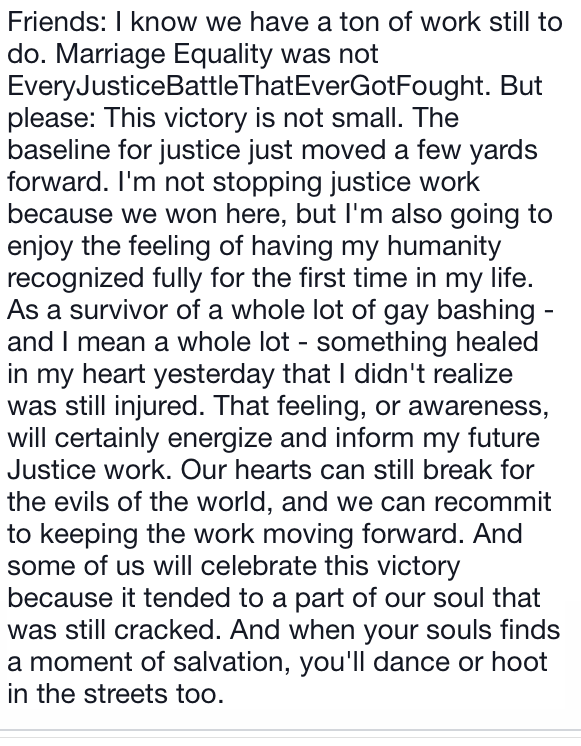
If you read yesterday’s blog post, you might think I am too much of a pessimist, that I can’t celebrate victories without bringing everyone down.  I guess that is what I did; I have been long cognizant of the “middle class white” nature of the marriage equality fight, and I let the bigger picture take over.

Thankfully, I am friends with Rev. Jude Geiger, who said this on Facebook today (photo because I can’t copy text from FB on my phone, where I am writing this):

  
What I realized is this:

1. We need to and CAN celebrate – without guilt. This was a major victory, with elegant words from Justice Kennedy to prove it. 

2. These victories – yesterday’s ruling, the strike down of DOMA, the strike down of anti-sodomy laws – these victories make each successive one EASIER. Justice Kennedy’s words will be quoted over and over again in legal cases because they make the case and pave the way for more justice. 

Yeah – as I said yesterday, and as Jude said on facebook, there’s still a lot to do. But let me be clear: 

This was a VICTORY for love, justice, and the inherent worth and dignity of every person. 
Love wins. 

Four years ago, when the New York State Legislature voted for marriage equality, I received the news with a mix of joy and sadness, relief and regret. I was so excited that justice, equality, and love won that day – but I missed my partner Tricia terribly; when she died in 1998, marriage was a pipe dream.

And now, it’s here. The Supreme Court of the United States (SCOTUS) has ruled, in a 5-4 decision, that marriage equality is the law of the land. As Kevin Russell at SCOTUSblog writes,

The majority bases its conclusion that same-sex marriage is a fundamental right on “four principles and traditions”: (1) right to person choice in marriage is “inherent in the concept of individual autonomy”; (2) “two-person union unlike any other in its importance to the committed individuals”; (3) marriage safeguards children and families; (4) marriage is a keystone to our social order.

It is a relief – more so now than in 2011 – less tears of sadness, more tears of relief. I am so thrilled that the hard work of so many people has paid off, that we have swayed not just hearts and minds but the law, and that we ALL can move from state to state and have the same legal rights, statewide and federally.

But this isn’t the end of the road for LGBTQ equality.

Just as the Civil Rights Act of 1964 was just one important step toward equality, the Obergefell decision is just one important step toward equality. There’s still so much to do; for example:

  • fair housing for LGBTQ people – because some people can be kicked out of their homes.
  • anti-discrimination laws in the workplace – because people can still be fired for being gay, even if they are legally married
  • acceptance and legal recognition of trans and non-binary gendered people – because the T isn’t there for its good looks
  • the court of public opinion – perhaps the hardest battle of all, especially when you consider that not only was the decision 5-4, but that each of the dissenters wrote their own dissenting opinion. There’s a lot of anger and distress here, and that’s just the court.

We know that significant laws and court cases have not stopped racism from thriving. We know that a landmark decision has not stopped the war against women and reproductive rights. So we must brace ourselves for continued homophobia and transphobia – along with the continued racism, bigotry, and misogyny we already work to fight. We must remember the stirring words of Joyce Poley’s song*:

One more step, we will take one more step,
‘til there is peace for us and everyone, we’ll take one more step.

One more word, we will say one more word,
‘til every word is heard by everyone, we’ll say one more word.

One more prayer, we will say one more prayer,
‘til every prayer is shared by everyone, we’ll say one more prayer.

One more song, we will sing one more song,
‘til every song is sung by everyone, we’ll sing one more song.

Let’s take those steps together. In faith, in love, in our call for justice, equality, and the inherent worth and dignity of EVERY SINGLE PERSON.


*Hymn 168 in Singing the Living Tradition