This round evokes in me another, which we’ll get to in November:

Where does it come from? Who wrote it? Why is it in here?
Where does it come from? How did it get here?
Mystery. Mystery. This hymn’s a riddle and a mystery.

Okay, so not all of it is a mystery – it is clearly a round whose text comes from perhaps the most famous of all of the lament Psalms, number 137, which was written by the Israelites during their forced exile in Babylon, beginning around 587 BCE. In even this first verse of the Psalm, we understand the longing of a people taken from their homeland.

We do also have in our hymnody a much-more-familiar-to modern-ears reggae version, which we’ll get to in late December, but this version is a lovely round whose composer is unknown. According to Between the Lines, the round is falsely attributed to William Billings – a likely mistake as he was a master of the fugue form, and this round has probably been around for a long time.

I had never heard it before this morning, and it’s a lovely round with a haunting melody. I’d love to know more about it. Here are the lyrics:

By the waters, the waters of Babylon
we sat down and wept, and wept for thee, Zion.
We remember, we remember, we remember thee, Zion.

Psalm 137:1 reads “By the rivers of Babylon— there we sat down and there we wept when we remembered Zion.”

There is, of course, a lot more to say about the whole Psalm, but I want to wait until December, when we get more of the psalm’s text in song. Something to look forward to….

Meanwhile, I am hoping to solve the mystery of this tune. Or at the very least become comfortable with dwelling in the mystery.

Painting by 19th century French artist Jacques Joseph Tissot, entitled “By the Waters of Babylon.”

These are the days I wish I was a pianist, or lived with one.

Because while I have listened to a recording of this hymn at Small Church Music, I feel like I want to play with this rather square tune by Frederick Charles Maker. I don’t want to change it, partly because the tune was written for this text by John Greenleaf Whittier and partly because there’s something lush in the melody. But the way I have heard it, it’s square and old timey, and I bet if I were a pianist or living with one, we’d be the kind of people who could reimagine the accompaniment.

And if we did that, I’d probably use this hymn – although I would take Whittier’s first line, “Dear Lord and Father of Mankind” one step further than our Hymnal Commission knew to do in 1993, and I’d make it something like “Dear God of All Humanity.” These lyrics are pretty great otherwise:

Dear Mother-Father of us all forgive our foolish ways.
Reclothe us in our rightful mind,
in purer lives thy service find, in deeper reverence, praise.

In simple trust like theirs who heard, beside the Syrian sea,
the gracious calling of the Word,
let us, like them, our faith restored, rise up and follow thee.

O Sabbath rest by Galilee, O calm of hills above,
where Jesus knelt to share with thee
the silence of eternity, interpreted by love.

With that deep hush subduing all our words and works that drown
the tender whisper of thy call,
as noiseless let thy blessing fall as fell thy manna down.

Drop thy still dews of quietness, till all our strivings cease;
take from our souls the strain and stress,
and let our ordered lives confess the beauty of thy peace.

Now barring the first line business, the lyrics are almost entirely Whittier’s, with just a couple of adjustments by our Hymnal Commission that I think make it stronger – mainly the second verse. Here’s Whittier’s, with the changed words in bold:

In simple trust like theirs who heard,
beside the Syrian sea,
the gracious calling of the Lord,
let us, like them, without a word,
rise up and follow thee.

I think our version is better, and I’m glad for it. It’s clearer that we are being called not by one man but in service to that which is greater and more powerful than all humanity and yet is the best of humanity.

All in all, a good hymn. I just long for a better arrangement…

The photo is of Syrian refugees along the Syrian Sea. In case we forget what we are called to.

Fred’s back!

Good ol’ Frederick Hosmer (with an M)  – 19th/early 20th c Unitarian minister and hymn lyricist – gives us the lyrics to the second of our two official Pentecost hymns.

I say official because according to STLT, this and Come Down O Love Divine are the two marked “Pentecost” – but what has become clear is that we have a lot of Pentecost hymns and songs all over our hymnals… from the joyful Every Time I Feel the Spirit, the jazzy Do When the Spirit Says Do (from Singing the Journey), and even the prayerful Spirit of Life.

It seems to me that Unitarian Universalists should be the people of the Pentecost, that time of spirit calling us to answer yes to loving the hell out of this world. Whether you believe this is the time of Jesus’ ascension into heaven or just that moment when the disciples truly became apostles (meaning they went from learning to preaching), it is a significant recognition of that which some call Spirit (or which we might call the fire of commitment – another good Pentecost hymn, as I think about it) dwelling within us, being that flame that burns within.

So I don’t know about our having only two official Pentecost hymns – but I do know this: as I said yesterday, Pentecost is about joy and excitement; I don’t think it’s a mistake that our General Assembly happens each year just after Pentecost, as we often get ourselves revved up for the work ahead, and our church is reborn a little into something a little different each time.

Anyway, I really like the lyrics Hosmer gives us for a Unitarian Pentecost:

O prophet souls of all the years, speak yet to us in love;
your faroff vision, toil and tears to their fulfillment move.

From tropic clime and zones of frost they come of every name;
this, this our day of Pentecost, on us the tongues of flame.

One Life together we confess, one all-in-dwelling Word,
one holy Call to righteousness within the silence heard:

One Law that guides the shining spheres as on through space they roll,
and speaks in flaming characters on Sinais of the soul:

One Love, unfathomed, measureless, an ever-flowing sea,
that holds within its vast embrace time and eternity.

What I don’t love is the tune. This one is Bangor – a serviceable tune to be sure, but not at all a rouser. In fact, it’s somewhat dour and all too serious. As it’s in common meter (CM), we have a plethora of other tunes to choose from – I personally like the McKee tune for these lyrics but would love even a new tune if that ever happened.

And yes, I still maintain that “love” and “move” don’t rhyme. GRR.

But all in all, a good hymn. Just don’t let this be the only Pentecost song you sing.

I am writing this from the dining room of a sweet, retired director of religious education who has provided home hospitality for me and colleague Amy Zucker Morgenstern in Peterborough, New Hampshire, where yesterday we celebrated the installation of Diana McLean.

It’s entirely possible the sweetness of this woman, and of Amy, and of Diana, and of yesterday’s celebration, has infected me… and as I finished singing this hymn, I thought, “wow, what a sweet hymn.”

Now I admit that some of the sweetness is in the tune – it is a delightful dance by Polish violinist Leon Lewandowski, so seemingly familiar that I was sure we had other hymns set to it.

But are the lyrics really so sweet?

O hear, my people, hear me well: “I have no need for sacrifice;
but mercy, loving kindness shall alone for life and good suffice.”

Then source of peace, lead us to peace, a place profound, and wholly true.
And lead us to a mastery o’er drives in us that war pursue.

May deeds we do inscribe our names as blessings in the Book of Life.
O source of peace, lead us to heal. O source of peace, lead us from strife.

These words, from Rabbit Nachman of Bratzlav, reflect his ministry during the late 1700s, which was informed by both in-depth study of the Torah and the esoteric Kabbalah. It is a prayer of self-knowledge, searching, spiritual deepening, and deep care of each other.

So, yeah. Despite the declarative “o hear, my people”… this is a sweet hymn.

Sweet.

Day two of laryngitis – day two of not actually singing, and letting a series of YouTube videos sing for me (by and large, videos of high school choirs around the world singing this with a simplicity this middle aged voice long ago relinquished).

It is again a simple piece with deep complexity, a prayer from the Book of Lamentations 5:21: “Restore us to yourself, O Lord, that we may be restored; renew our days as of old.” (NRSV)

Hashiveinu, hashiveinu,
Adonai eilecha venashuva.
Venashuva.
Chadeish, chadeish yameinu kekedem.

“Restored” can mean a lot of things – from simple sleep and rest, to remembering who we actually are, to being brought back to repent and renew. And while I know the prayer seems like it starts with the Divine – ‘restore us to yourself” – the very act of saying this prayer is the first step. We must be willing to ask, to use that pesky free will we have, to spiritually ask God to “open the door, please, I want to repent.”

Lately in Unitarian Universalist circles, there’s been some discussion about our lack of prayers of confession, and how, without our formally being able to say “we’ve messed up, we repent, and we seek forgiveness” means a lot gets bottled up, overlooked, swept under the rug. This happens amongst each other, in our congregations, and in our denomination. I know we aren’t a ‘confessing church’ – rather, we are much more likely to feel that if humanity is innately good, what have we to confess? We forget that good people sin too, and confessing isn’t necessarily about saying “I’m terrible and was born terrible” as much as the Calvinists would like us to believe. Rather, it’s about saying “I want to be restored to the goodness I know lives in and among us.” Our Universalist theology doesn’t say we don’t sin – rather, it says sin and evil are here on earth, and we must work hard so that love, freedom, justice, and compassion win. And part of that has to be confession. How can we be good, honest partners for each other if we can’t acknowledge the elephants in the room that keep us from one another?

Lord help me, I am about to quote a poem I want beyond want to forget – mostly because I had to memorize it for a class in seminary and it annoyed me – but for real, this is at the heart of WIlliam Stafford’s poem, “A Ritual to Read to each Other”:

If you don’t know the kind of person I am
and I don’t know the kind of person you are
a pattern that others made may prevail in the world
and following the wrong god home we may miss our star.

For there is many a small betrayal in the mind,
a shrug that lets the fragile sequence break
sending with shouts the horrible errors of childhood
storming out to play through the broken dyke.

And as elephants parade holding each elephant’s tail,
but if one wanders the circus won’t find the park,
I call it cruel and maybe the root of all cruelty
to know what occurs but not recognize the fact.

And so I appeal to a voice, to something shadowy,
a remote important region in all who talk:
though we could fool each other, we should consider–
lest the parade of our mutual life get lost in the dark.

For it is important that awake people be awake,
or a breaking line may discourage them back to sleep;
the signals we give–yes or no, or maybe–
should be clear: the darkness around us is deep.

Hashiveinu calls us to reawaken, to see beyond the darkness, to talk to each other and seek restoration.

The song is simple. The lyrics even more so. Yet it is hardly simple at all, is it?

Shabbat shalom is the traditional greeting on the Sabbath, meaning essentially ‘may the peace of God be with you on this Sabbath day.’ The joyful three part song is a reminder that there is joy to be found in this day of rest. And with it come the complexities of human habit, to keep doing… the complexities of what the commandment to keep the Sabbath holy is really all about… the complexities of ensuring we honor, not misappropriate, this song and practice…the complexities of wanting simply to sing a joyful greeting on a Sabbath day.

And at it’s heart, it is just a joyful song…and for me, it evokes thoughts of a member of my clinical pastoral education (CPE) cohort, a cantor who is becoming a rabbi in a new tradition. Our mutual love of music meant we shared a lot of songs with one another last fall during our CPE unit, and she was often surprised when I knew songs they sang in her congregation. She is now one of those people I send a quick “Shabbat shalom” text to on Friday evenings, because it means a lot to her to be seen by me.

Shabbat Shalom, Shabbat Shalom.
Shabbat, Shabbat, Shabbat,
Shabbat Shalom. (2x)

Shabbat, Shabbat, Shabbat, Shabbat Shalom. (2x)

Shabbat Shalom, Shabbat Shalom.
Shabbat, Shabbat, Shabbat,
Shabbat Shalom. (2x)

Otherwise remember to enter the Hymn By Hymn at GA drawing, and be joyful and gentle with one another. May the peace of God be with you always.

Shalom.

I’m afraid I couldn’t find the artist for this painting – best source I could come up with was this post at Soul Mazal.

There’s a special announcement at the end of this post – but you have read it first. No cheating! (Like I’d notice, but really, what fun would it be? Especially since there’s a good hymn to talk about!)

This hymn, y’all. It’s not the most lush or most poetic, but don’t let aesthetics get in the way of an incredibly important message: STOP LIMITING GOD.

I know that it’s an easy trap for all of us – me included – to fall into. It’s what kept me from talking to God for over a decade, figuring that God was prey to human whims and conditions. But the day I realized, sobbing in my car with my snoring then-boyfriend in the passenger seat, that God speaks without limits, through all of creation, and loves abundantly, more abundantly than seven billion humans could begin to conceive – that day was a lightning bolt. If I were a 16th century German monk, I’d have fallen off my horse, it was that strong.

And even in the lyrics (by Frederick William Faber), the metaphors trying to help us understand the expansiveness are limited – “like the wideness of the sea” is a nice start and infinitely more imaginable than is the wideness of the Divine. But I venture that like me, standing on the shore of an ocean reminds you of that expansive, infinite whatever-it-is that is so much bigger than us.

There’s a wideness in your mercy like the wideness of the sea;
there’s a kindness in your justice which is more than liberty.

But we make your love too narrow by false limits of our own,
and we magnify your strictness with a zeal you will not own.

For the love of God is broader than the measures of our minds
and the heart of the Eternal is most wonderfully kind.

I needed this hymn today. Those days when it’s rainy and dark, when the to do list is so long you have several of them cross referenced to keep track, when exhaustion and allergies and the unrelenting sadness and anger of the times beats down. Those days, a hymn like this, with its Sacred Harmony lilt, gets inside and pulls me out of the funk, at least for a moment, as I remember how wide, merciful, kind, and loving the Divine truly is.

Amen.

And now, the announcement: I love engaging with you all in comments here and Facebook, and I thought it would be fun to engage in person… click here to learn more!

And…today’s image is from the Hubble – the Tarantula Nebula. Infinite indeed.

I want to tell you a story about why this song means so much to me, but I want to get two bits of “hmm” out of the way first:

First: There is a long tradition in folk music – and hymnody – of writing new words to familiar tunes, or adapting old words and tunes for new use. One of my favorites is Dan Berggren’s rewrite of “Wayfaring Stranger” with the chorus “I’m going home to help my neighbor / I’m going home to do my part / love depends on peace and justice / peace begins in my own heart.” And… I know that it gets trickier when the tune in question is borne of the spirituals sung by enslaved Africans. I’m not sure exactly what to say about that in this case, except to say I think, perhaps, in this case the lyrics continue to call of We Are Climbing Jacob’s Ladder to find freedom here and now, with new ways of expressing it. I also understand I could be wrong about my assumptions and beg forgiveness if I blew it here.

Second: I know that “sisters, brothers, all” rankles against what we now understand as a gender spectrum, and that many who don’t find themselves in the binary of male and female don’t find space for themselves in this song – particularly poignant as the lyrics are about exactly that: making space and growing. I don’t fault the lyricist, Carole Eagleheart, nor the Hymnal Commission, because we just didn’t have the understanding and the language 25 years ago. (I recently saw someone compare this new understanding of gender to how the ancients didn’t see the color blue and thus didn’t have a word for it – as our understanding grows, we get new words and see the world differently.) I have heard a few substitutions for “sisters, brothers” but the one I like best is “family, neighbors” – it widens the circle and harkens back to Jesus’s admonition to love our neighbors as ourselves.

We are dancing Sarah’s circle,
we are dancing Sarah’s circle
we are dancing Sarah’s circle,
sisters, brothers, all.

Here we seek and find our history…

We will all do our own naming…

Every round a generation…

On and on the circle’s moving…

But now the story:

In 2004, I fell into a major clinical depression with suicidal ideation. I was living in Winston-Salem, North Carolina, and had no friends, hated my job, worked too hard, and at that moment, just couldn’t figure out how to get out of the hole. Fortunately, I said the right things to the right people, and I found myself in treatment. Many long months of psychiatrists, psychologists, and a litany of medications led to me seeing the path out of the hole, which led me to move back to where my family lives in New York State. As it happens, my mother’s failing health meant she needed more care, so moving in with my mother and sister was a lifeline to me but also a help to the family. It was there that I healed and found my self again.

In order to ensure I built community outside my family, I actively sought out a Unitarian Universalist church, long my tradition but not much my practice in those years in Winston-Salem. I was embraced by Rev. Linda Hoddy and the members of the UU Congregation of Saratoga Springs, which quickly became my home, and which provided space for me to hear my call to ministry.

But in those first few months, feeling very unsure of myself and my footing, figuring out how to be in my family system again without losing myself, figuring out what to do with my life, I encountered a religious community who held and loved me, even as they were in their own pain and sorrow, as a beloved member, Sarah, surrendered her fight against stage-four breast cancer. I watched a community have enough love and care for all of us, and it helped me focus outside of myself and truly begin to heal.

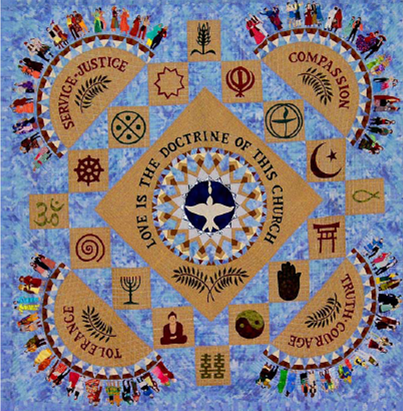
In those last months of 2004, Sarah worked as she was able on what was to be the centerpiece of a large quilt that now hangs at the back of the chancel at UU Saratoga – it features a dove which can also be a chalice, with the only piece of metallic fabric, a beacon of peace and love.
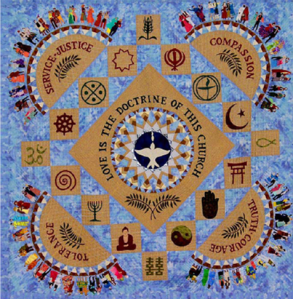
Sarah died on Christmas Eve. When the quilt, called “Journey Well,” was completed a few months later, we saw the center and instantly called it Sarah’s Circle. And we sang this song in her memory. And we all cried.

I barely knew Sarah – I met her only once. But I carry that memory, and every time I am at UU Saratoga, I pause for a moment when I approach the quilt to remember her.

Journey well, Sarah.

Journey well, all.
Later this morning, I am leading our congregation’s Teach In on White Supremacy, joining over 600 Unitarian Universalist congregations around the country in examining the larger cultural systems that even progressive organizations like ourselves don’t realize we’re perpetuating.

In this service, I am preferencing the words of people of color, letting their words inform and minister to my largely elderly, almost entirely white congregation. To pontificate myself would do a huge disservice, for how can I possibly speak for those whose pain, fear, anger, and sorrow I can never know?

Similarly, I find myself unable to talk much about this song, which holds such deep resonance for the descendants of enslaved Africans, for whom this song spoke of hope, salvation, and freedom. It may have been a coded song, although its origins in 1825 or so tell us it was being sung was before the Underground Railroad, and certainly before the US Colored Infantry and US Colored Troops, which some say the original lyric “soldiers of the cross” alludes to.

What I know is that there is a deep, soulful, melancholy to this song that I can never understand for myself but can hear from others, most powerfully, to me, from Sweet Honey in the Rock:

We are climbing Jacob’s ladder,
we are climbing Jacob’s ladder,
we are climbing on.

Ev’ry round goes higher, higher…

If I stumble, will you help me? …

Though the road is steep and rugged…

Amen.

Painting of Jacob’s Ladder is by Marc Chagall

I’m feeling at a bit of a loss this morning.

On one hand, this is an important code song from the Underground Railroad, a warning to follow the river and keep an eye out for the friendly folk.  As Walter Rhett at Black History 360 writes, “People think the song is about Moses and Exodus, but the troubled waters the spiritual refers to are in a New Testament verse. The conventional wisdom of history contends the song sent a signal to runaway slaves: Use the river so the hounds can’t trace you. Tonight is the moment for flight; move swiftly; the reaction will be fierce.”

That new testament verse is John 5:4 – “For an angel went down at a certain season into the pool, and troubled the water: whosoever then first after the troubling of the water stepped in was made whole of whatsoever disease he had.”

So there’s that.

On the other hand, I am simultaneously preparing my remarks for the Teach In on White Supremacy, and I am keenly aware of how damaging misappropriation can be, and how much I wish more notes could have been included in the printed hymnal rather than as a extra book.

And… in the middle of those hands is my experience singing, which was full and rich and deep as I thought of all the people for whom this song might have been a lifeline.

(Chorus)
Wade in the water,
wade in the water, children,
wade in the water,
God’s gonna trouble the water.

See that band all dressed in white.
God’s gonna trouble the water.
The leader looks like an Israelite.
God’s gonna trouble the water.

(Chorus)

See that band all dressed in red.
God’s gonna trouble the water.
It looks like the band that Moses led.
God’s gonna trouble the water.

(Chorus)

I’m uncomfortable right now, and I should be. I know that my English and Dutch ancestors settled in New England and New York in the 1600s, but that doesn’t mean they weren’t complicit in the spread of slavery. And still I want to honor ancestors that weren’t mine, ancestors of my friends who are descended from the enslaved Africans, because they did survive, and their descendants live today, fighting for what should always have been theirs – freedom.