Just before 5am I was awakened by a disturbing dream where a group of supervisors demanded that I quantify what percentage of myself was actively engaged in the resistance; I kept coming up empty because none of them accepted any of the ways I was engaged as valid, and both in my dream and in my waking, I was scared and exhausted from trying. I never went back to sleep, instead my mind worrying over the next four years and wondering if any of us will ever get a good night’s sleep again.

I finally dragged myself out of bed to make coffee and sing today’s hymn – another one that I tend to flip past, not because it is unknown but because it doesn’t ever seem to connect with what I’m looking for.

Well, tie me to a fence post and stick my head in mud. This was exactly what my soul and my dreams needed. Take a look, and I’ll explain.

Mysterious Presence, source of all —
the world without, the soul within —
thou fount of life, O hear our call,
and pour thy living waters in.

Thou breathest in the rushing wind,
thy spirit stirs in leaf and flower;
nor wilt thou from the willing mind
withhold thy light and love and power.

Thy hand unseen to accents clear
awoke the psalmist’s trembling lyre,
and touched the lips of holy seer
with flame from thine own altar fire.

That touch divine again impart,
still give the prophet’s burning word;
and vocal in each waiting heart
let living psalms of praise be heard.

You see, over the last month or so, it’s become vitally clear to me that what I can bring to the resistance is art – art in our congregational lives, in our worship, in our public witness, in our spiritual practices. Visual arts – drawing, painting, sculpture, graphics. Performing arts – dance, theater, music. Written arts – poetry, prose, spoken word, sermons. Liturgical arts. Circus arts. Burlesque arts. You see, when a society loses its art, it loses its soul. When we engage artistically, we cross borders, we connect, we forge relationships, we engage the difficult, we take risks, we are reminded of who we are and what is true. We find the truth in beauty and remember the beauty of truth.

And this hymn reminds us – reminds me – that the mysterious presence not only lives in all existence but inspires both the singer and the prophet, the poet and the sage. We need inspiration. We crave inspiration. In this incredibly uninspiring time, we need inspiration more than ever.

How engaged am I, Dream Supervisors? A lot more than zero… in fact, much closer to 100%. Because while I am tired and scared, I know that resistance looks like many things, and sometimes it looks like art.
Confession: the first version of this blog was nitpicky and judgy, and by the time I got toward the end, I was really annoyed with myself. “Why can’t I just let this one be?” I thought. And so I looked not only at how critical I was being but how humorless I was also being and thought “if I’m this annoyed with me, everyone else is gonna be too.” So I decided I could do better, deleted the whole supercilious mess, and started again.

And, apparently, felt the need to confess this to you. I think it’s partly because there’s something about this hymn that does bug me, and I don’t know what it is, so I went on a quibble hunt. I don’t know if it’s because there’s still binary language, or because the Alexander Pope poem that lyricist Michael Young riffed off of is troubling (third line of the original is “by saint, by savage, and by sage”), or if it’s because the tune is too cheerful to be a mystical/meditative song.

I don’t know. I suspect this is someone’s favorite – and it’s a decent piece, all in all. And I can imagine perhaps using it in a service that needs a more theistic view of the seventh principle.

Mother of all, in every age,
in every clime adored,
by saint, by poet, and by sage,
your praises high have soared.

Goddess of nurture and of love,
all nature sings your care.
In life’s extravagance you prove
the gift of giving fair.

O spirit of unfolding grace
and deepest mystery,
teach us compassion’s gentle face
and wisdom’s mastery.

Teach us to cherish this proud earth,
its fragile beauty praise,
and for the dreams your joy gives birth,
a hopeful future raise.

It’s a fine hymn. It doesn’t inspire me, but it’s fine. It surely is not worthy of my snarky criticism – and sometimes, as I taught a troll yesterday, just because you can snark doesn’t mean you should.

Thus endeth the lesson.


PS: I couldn’t figure out what image to use, so here’s a nice picture of Nature in Winter. With a bridge.

It’s Christmas Eve – time for another litany of things that are cool about the earth, and oh, before we forget, a little of humanity too, because we’re not actually part of nature.

Sigh.

I know why we have this World of Nature section, and why we have these hymns that praise said nature. And yes, some of them have been incredibly inspiring and beautiful. But I can’t deny a little joy at the prospect of turning the page and getting into the meditation and mystical songs tomorrow. I will say that one of my colleagues was right: this is why we don’t just sing through the hymnal in order on a regular basis; when taking the 15,000 foot view, I can see how it’s good to have some options that we might dip into. This is the downside of this spiritual practice – all the hymns of one kind in one fell swoop.

Now let’s look at the lyrics: these are the words of famous Unitarian activist John Haynes Holmes, founding minister of Community Church of New York, and who, among other things, helped found the NCAAP and the ACLU. I’m glad I get to talk about Holmes briefly, but I wish it were in a different setting, because he’s not exactly known for writing hymn lyrics. They’re lovely, but I prefer Holmes when he’s being prophetic and railing against war. Hymn writing was not his strong suit.

This land of bursting sunrise, all lavender and blue,
its cloud-strewn, light-swept day skies flow, and every day renew.
To east the glow of dawning, to west the blaze of night,
‘round all the long horizon’s rim, the everlasting light!

This land of open vistas, life rooted deep and free,
thy canyoned plains, thy mountains vast, plumb earth’s immensity.
Here in life’s fragile balance, the sun and stars above,
find hand in hand, and heart to heart, the everlasting love.

The lyrics are set to a modern tune by David Johnson that is rolling and minor and has all of those unusual chord progressions that make you focus on the singing and then lead you to wonder why, other than meter, this pairing exists. There’s a disconnect here for me that I can’t quite parse. If you’re going to talk to me about the loveliness of nature and the loveliness of us being hand in hand and heart to heart, then I want a lovely melody. Yes, it’s set in 6/8 and rolls in the accompaniment, but even that, to my ear, isn’t enough to save it.

Curious as always, of course, I then turned to the internet to see what it could tell me, all the while wishing I could just sing an easy Christmas carol and be done with this juxtaposition of definitely-not-holiday-music and holiday-on-nauseating-repeat.

What the internet told me is that the original lyrics to this hymn are as Christmas Eve as they come:

A stable lamp is lighted
whose glow shall wake the sky;
the stars shall bend their voices,
and every stone shall cry.
And every stone shall cry,
and straw like gold shall shine;
a barn shall harbour heaven,
a stall become a shrine.

Subsequent verses tell of Jesus’s life story, because we need a reminder I guess, and wraps up back at the night of his birth.

So there it is. This slog through the World of Nature landed me right where we actually are. Whodathunkit?

(Yes, faithful readers: there will be a reflection tomorrow. It’s one of my favorite hymns coming up – feels like a Christmas present to me!)


There are days in this practice when I get so caught up in the holy act of singing, I hardly pay attention to any analysis. Then there are days in this practice when I get so caught up in the analysis, I lose any sense of the holy. A perfect day is when there is an equal balance – a holy moment and an analytical eye. When that happens, I tend to delve into the theological more than the musical or, frankly, the trivial.

Sadly, today is not a perfect day, as much as I want it to be.

Setting aside mood or events, what takes me out of this spiritual practice’s original purpose most is running into hymns that are troubling right from the start – sometimes it’s misappropriation, sometimes it’s odd or concerning lyrics, and sometimes, such as in this case, it’s because of its tune.

Here’s the thing: if this is intended to be a hymnal – a book of songs for a congregation to sing – then fails to complete its mission, as there are definitely songs (like this one) that are not meant to be sung by a congregation. If this is intended to be a collection of music that informs our living tradition, then it fails to inform the user of that purpose.

All of this to say, this is not a congregational hymn. It is an art song that sets some amazing lyrics to a texture. From a musical standpoint, it’s beautifully crafted – the melody matches the lyric, speeding up at the crashing of the sea, slowing at the calm and still. And the lyrics are more than “hey, look at pretty nature” – the final two verses make a fantastic connection between humans and the rest of nature – we can see our hearts, minds, and souls in the wonder of the sea. It’s an inspiring lyric and a well designed song to match it.

Wild waves of storm,
the wonder of the wind and crashing sea,
nature in power and might and majesty,
yet wonder more in deep tranquility,
sea, calm and still.

Migrating birds,
in flock intent upon far distant shore
great wonder hold; yet there is wonder more
when lonely eagle, watchful on the tor,
sits, calm and still.

All people one
in urgent haste, on some great enterprise,
hearts beating fast, great dreams to realize,
yet in the soul a dream of richer prize,
serene and still.

Then striving cease:
from troubled turmoil seek an inward goal;
tranquility shall make the spirit whole.
Be still, and know a Presence in the soul,
serene, alive.

But let’s not fool ourselves: this would take a lot of work and an already extremely musical congregation to attempt this. The only example of this song I found was the Oakland UU Chancel Choir’s recording, and their performance reveals the complexity of the piece.

This is a piece that belongs in our Unitarian Universalist repertoire.

But it is not a hymn.

Wherein I think about process, relationship, and resistance – set to a quaint tune.

I don’t know how many congregations sing this hymn. I know that my home congregation sang it exactly once a year – at flower communion, a ritual devised by Unitarian minister Norbert Čapek in Prague in the 1920s and later brought to the US by his wife Maja in the 1940s.

The tune is, for lack of a better word, quaint. Old fashioned, but not in a ‘stand the test of time’ sort of way. And that’s okay, because it does make it a song of its time, perfect for hauling out once a year so we can tell the story of Capek’s ceremony and his subsequent martyrdom at the hands of the Third Reich.

But this hymn is so much more. And there’s a prescience to the lyrics that make me admire Čapek the theologian even more. You see, this is a very process-theology hymn, yet Čapek had been executed in Dachau several years before Charles Hartshorne wrote The Divine Relativity, which established this new theology, based on a philosophy, based on mathematics and physics.

In this remarkable lyric, we discover a growing God – a creating creator, inviting us to not just notice creation, not just be part of creation, but to be part of creating. All of earth and its earthlings = God’s vision growing. Especially those last two verses that make it clear that WE are God’s vision growing. We are the creation and the creators of reality, though our actions, through our being, in relationship, moving in harmony.

Color and fragrance, magical rhythm,
sweet changing music will change us with them:
life within life, inner light gently glowing,
surely you seem to be God’s vision growing.

O starry heavens, worlds of all splendor,
suns without number, new life engender:
wheel in a wheel with the light brightly glowing,
moving in harmony, God’s vision growing.

Hand full of pebbles, high mountain passes,
depths of the ocean, dew on the grasses:
great things and small, with the light gently glowing,
word of the wordless song, God’s vision growing.

Delicate beings, lacewing and sparrow
in field and forest, clover and yarrow:
life greeting life with the light brightly glowing,
none are too small to be God’s vision growing.

In human eyes burns the soul of living,
illumines altars of loving giving:
greeting, we meet, seeing light brightly glowing,
share in a greater life, God’s vision growing.

Shaper of all things, to us you’ve given
our chance to keep here on earth, a heaven.
Moving in harmony, light gently glowing,
may we be, gratefully, God’s vision growing.

Now as kind of a postscript, but not really – I’m writing this the day after the electoral college, in my opinion, failed democracy. We’re heading for several rough years as we resist the soul-crushing, life-threatening changes that may come. I have been wondering how we will manage, and more, how we can make sense of our faith (and my own process-relational perspective) without it turning into an unrealistic Pollyanna-like fairy tale. Am I asking too much of this positive, creative approach to life, thought, and divinity?

Of course, an answer appeared. As I sat down to write and hunt for the links for this piece, I encountered this quotation from process theologian Bob Menke:

Relational power takes great strength. In stark contrast to unilateral power, the radical manifestations of relational power are found in people like Martin Luther King, Jr., Mahatma Gandhi, and Jesus. It requires the willingness to endure tremendous suffering while refusing to hate. It demands that we keep our hearts open to those who wish to slam them shut. It means offering to open up a relationship with people who hate us, despise us, and wish to destroy us.

It’s about relationships. Not just to what some call God, but to each other, to events, to power, to suffering, to our enemies and our friends, to the earth, to growth. It’s about relationships – because in the end, that’s all we have.

It won’t be easy. In a piece called “How will they change their minds?” blogger and friend Doug Muder explores what it will take (and how minds have changed in the recent past). It requires patience, resistance, and most of all, relationships.

It won’t be easy. But it is what we’re called to, if we are ever to see “God’s vision growing.”


This hymn made me giggle with a little delight and a little theological tee-hee this morning.

First, the giggles of delight – I love the Coolinge hymn tune (I got too caught up in Robert Frost the last time this came up to mention it), and thus, anything set to it already has a leg up. It’s a lovely, flowing, interesting but not at all confusing melody. This is also a tune I associate with the minister who helped me discern my call, Linda Hoddy – she often used another hymn set to this tune, From All the Fret and Fever of the Day (number 90), and I have fond memories of her service to my home congregation – particularly the music and creativity.

And so jumping in to sing was easy – no awkward plunking out of notes on the keyboard app on my phone, no hunting through hymnody websites for a recording of the tune. I was able to dive right in without a second glance at the melody, so that I could read and sing the lyrics confidently.

Seek not afar for beauty; lo, it glows
in dew-wet grasses all about your feet,
in birds, in sunshine, childish faces sweet,
in stars and mountain summits topped with snows.

Go not abroad for happiness; behold
it is a flower blooming at your door.
Bring love and laughter home, and evermore
joy shall be yours as changing years unfold.

In wonder-workings or some bush aflame,
we look for Truth and fancy it concealed;
but in earth’s common things it stands revealed,
while grass and flowers and stars spell out the name.

I then giggled, because here’s another ABBA rhyme scheme, which I have a rule about. And I feel conflicted, because I love this hymn but the off-kilter rhyme caught me every time I ended a verse; after getting to “unfold” I actually stopped and looked at the lyrics and giggled when I saw the ABBA, knowing I once gave it a pass. But as much as it bugs me, I still am into this hymn.

Mostly because of the theological reason I started to giggle.

Go back and read the first and second verses. I’ll wait.

[Kimberley hums “Girl from Ipanema” to herself]

Okay, so you see how wonderfully sixth source/seventh principle it is? Lovely! Celebrate nature and the happiness it brings, look at how easy it is to find love and blessings. Very earthly, very humanist-in-nature. Awesome. Now look at the third verse.

Why look – it invokes Old Testament miracles. It invokes a Creator. Commence theological giggling. Yes, this is a theistic hymn. And what’s interesting is how many of these hymns in the “World of Nature” section ultimately are. It’s not surprising, given how theistic and rather Christian many of the transcendentalists were. We forget that, because the left turn Emerson and Thoreau took was so radical for its time. We remember how focused on humanity and nature they were, and we forget how theistic they were. So I delight in hymns like this that sneak in the reminders of our theological foundations.

Plus, this hymn really works for me and my theology – as I suspect it does for many Unitarian Universalists. But it’s a real lesson in ‘read all the lyrics’ – just as some titles mislead, sometimes the turn of the poem and the meaning of the piece doesn’t happen until the last verse.

Tee hee.

Singing Belletini

(a hastily written ode)

It is the volume I reach for first
looking for that particular presence
that metaphor
that cadence
that neither Sarton nor Oliver can match
nor even Whyte in his rich considerations

It is the rhythm of Belletini
who knows us deeply
who has served us and continues to
who understands the need
for Unitarian Universalists
to linger
and consider
what our voices cry out for

there is always a turn in his words
a something that gives us pause
whether it be a unique word like “starwheel”
or a repetition like “is upon us”
words that turn our heads
and make us wish
we weren’t singing at all
because we need the precious time
to revel in the glorious and sweet
to lean into the glow and the greening

would Rumi make us barrel on?
would Julian or Hildegard?
would Hafiz?

why then should our own poetic prophet
demand that we chant away
barreling onward
losing the moment?

we wish we weren’t singing at all

but rather
reading aloud
to one
another
and letting our NPR voices
fade
into silence.

(Autumn)
Summertime has turned the starwheel, autumn is upon us.
Sweet the angling sun, sweet upon the air the smell of blue mist rising.
Summertime has turned the starwheel, autumn is upon us.
Glorious the trees, glorious the sight of rust leaves falling, falling.
Summertime has turned the starwheel, autumn is upon us.

(Winter)
Autumn cold has turned the starwheel, winter is upon us.
Grey the windy storms, cold upon our cheeks the wet rain glistens, glistens.
Autumn cold has turned the starwheel, winter is upon us.
Leaping is the fire, golden in the glass the cider glows like amber.
Autumn cold has turned the starwheel, winter is upon upon us.

(Spring)
Winter rains have turned the starwheel, springtime is upon us.
Sharp the smell of loam, bursting in our eyes the turrets of the tulip.
Winter rains have turned the starwheel, springtime is upon us.
Greening is the grass; soft upon our brows the sunlight warm caresses.
Winter rains have turned the starwheel, springtime is upon us.

(Summer)
Vernal clouds have turned the starwheel, summer is upon us.
Gliding are the hawks, hovering above the hot and yellow hillside.
Vernal clouds have turned the starwheel, summer is upon us.
Crickets in the night, chirping in our ears the sound of moonlit music.
Vernal clouds have turned the starwheel, summer is upon us.

I’ve not much more to say. I love Belletini’s words – although I’m not a huge fan of the tune sung alone. Perhaps with others, with accompaniment, I would find the connection that would move me.

But for now, clearly what has moved me is Mark Belletini. The truth is, his meditation book, Sonata for Voice and Silence, is indeed my go-to when I need a reading, or even when I just need to read some poetry. Don’t get me wrong – I love other poets and mystics. But Mark is something special.

I had the pleasure of working with Mark for one of the Soulful Sunday services co-led by the Church of the Larger Fellowship and First Unitarian-Portland last winter, and after I fangirled a little (yes, it’s true, I did fangirl on the Zoom video conference), I discovered in Mark a minister as loving and gentle and surprising as his poetry. It was a delight and an honor to help him bring a visual element to his words, to be, just for a moment, a part of that creation.

On a day of blustery cold, it’s nice to have a warm memory to hold me.

It’s almost like someone heard me complain about hymns going nowhere, and slid this one right in for me so I wouldn’t lose faith in our hymnal.

This isn’t bad, as hymns go. The title hides the message, for sure – you wouldn’t think something called “In the Spring with Plow and Harrow” would be an anti-war tune, but sure enough: anti-war, anti-greed. And really, we don’t sing the word “avarice” enough in hymns.

In the spring, with plow and harrow,
farmers worked in field and furrow;
now we harvest for tomorrow.

Beauty adds to bounty’s measure
giving freely for our pleasure
sights and sounds and scents to treasure.

But earth’s garden will not flourish
if in greed we spoil and ravish
that which we should prize and cherish.

We must show a deeper caring,
show compassion to the dying,
cease from avarice and warring.

So may we at our thanksgiving
give this pledge to all things living:
that we will obey love’s bidding.

My real problem in writing about this hymn is not the hymn itself – it’s good, it moves, it’s easy to sing, it’s a mid-20th century hymn that doesn’t try to be too clever. My real problem is that I’m becoming frustrated by this lingering in the first source.

You see, while hymnals from Christian denominations are arranged by liturgical season, ours are arranged by source – from the start, we’ve been working through Transcending Mystery and Wonder (don’t believe me? Look at the Contents page of your hymnal). We are about three-quarters of the way through, with more nature, then meditations, mystical songs, and hymns of transience still to go. We will be stuck in the first source until mid-January.

I get it. Oh lordy, do I get it. Through dark days – politically, spiritually, and naturally – it’s been all about transcending mystery and wonder. And sure, on ordinary days in ordinary times, I’m a big fan of the first source. But it just keeps on coming right now, day after day, when I am tired of taking the long view, tired of seeing the long arc of the universe grow longer, tired of looking beyond the here and now for some greater inspiration and meaning, tired of looking at nature to inform us, tired of awe.

Really, it just boils down to being tired, beaten down, still fearful, still angry, feeling uncertain and frustrated, and watching these cold dark days get colder and darker. I’m tired.

But tomorrow, I’ll pick up the hymnal again and sing a hymn of mystery and wonder again, and maybe feel just as tired, or maybe less so, but most certainly will keep on moving forward. Maybe I’ll feel a little more transcendence in another day or so.

Well, that was boring.

Maybe I’m asking too much of a hymn. Maybe I am too invested in meaning and movement. Maybe it’s okay to have songs that just sit there and get folks to sing together even if all they are doing is noticing the season. Maybe the singing is enough.

These lyrics, though. “Let’s here it for the harvest. Yay, harvest!” Sigh.

Heap high the farmer’s wintry hoard! Heap high the golden corn!
No richer gift has autumn poured from out the lavish horn!

Through vales of grass and meads of flowers our plows their furrows made,
while on the hills the sun and showers of changeful April played.

We dropped the long, bright days of June beneath the sun of May,
and frightened from our sprouting grain the robber crows away.

All through the long, bright days of June its leaves grew green and fair,
and waved in hot mid-summer’s noon its soft and yellow hair.

And now, with autumn’s moonlit eyes, its harvest time has come,
we pluck away the frosted leaves and bear the treasure home.

Maybe I am missing something. Maybe it’s my sad mood, matched by a dark, rainy day that called me to linger in bed in order not to face it. Maybe it’s like those damn morning songs that came the days after the election – too much joy for the day. Or maybe I am still too cynical to be happy just noticing a thing that happens every year and celebrating it. We’re coming up on Christmas, and I am really clear that it has meaning and resonance for our time, so the celebration is in fact a call to resistance. This is just… there.

It’s not a hard tune to sing – Land of Rest appears serveral times in the hymnal and has a familiarish melody. And if you sing it with a lilt, it could be almost Irish.

But I’m not a fan of the lyrics and am not sure why I would ever use a hymn like this when there are others that connect more deeply.

For those who were hoping for more analysis, wit, or poetry, I’m sorry. This one is just a dud to me, and so you get a dud of a post. Maybe tomorrow will be better.

I looked at the title and started singing the hymn before I’d even gotten to the page.

I knew this was another one of those wonderful Southern Harmony tunes, and I relished in it as I flipped open the hymnal. “What more can I say about Southern Harmony?” I said to myself. “I don’t want to bore my readers.”

Flip…flip…flip….ah, number 69. Oh wait. Union Harmony.

UNION Harmony?

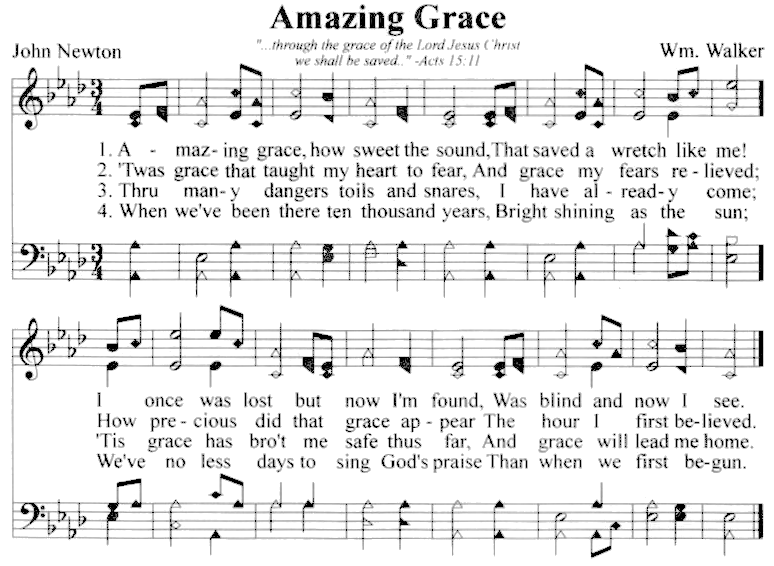
Apparently, while William Walker was in South Carolina compiling Southern Harmony, WIlliam Caldwell was in Tennessee compiling Union Harmony. Both are collections of tunes noted in shape note (the note heads have different shapes to, as the theory goes, facilitate easier learning – here’s an example of Amazing Grace in shape note:

Both men collected tunes that had cropped up in the first two hundred years of European settlement in the eastern US – tunes that, as I reflected a few days ago, are borne of tragedy and sorrow but tinged with hope.

Such is the case in this one (the tune is called Foundation). And because of the vague melancholy of the tune, the words seem less plainly cheerful and more earnest.

Give thanks for the corn and the wheat that are reaped,
for labor well done and for barns that are heaped,
for the sun and the dew and the sweet honeycomb,
for the rose and the song and the harvest brought home.

Give thanks for the mills and the farms of our land,
for craft and the strength in the work of our hands,
for the beauty our artists and poets have wrought,
for the hope and affection our friendships have brought.

Give thanks for the homes that with kindness are blessed,
for seasons of plenty and well-deserved rest,
for our country extending from sea unto sea,
for ways that have made it a land for the free.

And it becomes even more melancholy at that last couplet. Is this the land of the free? Free for whom? Or is this aspiration again, knocking on our doors, reminding us of the vision and intention of America even as we regularly watch ourselves fall short?

We have much to be thankful for – even if not everyone has all of those things. We have much to be thankful for – even as we work to ensure everyone eventually does.  We have much to be thankful for – even if it’s simply a hymn that reminds us not just what we have, but what we know is true in the world, and what calls us to help.