Let’s not kid ourselves: Willa Cather could write.

This lyric, from a longer poem “I Sought the World in Winter” is a graceful meditation on the beauty of nature:

I sought the wood in summer when every twig was green;
the rudest boughs were tender, and buds were pink between.
Light-fingered aspens trembled in fitful sun and shade,
and daffodils were golden in every starry glade.

“How frail a thing is Beauty,” I said, “when every breath
she gives the vagrant summer but swifter woos her death.
For this the star dust troubles, for this have ages rolled:
to deck the wood for bridal and slay her with the cold.”

I sought the wood in winter when every leaf was dead;
behind the wind-whipped branches the winter sun was red.
The birches, white and slender, in breathless marble stood,
the brook, a white immortal, slept silent in the wood.

“How sure a thing is Beauty,” I cried. “No bolt can slay, nor wave
nor shock despoil her, nor ravishers dismay.
The granite hills are slighter, the sea more like to fail,
behind the rose the planet, the Law behind the veil.”

Gorgeous.

And yet, this one leaves me flat. And I think it’s the tune; it just doesn’t inspire or engage me at all. And maybe it’s my mood – I am halfway through this leadership school with 13 of the most incredible, engaged, passionate youth I’ve met, and they are so full of life, laughter, and inspiration – and their songs reflect their qualities. In comparison, this hymn is old, dull, and resigned.

Oh well. I’m sure this is a favorite of many. While it’s not on my Nope list, it’s not one I’m likely to reach for any time soon.
When I say “Beethoven” I bet most of you think “da da da DUM” and the strikingly innovative opening to the Fifth Symphony. But for me, it’s this – Ode to Joy.

I first waxed poetic about it on November 1st, noting the joy of the music and the lyrics by Henry Van Dyke. And while Van Dyke’s lyrics are more well know. it is these lyrics, by German dramatist, poet, and historian Friedrich Schiller, that Beethoven included in the Ninth Symphony.

Joy, thou goddess, fair immortal, offspring of Elysium,
mad with rapture, to the portal of thy holy fane we come!
Fashion’s laws, indeed, may sever, but thy magic joins again;
humankind is one forever ‘neath thy mild and gentle reign.

Joy, in nature’s wide dominion, mightiest cause of all is found;
and ‘tis joy that moves the pinion, when the wheel of time goes round;
from the bud she lures the flower, suns from out their orbs of light;
distant spheres obey her power, far beyond all mortal sight.

Freude, schóner Götterfunken, Tochter aus Elysium,
wir betreten feuertrunken, himmlische, dein Heiligtum.
Deine Zauber binden wieder, was die Mode streng geteilt,
alle Menschen werden Brúder, wo dein sanfter Flúgel weilt.

Freude heiefst die starke Feder in der ewigen Natur.
Freude, Freude treibt die Ráder in der grossen Weltenuhr.
Blumen lockt sie ausden Keimen, Sonnen aus dem Firmament,
Spháren rollt sie in den Raumen, die des Sehers Rohr nicht kennt.

I love that we have to verses of the German, along with two English verses. The first line, “Freude, schóner Götterfunken” translates directly as “Joy, beautiful spark of God, daughter of Elysium” – the English translation we use appears to be uncredited (at least according to my Google search).

I could talk more about the theology of this versus Joyful, Joyful – and I’m sure it’s worthy of analysis. But today, in the midst of the Goldmine Youth Leadership School (with incredible youth and their incredible minds and enthusiasm), I don’t have the energy for deep thought. I do also wonder about attributing gender to an abstract – but I am not sure how I feel about it. Maybe someday.

Meanwhile, JOY! In a big, famous, broad, triumphant German way.

Welcome to another edition of “Hymns Kimberley Would Use Too Often If Let Loose.”

I love this one. I love its inspiration, I love the joy, I love the celebration. And, not surprisingly, I love the tune too – another Ralph Vaughan Williams setting (Danby). It is lush and sweet.

Let all the beauty we have known illuminate our hearts and minds.
Rejoice in wonders daily shown, in faith and joy, and love that binds.

We celebrate with singing hearts the loveliness of sky and earth,
the inspiration of the arts, the miracle of ev’ry birth.

Life’s music and its poetry surround and bless us through our days.
For these we sing in harmony, together giving thanks and praise.

And it is most assuredly a part of my theology, and my ministry.

Today’s image is the gorgeous watercolor I bought for my 49th birthday from the talented Jordan Lynn Gribble. It hangs on my bedroom wall and is often the first thing I see in the morning.

Another list song – must be Brian Wren.

And so it is. Now this is not to say his list is bad, necessarily, but It can get tiring pretty quickly.

And when it comes to Wren, there is always something – even in songs I like, like this one – that make me go “hmm” …

Love makes a bridge from heart to heart, and hand to hand.
Love finds a way when laws are blind, and freedom banned.

Love breaks the walls of language, gender, class, and age.
Love gives us wings to slip the bars of every cage.

Love lifts the hopes that force and fear have beaten down.
Love breaks the chains and gives us strength to stand our ground.

Love rings the bells of wanted birth and wedding day.
Love guides the hands that promise more than words can say.

Love makes a bridge that winds may shake, yet not destroy.
Love carries faith through life and death, to endless joy.

Did you spot it? In this case it’s the fourth verse, “love rings the bells of wanted birth.” That line falls sharply on my ear, breaking open my heart for all the births that were not wanted – do they not deserve the bells of love too? And because of that hard line, I find myself checking out of the final verse, which may be the best one of all.

Oh, Brian. This one is so, so close. Sigh.

Anyway, this is set to a tune by Gerald Wheeler that is surprisingly more complex than you’d think. It’s worth learning, as a five-verse hymn makes “sing 1, 2, and 5” an easy choice. but I recommend a strong song leader to help with some of the more intricate intervals.

All in all, not a bad one. I’ve used it before – but with care.

One of the downsides of so many hymn tunes is that groups of them begin to sound alike. For instance, there’s a whole set of them in the O Waly Waly/Gift of Love milieu that I constantly confuse for one another.

And now there is another set of them – including this English tune, called Kingsfold, set by Ralph Vaughan Williams. I started singing it and was sure I knew what it was and where it was going, until I realized there were differences in what I thought I knew. Google told me, surprisingly, that Kingsford is NOT the tune to Canticle of the Turning – that one’s called Star of the County Down, an Irish tune set by Rory Cooney.

So are they originally different? Or are they both based on a tune that ran around the British Isles, and we have two different interpretations? They’re both great, but both different.

What I do know is that whichever of the two you wind up singing to yourself, the lyrics (by Alicia Carpenter) are fitting – the tune is joyful yet melancholy, as are these words:

Where my free spirit onward leads, well, there shall be my way;
by my own light illumined I’ve journeyed night and day;
my age, a time-worn cloak I wear as once I wore my youth;
I celebrate life’s mystery; I celebrate death’s truth.

My family is not confined to mother, mate, and child;
but it includes all creatures be they tame or be they wild;
my family upon this earth includes all living things
on land, or in the ocean deep, or borne aloft on wings.

The ever spinning universe, well, there shall be my home;
I sing and spin within it as through this life I roam;
eternity is hard to ken and harder still is this:
a human life when truly seen is briefer than a kiss.

I hadn’t ever really sung this one before, to be fair, but I like it. I would use this for a memorial service, I think, in its loving picture of a life well lived. And I’d use it for services on community.

I wish I had more insights today – I’m about to get in a car and drive to Murray Grove and the Goldmine Youth Leadership School, where I will be working  with youth on worship (surprise, surprise). Thus – programming note – the week’s posts may not come out in the mornings, but that’s my hope.

Just before I opened the hymnal, I saw a Facebook post from a dear friend who asked ‘But what if this world runs out of lovers? What then?”

Then for me was opening the hymnal to this wonderful hymn, reminding us to draw the circle ever wider, because – as Susan Frederick Gray has reminded us, “no one is outside the circle of love.”

And to me, that’s our call. Right now, as we find ourselves shockingly having debates about Nazis and white supremacists, we also must find ourselves speaking out from this circle of enabling love, growing it ever wider, actively loving the hell – and the hate – out of this world.

This hymn is incredibly aspirational. Seemingly unattainable, in fact. Can there ever be this much love? And yet, the vision described by Fred Kahn (who also wrote lyrics for Almond Trees Renewed in Bloom is precisely what we need today.

Break not the circle of enabling love
where people grow, forgiven and forgiving;
break not that circle, make it wider still,
till it includes, embraces all the living.

Come, wonder at this love that comes to life,
where words of freedom are with humor spoken,
and people keep no score of wrong and guilt,
but will that human bonds remain unbroken.

Join then the movement of the love that frees,
till people of whatever race or nation
will truly be themselves, stand on their feet,
see eye to eye with laughter and elation.

A side note about the tune, written by the delightful Tom Benjamin (whose praises I have sung before): do you ever wonder why a tune has a particular – and sometimes unusual name? I suppose there are any number of reasons, often tied to the original lyrics, although some tunes get a name to honor a person or a place. Such is the case with this one, called Yaddo. I learned from Tom that he once spent a summer at an artist’s retreat at Yaddo, this incredible place with a gorgeous mansion and lovely gardens, and it was there – not 3 miles from my home congregation – where he wrote this tune. It is one that holds a special place in my heart because of the local connection.

Anyway. I love this hymn. I think it is exactly what we need to remember today as we show up on the side of good, the side of inclusion, the side of love.

Photo is part of this article from Lake George Magazine on Yaddo – a very interesting read!

In the spring of 2009, two young adults, Alie Mihuta and Emma Flynn, traveled to Central America on a mission trip to a poor community in San Salvador. They were excited to get their hands dirty, doing some serious work in the community. When they arrived at the mission, the priest in charge explained their task: paint a mural. At the time, they reported being surprised and disappointed – until they began painting.
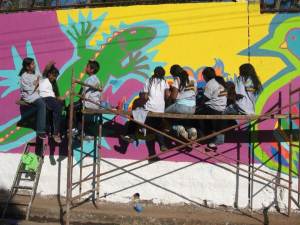
They were surrounded by children in the neighborhood, who were fascinated and who also began painting the mural.

At night, the people of the community – out of their poverty – pulled enough food together to feed the visitors from El Norte. There was singing, dancing, and much merriment.

Alie – now the development coordinator at the non-profit organization Turning the Page, recently reflected on her experience:

It was one of those experiences that completely shatters the way you perceive the world and humans which operate in it. And for a teenager it was a time where you figure out… Holy shit, the universe isn’t made for me… the world is so much bigger than me… I’m just one, little person. But at the same time it was a trip that made me realize that even though I am just one person- I can do so much. And everyone who can, should try to do the little things that they can to make the world better. I wouldn’t be the person I am today without having made that trip. I have no idea who or what kind of person I would be… But I feel like I would be clueless and naïve.”

Alie and Emma were transformed by the power of art.

One of the delights of being an active member and now religious professional in the Saint Lawrence District (upstate NY and part of Ontario) is getting to know Richard and Joyce Gilbert a little. They are so much a part of my story, in the way peanuts are a part of a Snickers bar – not a constant presence, but the nuggets of experience and wisdom are priceless. From Dick’s telling of how simple his fellowshipping process was (after completing seminary, he had dinner with denominational leaders. They talked, laughed, ate, and at the end, stood up and shook Dick’s hand, saying “welcome to fellowship.”) to learning about the founding of the UU Musicians Network over dinner with Joyce, to various interactions, workshops, and worship over the years. And many slim volumes of Dick’s meditations – edited by Joyce – sit on my shelf, inherited from Linda Hoddy, who bought some and inherited others from Charles Sapp.

One of the collections is called Thanks Be for These – named for a meditation from which this lyric is based. That Joyce is also credited suggests she helped set the words to a sweet Hungarian tune (Transylvania). And this song is sweet indeed:

Thanks be for these, life’s holy times,
moments of grief, days of delight;
triumph and failure intertwine,
shaping our vision of the right.

Thanks be for these, for birth and death;
life in between with meaning full;
holy becomes the quickened breath;
we celebrate life’s interval.

Thanks be for these, ennobling art,
images welcome to our sight;
music caressing ear and heart,
inviting us to loftier height.

Thanks be for these, who question why;
who noble motives do obey;
those who know how to live and die;
comrades who share this holy way.

Thanks be for these, we celebrate;
sing and rejoice, our trust declare;
press all our faith into our fate;
bless now the destiny we share.

Even if the Gilberts hadn’t written it, I would love this hymn. It’s such a loving prayer of gratitude for the wide ranging experiences of our lives. It’s setting in the tune is perfect – a tune that is joyful but tender. I use this maybe too often – most certainly at Thanksgiving, but also in other services.

If you don’t know it, please learn it. It’s one of my favorites.

And it always reminds me of the precious gift that is Richard and Joyce Gilbert. Thanks be for them, too.

Let me start off by saying I feel significantly better today, with just a leftover fog from the meds and sleeping a lot. Phew – what a weird siege that was. Yet even a clearer head and lack of pain won’t help me today.

Let me say for the record that I am glad we have a variety of hymns that speak to all theologies, including atheism. But it is also true that all I can come up with this morning is a smart ass thought: namely, I might be more inclined to love these atheist hymns if the tunes were more appealing.  I’m finding the melodies discordant, which isn’t helping me embrace the lyrics’ (a)theologies.

I mean, this lyric, from a sonnet by 20th-century poet John Mansfield, isn’t wrong necessarily, but I guess what I find hard to understand (and this is just me talking here) is why we would want to settle for these limits. Here is all that we can know” – where’s curiosity and discovery? And I’m not sure I get how one understands the universal mind when the flesh is all we know…

Here in the flesh is all that we can know,
all beauty, all wonder, all the power,
all the unearthly colors, all the glow,
here in the self which withers like a flower.

Here in the flesh is all that we will find,
swift in the blood and throbbing in the bone,
Beauty herself, the universal mind,
eternal April wandering alone.

I know I have thoughtful atheist friends who will not like that I struggle to understand atheism and one or two who might thing I’m dismissing them. I am trying to understand, and I think I do a good job as a religious professional of making space for them and those who identify with other theologies in my work. As an individual person, just sitting here on the sofa in my pjs with my first cup of coffee, however, I struggle with it.

I also wish to quibble with the phrase “beauty herself” – argh. Beauty isn’t female, it’s a quality. A thing. An it. Grrr….

Anyway.

This is not a hymn I’d use unless I heard that the song, written by STLT hymnal commission member TJ Anderson, was lovely and graceful and reasonable to sing – plunking out the melody on my phone didn’t help one bit.

And because I couldn’t come up with anything for a photo, I’ve chosen a pic of Fairy Glen on the Isle of Skye in Scotland (public domain).

I wish…

I wish I felt better so I could really dig into this hymn.

I wish I had looked ahead and scheduled a Hymn-by-Hymn conversation with Suzanne Fast about this hymn.

I’ll just say that having had a conversation with Suzanne at General Assembly, I now understand how difficult this embracing our bodies without shaming our bodies for the ways they work, move, and look can be.

The pen is greater than the sword.
To wield a blade or write a word
we need the skill which hands accord.

A surgeon takes a knife to heal;
assassins do the same to kill.
Each acts according to their will.

I pick the cherries from a tree,
or break the branch and let it die.
For good or ill, my hands are free.

With fingers I can soothe a brow,
or make a fist and strike a blow,
kindness or cruelty bestow.

Then let us now this lesson see:
like life itself our hands can be
for evil used, or charity.

My analytical abilities continue to be put off by a flu that has settled into my shoulder, causing great pain. I’m on anti-virals and muscle relaxers to ease it out; they’re starting to work, but I am Flexeril-loopy.

Anyway – have at it: the song about assassins and hands.

At least it’s not a cankerworm?

Cool pen image via deviantart.net.