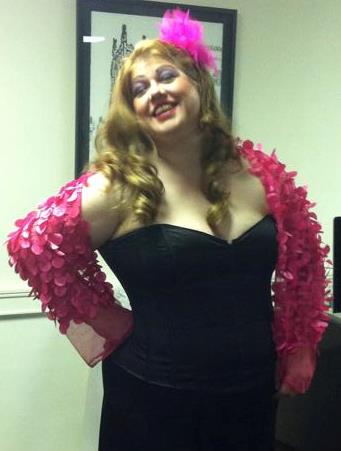
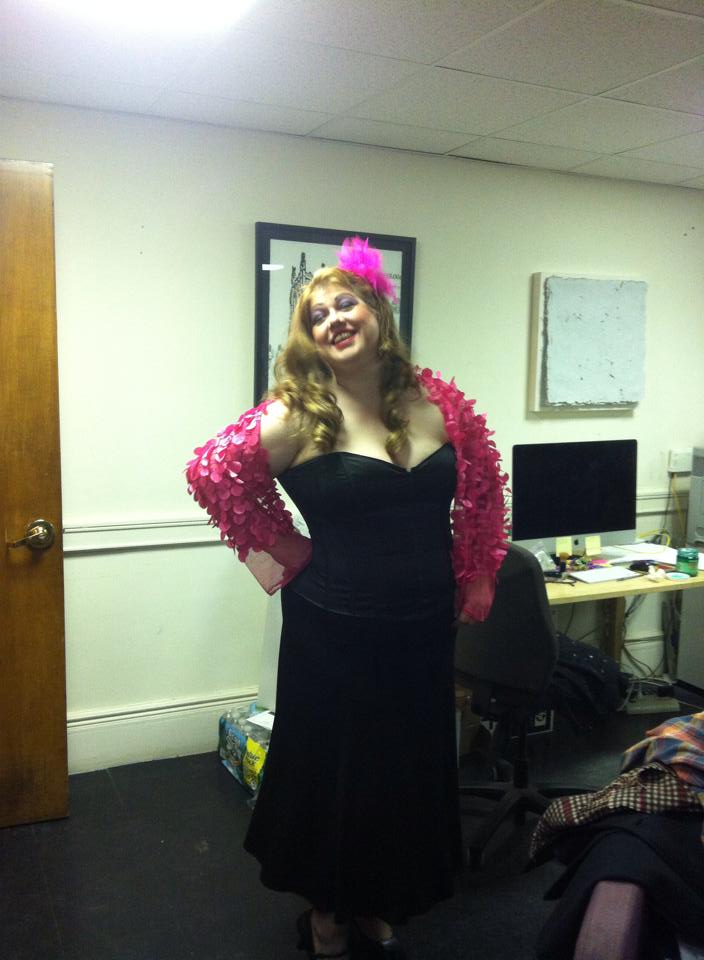
For much of my adult life, I’ve been a consciously sexual being. I recognize in myself an enjoyment of the human body – mine and others – and have had a number of satisfying (and a few unsatisfying) sexual relationships. I love that part of our being human that makes us both sexual and aware of our sexuality. I love that we get, as they say, warm for another’s form. Even when I am single, like I am now, I enjoy flirting, feeling sexual and sensual, dwelling in desire and passion. I love performing with a bit of sexual sparkle (as I did in the UTS drag show last year). And I absolutely love that we teach healthy sexuality to all ages in the Our Whole Lives curriculum.
In other words, sex is pretty awesome and a celebrated part of who I am.
Thus I’m finding it awfully unnerving to be in a space where there is no passion, no attraction, no feeling of sensuality or sexuality, no desire to be sensual or sexual. This just isn’t me. I’m not asexual. I’m not cold or unmoved. So it’s been odd.
I’m keenly aware that a number of things may be contributing to this: I’ve been stressed in my work and home life (both of which have just recently released their anxious grip). I am in that wonderful stage of a woman’s life known as peri-menopause (Lord, help me to hold out / until my change comes!). There is a distinct lack of interested parties within 3,200 miles of me – including myself. Before now, I could overcome lack of partner or lack of peace and still get in touch with my sexual core, but right now, I’m feeling like a dud.
This is typically the place where I would spiral into negative self-esteem – no one will ever love me, I’m utterly unattractive, there’s something wrong with me, I’m officially a broken mess. If I can’t be wholly whole, then I am completely broken.
But now, this is where my faith steps in – a faith that says we can never be completely whole, because then we wouldn’t be human. A faith that says its in the cracks where the light gets in. A faith that says there is space for all the ways I am.
Except that for a long time, I wondered if I was too sexual for this path, too expressive with my passion and enjoyment to be the perfect pastor. Even through three OWL training weekends, I wondered if my personal enjoyment was inappropriate despite a clear call for some to be healthy sexuality religious professionals.
And then I met a colleague, Dawn, at General Assembly in Providence, whose energy connected to mine (and we became fast friends), whose queerness of both gender and preference is intriguing and delightful, whose fierce work in sexuality is inextricably connected to their call, which makes them come alive and evoke aliveness in others. Dawn showed me that all the facets of who I am – artist, nerd, extrovert, brain, geek, sexual being – make me the minister I am called to be.
Even now, when I’m not feeling it. And I mean, I’m really not feeling it. I can’t even fake feeling it right now.
But I am still a sexual being. And an artist, and a nerd, and an extrovert, and a brain, and a geek. All at once, and in different measure at different times.
So what if I’m not feeling sexual right now. It’s okay. I’m still whole and healthy and worthy.
Last Monday at our weekly Theology on Tap gathering, we discussed death. Cheery topic, I know, but we had a wonderful conversation about funerals, memorial services, preparing wills and other documents, and how we perceive our own impending deaths.
Someone mentioned the idea of living each day as if it were your last, and another considered the idea of living each day as if it were your first. Somewhere in the middle of it we talked about our bucket lists – things we want to do before we die. Someone said he was writing a history of his life so that his close descendants could look back and see that dad had done things he wanted to do.
Now I have joked a time or two about a bucket list, but I realized at that gathering that if I had a list, there are a number of things that would already be crossed off it. And more – there are things that other people might wish were on my list, but I know don’t belong there at all. Does anyone know some of the things I’ve done – that I wanted to do? Does anyone know why there are things I haven’t done and am okay with?
It seems to me that we keep looking ahead with longing, or back with regret. But this kind of assessment lets us look at our lives with some sense of connection to who we are and where we’re headed. I want someone to know that not only did I not have kids, but I was fine with it. I want someone to know that I’d always wanted to live in NYC and go to grad school and I got to do both at the same time. I want someone to know big and little things have happened in my life that are pretty cool. I want someone – besides me – to know something about me.
We don’t know when we will kick the bucket. I hope it’s a long time from now, but just in case… here’s a quick list of some notable things I have gotten to do and have chosen not to do, and few things I still hope to do. Just in case.
Things I’ve wanted to do, that I did (even if I didn’t realize it was something I wanted to do until I did it):
Live in New York City
Live and work on a tropical island
Travel to the Channel Islands
Fall in love and live with a partner (it’s been a while, but I did it)
Finish my bachelors
Get a graduate degree
Discover where I belong spiritually
Organize a protest
Organize a voter-registration drive
Present a paper at an academic conference
Direct and perform on Broadway (accomplished on a technicality – I directed and performed at Union Theological Seminary, which is on Broadway and 121st)
Preach to over 150 people
Meet some heroes: Rita Mae Brown, Z Budapest, Starhawk, Marilynne Robinson, Bill Moyers, Harry Belafonte, Harvey Fierstein, Carly Simon, Lee Smith, Kaye Gibbons, Ysaye Barnwell
Sing for someone well known (Carter Heyward is a giant in feminist theology and I got to sing to her at her partner’s memorial service)
Get paid to act
Get paid to do comedy
Get a standing ovation
Be a redhead
Things that were never on a bucket list (and I’m perfectly okay with that):
Have kids
Own a house
Marry my high school sweetheart
Run a race of any sort
Go to the top of any building or tower
Things that still exist on the bucket list:
Be ordained
Figure out the answer to just one of life’s big questions
My memory is a little messed up. In 2007-early 2008, I had severe back problems and was on pretty heavy pain meds for about 18 months. Within that year, I had three surgical procedures, each one requiring general anesthesia. As I came out of that time period feeling much better and reemerging into the world, I noticed that my memory wasn’t nearly as good. My short term memory requires vigilant note taking and reminders, and there are some gaps in my long-term memory. I recall once listening to a recounting of an historical event and breaking down in tears, because I knew I had once known those facts but could no longer reach them. I didn’t lose everything, but I know that the act of remembering takes a little more work.
But there are some memories I wish I didn’t still have.
I wish I didn’t remember what it was like reading names at displays of the AIDS quilt when I read names at the Transgender Day of Remembrance. While others broke down – a reasonable reaction – I found I could, as I learned in the late 1980s, to read with emotion without getting emotional.
I wish I didn’t remember the moment-by-moment experience of the homeless Desert Storm vet running in front of my car that rainy night in 2006 when last week I sat with the family and friends of a young man who was walking on a street and hit by a drunk driver. I know the general circumstances were different, but it triggered something for me and made the week of pastoral care and memorial preparations all the more resonant.
Mom and Dad, 1969
I wish I didn’t remember the horror of finding my beloved partner Tricia almost dead on the sofa when marriage equality is declared legal in yet another state. We were just starting our life together in 1998, and same sex marriage at the time was a pipe dream. I am always so happy when justice reigns and love wins, but I also relive the loss.
I wish I didn’t remember that my mother died on November 21, 2007, when the reminder of my sister’s birthday pops up. While we justified it as fitting, it still is a hard day, and I pray each year that my sister dwells on the joy of her life and the celebration she richly deserves rather than marking it as simply a day of loss.
On the Sunday before Memorial Day in 2013, I was privileged to step into Sam Trumbore’s pulpit at the First Unitarian Universalist Society of Albany. As we led up to a candle lighting ritual, I talked about our need for memorials:
In memorial, the act of remembering is a physical act, that connects us with the past, that connects us with life, that alters time so that past and present can meet, even for a short while. And we find strength in the remembering. Director Anne Bogart says “As a result of a partnership with memory and the consequent journeys through the past, I feel nourished, encouraged, and energized. I feel more profoundly connected to and inspired by those who came before.”
Connected and inspired.
While it would be easier some days to have the pain of some of my memories much more faded than the crisp images that come to mind, when they do come, they connect me to life – my own, those who have died, and those still living. The pain of these memories informs who I am, how I enter the world, and how I interact with others. And yes, the pain of these memories inspires me to keep living, keep loving, keep remembering.
For several years, I have known that my master’s thesis would be a launching pad for my eventual book on theatricality in Unitarian Universalist worship – my general idea is that we can learn something from our performative cousin, theatre, in terms of how we approach everyday worship.
Every time I mention the project to someone, they say “you have to write this book” and I smile at the confirmation. But instead of writing, I think about it, glad I have my thesis to point to as a “good start.” And of course I have a lot of other things going on – my ministerial internship, some work on my next worship-performance piece, and Reading. All. The. MFC. Books.
In October, I attended the Florida UU Ministers retreat, where Mark Morrison-Reed was our inspiring and compelling presenter. I had the opportunity to ride from our meeting place in Mount Dora down to Orlando, where I caught a bus and Mark caught a plane. I told him about my vision of ministry and this book, and he said – like everyone else has – “you have to write this book.”
Now there are a lot of influential people in my life, and I value their input. But when Mark Morrison-Reed said “you have to write this book” – I finally, actually HEARD the call.
But how was I going to write this when I have all these other things happening? That’s when my friend Katy said she was thinking about doing the National Novel Writing Month (NaNoWriMo) – a program for writing about 50,000 words of a novel over the course of the month. Of course, I don’t have a novel in me, but I do have this book. That my advisor, my mentor, my supervisor, my friends, and Mark Morrison-Reed all implore me to write. So I decided to get in on the game, and use the structure of NaNoWriMo to get 50K words of a first draft completed.
It’s been seven days now, and I’ve written about 8,500 words – some of them I like, some of them are utter crap, some of them making me wonder why I think I can put actual English sentences together – but what I am discovering is that I really care about this.
As I start writing various sections about things like setting, story arc, object, or character, I find that I don’t just have things to say, but I care deeply about them. I want our worship to be better – more inspirational, more transformative, more compelling, more meaningful. I want the people conducting and helping in worship to care how it is presented. I want our services to inspire deep thinking and radical compassion. And the more I write, the more I realize how deeply important this aspect of our religious expression is and how much I have to contribute to the conversation.
You could say “of course you care – this is your passion” and you’d be right, of course. I am passionate about the arts as an integral part of how we live our days, express our selves, and connect to the Divine. But it was the depth of my passion that surprised me. It was the tears in my eyes as I wrote about the effects of good transition and the speed of my fingers on the keyboard as I wrote about presence that caught me off guard.
Of course, I did have the ‘why is this, and not some grand justice issue the thing that drives you to write passionate prose of questionable quality” thought – knowing that I am passionate about feminism, LGBTQ issues, and income justice too. But what I know is that if we are only passionate about what happens outside our walls, we will forget that we need the beloved community inside our walls to be fed, inspired, and compelled too. And one way we do it is to create nourishing, inspiring, and compelling worship.
I really care about this. So I’m going to keep writing.
I have never been comfortable with the word “bisexual.” As a young queer woman in Durham, North Carolina, in the 80s and 90s, our community was very clear that we would use the acronym LGBT, but we would struggle with the T (a subject for another day), and we would not believe the B. I grew to understood the B as meaning “not really gay” or “can’t make up their minds” or “horndog.” So in fact, “bisexual” was a wishy-washy term, attractive to couples looking for threesomes, useful as a category to put questioning folks in.
After my partner Tricia died in 1998, I found comfort not from my gay and lesbian friends, but from my straight male friends. They seemed to hear the pain in my heart – especially one friend, Mark. Mark’s comfort was inviting, and my relationship with him did turn romantic for a while. And that was fine. My mistake was telling my lesbian friends, who branded me a traitor to the sisterhood, who called me a “hasbian,” and then proceeded to ostracize me from the community I had loved and served in for years.
Over the next 15 years, I stopped dating women altogether and focused on men. I decided that my “lesbian days were over” but I didn’t quite step into the term “straight” (despite two boyfriends’ attempts). I also didn’t see myself as bisexual, because at that point, I was not sexually attracted to women, and I knew all the problems the B word brought with it.
That was fine for me personally – I didn’t really need labels. However, I knew that many would not understand my personal history, and I worried that they would think my years as an out, proud, activist lesbian were “just a phase” or that I was embarrassed by those relationships and activities – something that couldn’t be further from the truth. But I also carried the old, tired definitions of bisexual with me – and I honestly did not feel attracted to women at that point. How could I be bisexual if I don’t feel attracted to more than one gender? I wasn’t trying to play the field. I knew the truths of my romantic history and sexual orientations. But I couldn’t explain it well. Throughout seminary, I used the word “queer” and said simply “I exist in the queer cloud” as a way to show my general solidarity but not identify as anything I didn’t think I was.
So fast forward to this week.
Bisexual Visibility Week.
I started reading articles, blog posts, and Facebook statuses from and about bisexuals. Someone shared the video of actress Anna Paquin trying to explain to Larry King that her sexual orientation is not defined by the person she is in a relationship with. Someone else talked about the misconceptions about being confused and still sorting their identity out. And then I read this quote from Robin Ochs in an article called Bisexuality 101:
“Bisexuals are people who acknowledge in themselves the potential to be attracted – romantically and/or sexually – to people of more than one sex and/or gender, not necessarily at the same time, not necessarily in the same way, and not necessarily to the same degree.”
Not necessarily at the same time.
Oh.
Oh!
Oh. I AM bisexual… and it is my definitions that are too narrow.
As open and knowledgeable as I am about gender identity and sexual orientation, I was remarkably closed-minded about bisexuality. Mine, particularly. While I was open and affirming about others’ bisexuality, I used the old, outdated, incredibly short-sighted definitions for myself, thus cutting me off from embracing the fullness of who I am.
And I was doing a serious disservice to the people I want to minister to. A recent study shows that bisexual youth face particularly specific challenges. Others may not know what to do or say to be a good bisexual ally, whether they themselves are gay or straight. And others may just need to see the richer, more colorful texture of sexual orientation, even as we speak more fully about the richer, more colorful texture of gender identity. I need to be out, not just as queer, but out as who I am, in order to best serve others.
So…big breath…. here goes:
I am bisexual.
I wish to be visible… to my friends, to my congregation, to my community, to my denomination…. and most of all, to my self.
I am bisexual.
I am a sexually healthy, emotionally healthy, spiritually healthy human being that has loved and been attracted to people across the gender spectrum, to different degrees, at different times, in different ways.
I am bisexual.
I am called to ministry, to be everything I am and want to be, including who and how I choose to love.
This past Sunday, Unitarian Universalist congregations all over the country celebrated Ingathering/Homecoming. It’s a old tradition from when our elite Boston forebears closed their doors for the summer in favor of cottages on the Cape. But while almost all of our congregations are year round now, we still take the time to welcome everyone back from their summer adventures and officially begin the church year.
The rituals vary (although water is an extremely common element), but there is a sense that on this first Sunday after Labor Day, we start a cycle. It’s akin to the cycle of the school year – whether classes start in August or September, there is something about that cycle – even for adults without school-aged children. And I don’t think it’s just a calendar thing either; I think that when we live our lives according to certain yearly cycles, it affects our thinking, or emotions, and our spiritual practices.
This is on my mind not because I headed to an Ingathering on Sunday, but because I did not. In Key West, many of our congregants are still away: September is generally the slowest month here despite school being in session because many of our congregants are snowbirds or simply have cooler places to go in these dog days of summer. It’s not until later in the fall that things pick up, and it’s not until January that all our snowbirds have arrived.
This is odd for me. Not only am I not starting a school year for the first time in several years, I am not attending any Ingatherings right now. My body says it’s time to start and is looking for a ritual – any ritual. My head is full of songs like Jason Shelton’s “Holy Waters” and Dvořák’s “Going Home” and I can’t help but pause at watery songs as I peruse the hymnals for next week’s singing. My heart is a little sad watching ministerial friends prepare for their Ingatherings and describe the beautiful celebrations they witnessed. And my spirit is feeling out of phase.
Sunday was still a wonderful day at One Island Family – don’t get me wrong. Randy preached a terrific sermon on personal worship and individual altars, and one of our colleagues visiting from the mainland joined us in the pews. I was engaged and enriched.
And when we sang our final hymn, “Blue Boat Home,” all of the things my body, mind, and soul were missing – which I had pushed down in order to be present to our day’s worship – came bubbling to the surface in the form of tears. I had my own private water communion as I felt a deep longing for this deeply-embedded ritual.
I first wrote these ideas down in the form of a Year of Jubilee post on Facebook, but the idea kept haunting me through the afternoon, evening, and into this morning. Why was missing this one yearly ritual so important to me? Why can’t I get it out of my mind?
And then I thought about my mother.
My mother did not want a fuss at her death. She didn’t want a memorial service, a graveside service, nothing. She wanted us to go to dinner and enjoy each other’s company. And she wanted her wedding ring looped into my father’s and buried in the spot waiting for her next to Dad. That was it. And so, when she died in the fall of 2007, that is all the marking we did. Dinner at a nice restaurant a few days after she died, then the general busyness of paperwork, clearing her things, moving on with our lives.
It wasn’t until the next spring, when the ground was soft again, that we went up to the cemetery where Dad is buried, to bury the rings. I don’t know what anyone else was thinking that day; we all trudged up the mountain and up the hill to the spot – my brother and nephew pulled out some tools to dig a hole, which proved difficult, as the soil is very rocky. There was general chatter and conversation. But I was overwhelmed with grief, realizing that Mom’s request had actually robbed us of an important moment in the cycle of life: an organized container for mourning and remembrance, a marker for our grief. I sobbed a bit, and my step-nephew held me. In the silence of my quiet tears I thought a prayer of remembrance, and I think I internally quoted the Christina Rossetti poem. The rest of my family may – or may not – have understood that moment, but it was the moment I needed in the cycle.
We live our lives in cycles – the cycle a lifetime, the cycle of a year. When we don’t mark the moments of our cycles with rituals, celebrations, and memorials, we lose track. We need these markers to help us make sense of our lives.
Now I don’t know if Randy instinctively knew at least one of us would need some connection to Ingathering yesterday, but ending with “Blue Boat Home” helped me, at least for a moment, connect to the cycle of the year that means so much to me. May we always find ways to mark our lives and feel connected to ourselves and each other and we move through our days.
I am an extrovert and love to process ideas, emotions, and experiences with people. I hold strong opinions about equality, justice, compassion, and ethics. I am willing to be in a crowd of people rallying for causes, to sign a petition, to write letters, to even blog a bit about things I believe.
But I am scared to death of stepping out on my own.
I want more than anything to be brave, to have the courage of my convictions, to not worry about what others think of me, to go boldly in the direction of my dreams and vision. I want to be an example. I want to be Me with a capital M. I want to affect change. I want to take risks and make a difference.
Instead, I worry about what others will think. I step out gingerly. I couch my comments in wiggle words. I make excuses to stay among the crowd, not stand out. I dress conservatively.
Some of my caution comes from knowing there are others who have to approve of me in order to reach my goals – including ordination. I surely don’t want to freak out the Ministerial Fellowship Committee any more than I have already freaked out the Regional Subcommittee on Candidacy (who thought I was too theatrical and garrulous). And I will always need the approval of someone who will hire me to be their minister/consultant/artist/director.
Some of my caution comes from living in a family with beloved members who are on the opposite side of the political spectrum, who are older and have the power to put me on the defensive with just a look, whose questions hit like accusations.
But most of my caution comes from being a middle aged woman in America.
I’ve been called pushy, overwhelming, aggressive, too much. I’ve been told I “scare the boys in engineering.” I’ve been told to not go too far, do too much. Even in my years as an LGBT activist in the 1990s, I experienced urges for temperance and caution.
I’ve been taught to not do too much, not to color outside the lines, not to breathe into the fullness of who I am.
Who I am, of course, is a beautiful, loving, passionate, creative, compassionate, brilliant, sexy, queer, full-figured femme woman with a deep and unshakeable call to ministry. I am a powerhouse who wants more than anything to unleash my femministry on the world. I am a guide and a muse who wants more than anything to help others unleash their awesomeness on the world. I am a missional mother who wants more than anything to love the hell out of this world.
It is a fact that I am surrounded by bold, creative, beautiful, brilliant people who are much less fearful – who step out, who make waves, who are not afraid to be who they are. One of them even got honored on this impressive list of incredibly bold femmes.
Now my experience, qualities, and desires are particular to me, but the truth is, most of us are scared of something. Something holds us back from living into our fullness. Something keeps us ineffective, uncreative, and fearful. It could be money, or family, or a job, or – and this is more likely – messages from someone who told us we should scale down our dreams and desires, to be realistic, to be responsible rather than radical.
So how do we stop the cycle? How do we stop letting others’ expectations keep us from our fullness? How do we – how do I – stop being afraid?
Over this past year, I’ve been observing my Year of Jubilee – it is my 50th on earth, and I have been consciously noting life lessons, the thoughts and habits I want to discard, and those I want to express. I’ve been unearthing my true self. It’s been incredible – I’ve made frequent posts on Facebook, run a Tumblr of ideas, slogans, and images that speak to my true self, and have done a fair bit of private journaling. I know that by the time I complete this year-long spiritual practice, I will be stronger, freer, more creative, bolder. I am daily rejecting messages that keep me cowed and timid.
But it’s a process.
And maybe that’s my real message today. If you’ve spent a lifetime being timid, boldness can’t necessarily come rushing in all at once.
But I am ready for more boldness. I’ve been preparing for it, and when I look back, I can see many places where I am much bolder than I have been as recently as last fall.
I am still scared. I am still hesitant. And I don’t want to be.
On Sunday morning, someone in one of my Facebook groups exclaimed the awesomeness of “so many pics of red shoes” in her newsfeed. I then looked through mine; no red shoes and no other mention of them. So I went back to the group and asked what it was about, and I got a one-word response: “PENTECOST!!!”
And I was still baffled.
The respondent had to show me the liturgical colors explanation from the United Church of Christ for me to even come close to understanding that not only is red the color of this Christian holy day, but that women (and maybe men too?) wear red shoes. I’m still not sure I get the shoe thing…but what I do know is that I felt out of the loop.
It feels strange to not understand Christian practices, as someone who grew up in late 20th century America. It’s one thing to not understand Muslim practices, or Hindu practices, for example, as I didn’t grow up in communities where those religions surrounded me. But I know – or thought I knew – at least the basics of Christianity. In order to get a good religious education in a town too far from a Unitarian Universalist congregation, our folks sent us to the local Methodist church. Studies of English and American history and literature requires a knowledge of Christianity. And heck, our own denomination springs from two Christian denominations.
So why don’t I understand red shoes on Pentecost? Or why Protestants get all into the Lent/Holy week thing, when they didn’t when I was a kid? Or any number of other things that everyone else seems to know and considers basic, but I don’t?
I feel out of the loop – but also that I’m missing something. Other people are off singing and dancing in their new red shoes, and I’m sitting here surrounded by flower communions and final services and just random everyday UU services, filled with people who have no clue this is a special day in the religion from whence we sprang.
And honestly, it makes me sad. Not because I think we should be like other Christians – one look at Channing’s Baltimore Sermon scratches that off the list. And not because we should adopt the Christian liturgical calendar and do all the things they do. We have too many other sources whose wisdom and traditions we also want to celebrate.
But are we missing something by only celebrating our Christian sources on Easter and Christmas? Or are we honoring what we have become? Is it really okay that we have our own liturgical calendar, with special holy days that are just ours (flower communion, ingathering, etc.) with just hints of Christian, Jewish, Muslim, pagan, and other holy days? Is it okay to feel out of the loop?
I admit to feeling a bit heartsick that I don’t have a tradition of wearing red shoes on Pentecost or feeling the agony and ecstasy of Holy Week, or observing the fullness of Passover, or marking all the sabbats with glorious circles and spiral dances.
And so I sit, longing for a kind of belonging I will never have as long as Unitarian Universalism is what makes my heart sing. It’s not a bad thing… just something to ponder.
I am not a mother. I have no children, either those I have born or those I have adopted or fostered. I don’t have any spiritual or emotional children either. There is no one in my life who calls me Mom for any reason.
That is by choice.
I can tell you the two times in my life I have considered the idea of having children: the first was listening to one romantic partner’s wondering what it would be like to raise a child with two moms; the second was recognizing the admirable parental attributes of another romantic partner and thinking briefly that if I were 20 years younger, I might have considered having children with him. I thought about being a mother for maybe five minutes total.
I am, in fact, intentionally child free. I have really never had the mothering instinct, I have never felt that biological clock ticking, have never gone wistful seeing a baby, never thought how important it would be for me to be a mother.
But that’s only half the story. Most people are willing and eager, in fact, to emphasize how I give birth to creative projects and mother in other ways. It’s as though I have to replace having actual children with metaphorical children. It’s as though I am incomplete as a woman if I don’t have some sort of children. And it’s not just some friends and acquaintances who say this, offering this heartfelt replacement for what has to be a hole in my life. Our entire culture is centered around mothers and mothering, and on Mother’s Day, we are bombarded with images of mothers and exhortations to call your mom, send her flowers, do something nice for her.
In our congregations, there is a Mother’s Day celebration, usually with flowers and women standing up – and usually, the well-meaning worship leader includes as an afterthought “those who mother in other ways” – as though I am not enough of a woman if I am not considered a mother. Now it is true that other kinds of mothers are indeed left out of Mother’s Day – and I am grateful that the Unitarian Universalist Association is taking steps to celebrate Mama’s Day. As they write on their website,
With “Mamas Day,” we hear a call to honor all those who mother, especially those who bear the brunt of hurtful policies or who are weighed down by stigma in our culture. We celebrate trans mamas, immigrant mamas, single mamas, lesbian mamas, young mamas, and others. It’s opportunity to take action to create the conditions so that all families can thrive.
Yes, this is vitally important. We don’t see enough mamas of non-white, non-heteronormative identities and abilities in the Mother’s Day exhortations. We need this Mama’s Day celebration to check privilege and honor all kinds of mothers.
But we do not need to include all women in this celebration.
We do not need to include me.
I am glad there are mamas of many shapes and sizes, colors and actions. I am grateful for those who have mothered me. I am grateful for those who have mothered others. But I am not a mama, nor do I want to be.
What I DO want is to be recognized as whole, as a complete human being with inherent worth and dignity, without needing to take on a role – physically or metaphorically – that is not mine. Now this isn’t to say I’m not nurturing; I believe I am. And it’s not to say I haven’t created some big projects and set some intriguing things in motion. I have. But men do that all the time, and they’re not considered less than whole. Why should I be? Why does my gender require me to be recognized as a mother if I don’t identify as such?
I don’t want to be recognized for something I am not. Don’t make me stand up on May 11th to accept pity and a last minute nod to my existence.
I love their power to evoke emotions, actions, ideas, images. I love how a carefully crafted phrase can roll gracefully and deliciously like a warm cinnamon bun, or jar us like an unexpectedly bitter orange.
And more, I love that as Unitarian Universalists, we delight in words, and all that they can evoke. We memorize quotations from great thinkers and doers, we wrestle with words long laden with pain, we use as many words as we can to understand our world and the Divine. We continue to find new ways to describe the expansiveness of our extravagant welcome. We continue to explore theological and philosophical ideas in our deep-seated earnestness to understand the understandable through reason and fact.
This is why I am a reader. I want to see how others are thinking about things, describing things, wrestling with things. I love those moments when a phrase catches me and lives in my mind for hours or days or weeks. My vast collection of books are filled with post-its marking pages, sections highlighted, words underlined, and occasionally a conversation with the author scribbled in the margins.
This is also why I am a writer, and why I continue to blog, whether I have one reader or thousands. I love using words and playing with words to explore the joyful, thoughtful, and painful. I love writing papers for my courses. I frankly even loved writing the essays for the Regional Sub-Committee on Candidacy (but don’t tell anyone).
I am also a talker. I’m one of those people who best processes ideas out loud. I make decisions best when I talk them through with someone. I love class discussions and small group discussions and Q&A sessions. I love preaching and teaching and leading workshops.
Yes. Words matter to me. To us. Our fourth principle, the responsible search for truth and meaning, relies largely on words.
But are the words we say to each other enough? Is it enough to read each other’s blog posts and sermons, to absorb books and podcasts, to relish in the reading and the talking, to let words rule? What of the UU who says “worship is my least favorite part of being a UU”? What of the UU who says “I dislike music in a service. I’d rather just hear a sermon and some readings”? What of the UU who says “I don’t want spiritual experience, I want to do social justice”?
If we followed their lead, we probably wouldn’t need to come together for services.
If we followed their lead, we could sell off the beautiful buildings and instead build server farms where we host blogs and online books and occasional chats.
If we followed their lead, we would stop being a religion.
Obviously, I am not saying we don’t need all the words and intellectual stimulation. But I don’t think it’s enough.
In 2009, I chaired our congregation’s Stewardship campaign; part of our campaign included a call for pledges of Time, Talent, and Treasure. In our planning, we all agreed that members should be willing to make an investment in all three, but what did Time mean, exactly? Was time the hours spent in Sunday services and at church-wide events? Or was it okay if someone didn’t come to church but attended a small group ministry once a month? Do we ask for a commitment to the one hour a week that everyone shares (as opposed to the many more hours we share in small groups, committees, task forces, etc.)? What of the people who feel like the Sunday worship was a waste of time – a wasteland of intellectual stimulation?
To them I say that worship still matters, whether you think you’re getting anything out of it or not.
Without worship, we are nothing more than an intellectual social club with a service focus. Without worship, we forget how to enact the deeper parts of ourselves, which long remember the rituals of our ancient ancestors. Without worship, we become isolated, away from the interconnected web of which we are a part. Without worship, we lose touch with the sacred.
And more…without all the elements of worship – sights and sounds, touch and scents, words, music, movement, and silence – we are missing ways to access our own Divine spirit, as well as that which we define as Divine that is outside ourselves. We can think about, write about, talk about, intellectualize about this spiritual dimension all we like. But that thing inside us – the divine spark, the soul, the spirit, the human consciousness – that thing needs to be activated and engaged for us to really understand. There’s a scene in The Matrix, where information is uploaded to our hero’s brain:
The scene doesn’t stop there. Lawrence Fishburne’s character, Morpheus, takes Keanu Reeves’s character, Neo, into a room where they actually fight.
Engagement matters. And for most of us, we find that the habit of weekly worship provides the best chance we have of that engagement. And it’s not just about our individual selves getting engaged; it’s about the group experience. For several years, I was what they call a solitary practitioner in the pagan tradition. I held rituals, by myself. I meditated, sang, danced, incanted, by myself. And half the time, I gave up before I had finished, because it felt empty or I felt silly. When I was in ritual with even one other person, suddenly there was meaning. A shared experience. A connection. What I read and studied suddenly became real.
It’s this connection that then leads me on to act. just being with other people in scared space makes me want to be a better person, more engaged, more connected. They don’t tell me to, I feel it. I sing it. I smell it and touch it and taste it. All the books and blogs and discussions in the world cannot replace that.
So what do we do about it? How do we create communities that have room for all of it, such that even the woman who dislikes worship can find and make meaning?
I think back to the question my stewardship team wrestled with – what we mean by Time. As we reimagine what congregations look like, when and where they meet, we need to recognize that every opportunity to gather is both an opportunity to engage our intellects and to worship. And this is more than lighting a chalice before a committee meeting starts. It’s about action – doing something besides talking (like singing or meditating to start the meeting), or taking an intellectual idea and physically applying it to the world (like going down the street and showing the homeless woman you value her inherent worth and dignity). Every time we gather, we should be making meaning, engaging our minds and our bodies. Every time we gather, we should be engaging in worship – in making worth and meaning.
This isn’t easy. it’s one thing to say that the Buildings and Grounds Committee are “stewards of our sacred space” – it’s another to make taking out the trash a spiritual endeavor. It’s one thing to say the pot-luck should be a communing of our spirits – it’s another to let go of the random gossip and griping and actually show care for each other.
But it can be done. We need all the words – and touches and tastes and actions and images – we can get our hands on. Our souls demand it. Our denomination’s future depends on it.
 In other words, sex is pretty awesome and a celebrated part of who I am.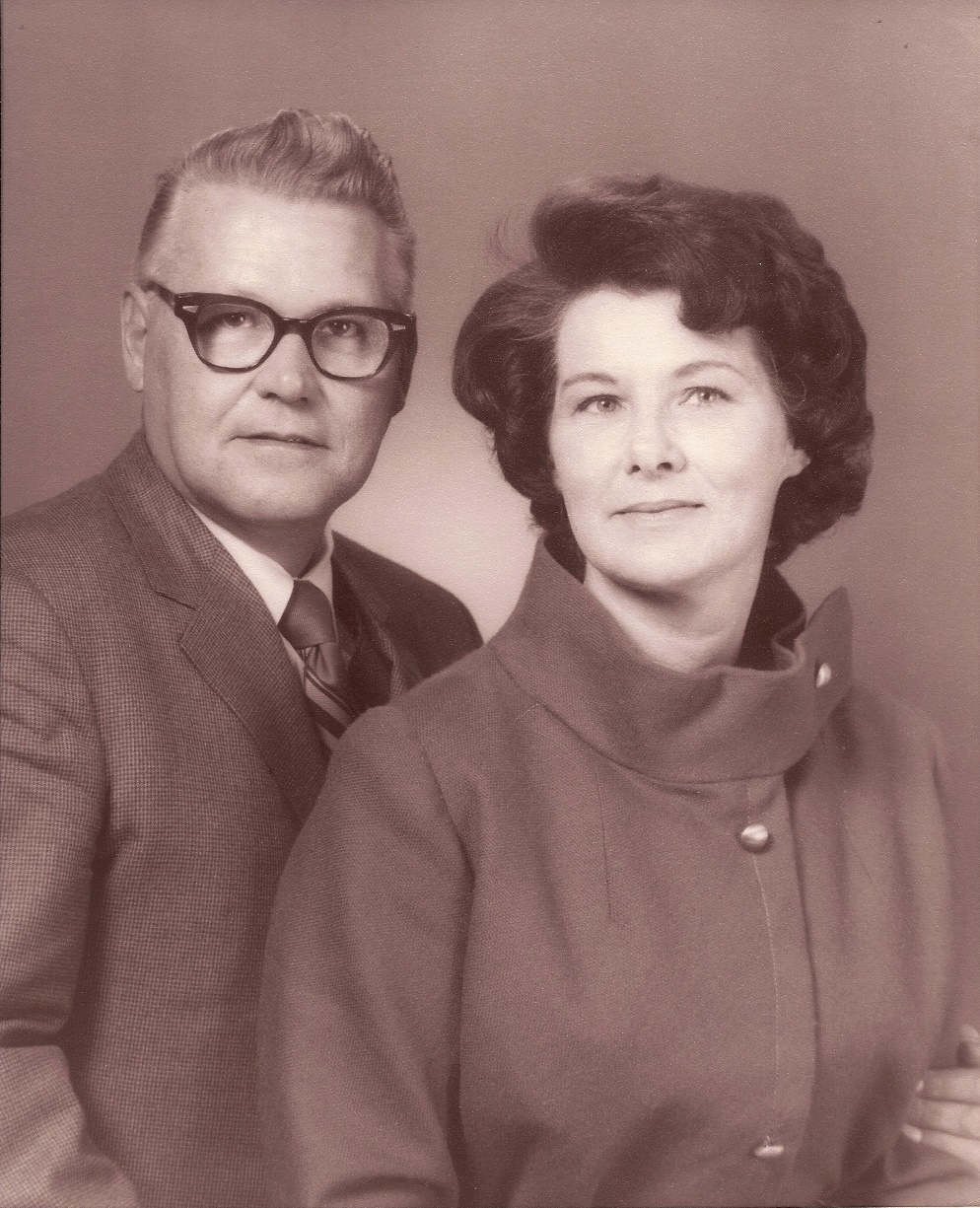



 THE ART OF MEANING